
Ever tried to explain a size to someone and just went “you know, about this big” while holding your fingers apart?
That’s the problem with small measurements.
Four inches is one of those sizes that feels tiny but shows up everywhere once you start looking.
This guide gives you real objects, real comparisons, and a few laughs along the way so you never have to guess again.
What 4 Inches Looks Like in Everyday Life
Picture a small remote sitting on your coffee table.
That’s roughly four inches, and once your brain locks onto that image, you can compare almost anything to it.
Visualizing measurements works best when you connect them to things you already touch every day.
Here’s the quick breakdown so you have the numbers handy too.
| Measurement Type | Value |
| Inches | 4 in |
| Centimeters | 10.16 cm |
| Millimeters | 101.6 mm |
| Feet | 0.33 ft |
| Yards | 0.11 yd |
| Meters | 0.1016 m |
Keep this table in your back pocket.
It comes in handy for quick unit conversions whether you’re baking, building, or just curious.
Everyday Objects That Measure Around 4 Inches
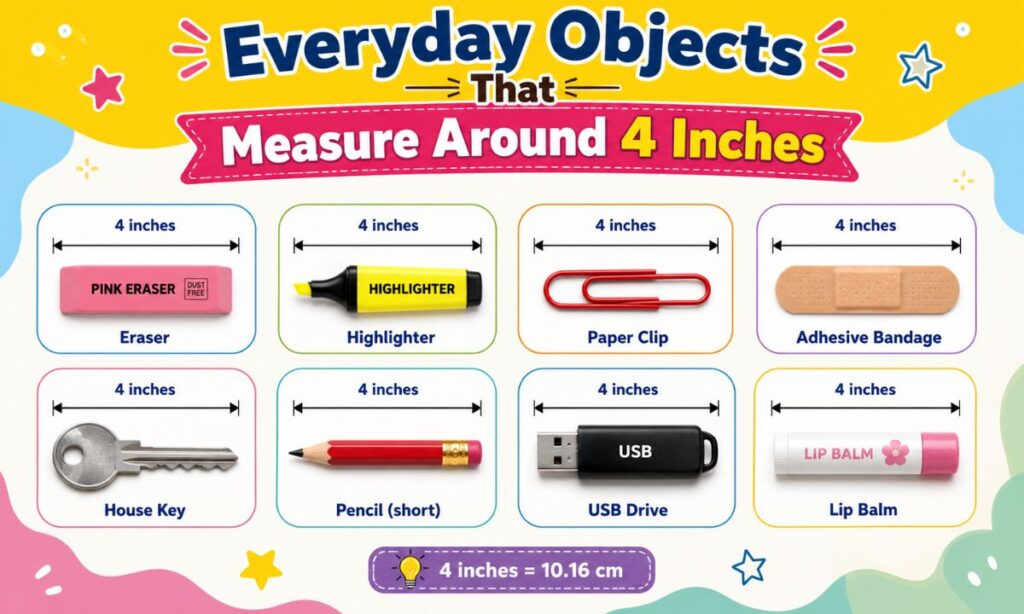
You don’t need a measuring tape if you know your everyday reference points.
The objects below are things most people already own or see all the time, which makes them perfect visual size guides.
Let’s go through them one by one so the size sticks in your memory for good.
1. Small Smart Home Remotes
Grab the remote for your streaming stick or smart light and you’re basically holding four inches.
These slim little compact gadgets are built to fit in one hand without feeling awkward.
That’s actually smart design, not an accident.
Companies size these remotes so they slide into a couch cushion gap or sit flat on a nightstand.
You get full control over your smart home setup without any bulk getting in the way.
Next time you pick one up, notice how it lines up almost exactly with our four inch mark.
2. Travel Sized Spice Jars
Ever packed spices for a camping trip or a small kitchen?
Travel sized containers like mini spice jars usually stand close to four inches tall, which is just enough to hold a solid pinch of flavor.
Their short, wide base means they won’t tip over in your bag either.
Premium brands now sell these squat little jars specifically because they fit better in tight cabinets.
You get real seasoning power in a size that barely takes up any room.
That’s a solid trade for anyone short on kitchen space.
3. Mini Ceramic Espresso Mugs
If you love a strong shot of coffee, you’ve probably held one of these.
Mini ceramic mugs built for espresso usually measure close to four inches from base to rim.
The thick walls keep your drink hot without burning your fingers.
These mugs also look great lined up on a shelf or coffee station.
They stack easily, rinse fast, and hold up to daily use without chipping.
Small, sturdy, and stylish, that’s a solid combo for your morning ritual.
4. A Folded Microfiber Cloth
Here’s a trick that actually works in real life.
Fold a standard microfiber cloth twice and you land right around four inches square.
That makes it easy to slip into a glove box, camera bag, or desk drawer.
Even folded down small, it still wipes screens and lenses without leaving streaks.
This is one of those practical size hacks you can use anytime you need a quick four inch reference and don’t have a ruler nearby.
5. Pocket Notepads
Those little notepads with tear off pages, the ones that fit in a jacket pocket, usually stand close to four inches tall.
That gives you just enough room to jot a phone number or a quick reminder.
Despite the small size, they hold more pages than you’d expect.
You can rip a sheet out cleanly, stuff it in your pocket, and keep moving.
This is a classic case where a small everyday object carries way more use than its size suggests.
6. Short Succulent Planters
If you’ve ever bought a baby succulent, it probably came in one of these.
Mini planters made for small plants often measure right around four inches high, giving roots just enough space to settle in.
These pots come in ceramic, clay, and concrete finishes.
They fit on windowsills, desks, and tight shelves without crowding anything else.
It’s a small commitment that adds real personality to a room.
7. Compact Soap Dispensers
RVs and small bathrooms need space saving fixtures, and this is one of them.
Compact soap dispensers built for tight counters often stand about four inches tall, which keeps them stable and easy to pump.
You still get plenty of soap for daily hand washing.
These little dispensers blend into minimalist setups and travel kits without looking out of place.
Function without the bulk, that’s the whole point.
8. Mini Desk Clock
Working from a small desk means every item has to earn its spot.
A mini desk clock usually measures around four inches across, giving you a clear time display without hogging space next to your laptop.
It adds a nice touch without cluttering things up.
These clocks bring a little bit of old school charm to a modern desk setup.
You get quick time checks without pulling out your phone every five minutes.
9. A Square Sticky Note Pad
Stack enough sticky notes together and you’ll notice something interesting.
A thick sticky note pad can reach close to four inches from top to bottom when it’s fully loaded.
That gives you tons of sheets while still keeping the block small enough for a drawer.
You can grab a note fast, jot something down, and stick it wherever you need a reminder.
It’s a small office staple that quietly does a lot of work.
10. A Folded Charging Cable
Most standard charging cables run about eight inches when folded once for storage.
Fold that same cable in half again and you get a neat four inch reference, perfect for a fast size check when you’re in a pinch.
This works especially well when you’re packing a bag and need to estimate the space cables and cords will take up.
It’s proof that the tech you already carry can double as a measuring tool when you need one.
Classic and Highly Recognizable 4 DInches Objects
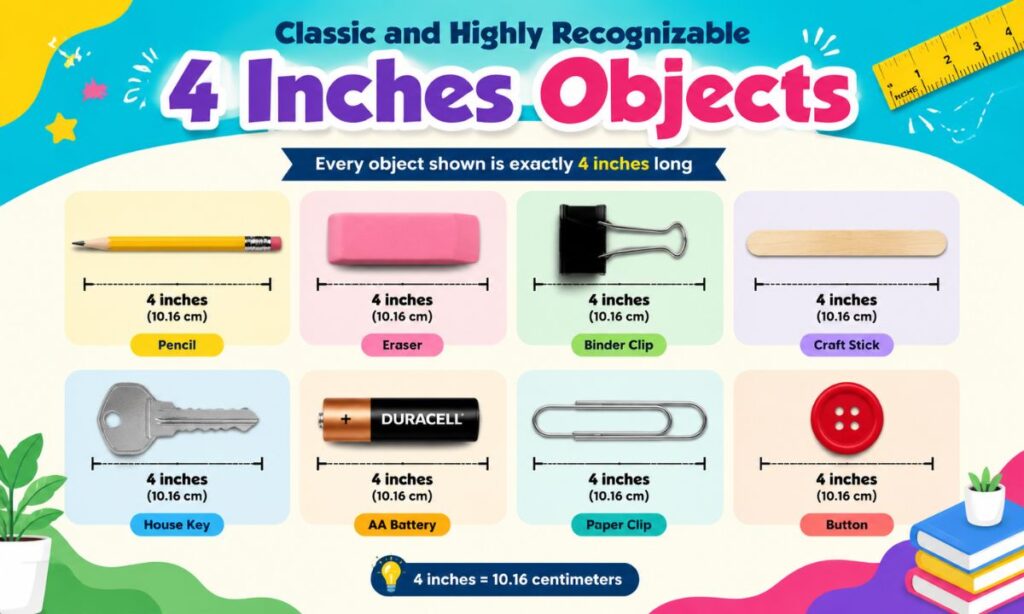
Some objects are so familiar your brain measures them without even trying.
These next few examples are things you’ve touched thousands of times, so the size just clicks.
Let’s break down why they work so well as mental measuring sticks.
11. Length of a Credit Card
You’ve swiped, tapped, and slid a credit card more times than you can count.
That kind of daily contact turns it into a natural mental reference point for size.
A standard credit card measures about 3.37 inches long, which lands just under our four inch mark.
Add roughly the width of a fingertip to that card length, and you’re right at four inches.
It’s a small mental adjustment, but it turns your wallet into a backup ruler when you need one fast.
12. The Long Side of a Playing Card
Shuffling a deck of cards is second nature for a lot of people.
That familiarity makes the standard card size stick in your memory without any real effort.
Most playing cards measure about 3.5 inches along the long edge, which sits just under four inches.
Stretch that image slightly in your head and you’re right at the four inch mark.
It’s a quick mental check you can use anywhere a deck of cards happens to be lying around.
13. A Smartphone Case Length Reference
Your phone goes everywhere with you, so its size feels automatic.
While screen width itself usually runs closer to three inches on most modern phones, many phone cases with a bit of edge padding land closer to four inches in overall width.
That makes your phone case a decent backup reference when you need one.
Your hand already knows this size from muscle memory alone.
It’s one less thing you have to calculate on the spot.
14. A Standard Playing Card Stack Height
Here’s a fun one people usually get wrong.
A single dollar bill folded in half only comes out to about three inches, not four, since a bill measures 6.14 inches long.
But stack about 15 to 16 playing cards together, and that stack reaches close to four inches tall.
It’s a neat trick if you ever need a quick four inch check and happen to have a deck nearby.
Small correction, but it matters if you’re trying to measure something accurately.
15. A Large Cookie
Picture a fresh bakery cookie, still warm from the oven.
Many large bakery style cookies measure close to four inches across the center, which is part of why they feel so satisfying to hold.
Some run slightly bigger or smaller depending on the bakery.
Either way, the size is easy to spot once you know what to look for.
This is one of the tastier ways to remember a measurement.
16. A Small Coaster
Coasters sit quietly on tables and desks, always within reach.
Most simple round or square coasters span close to four inches in diameter, giving them a balanced, intentional look.
You’ve probably set a mug down on one without ever thinking about its size.
Once you notice that width, it becomes an easy visual check for later.
Small object, but a surprisingly reliable one.
17. A Small Paint Roller
If you’ve ever painted a room, you’ve used one of these for the edges and corners.
Mini paint rollers made for trim work usually span about four inches wide, which makes them a solid mental reference for future projects.
That width lets you get into tight spots that a full sized roller can’t reach.
Once you’ve used one, the size sticks with you.
It’s a practical example most DIY fans will recognize instantly.
18. Half the Circumference of a Baseball
A baseball fits snugly in your hand, and its shape is instantly recognizable.
A regulation baseball has a circumference of about 9 to 9.25 inches, so half of that lands closer to 4.5 inches, just slightly over our four inch mark.
It’s still a useful trick even with that small adjustment.
Picture the ball’s curve stretched into a straight line, and you’re close enough for a fast estimate.
That’s a clever way to turn something round into a workable measuring guide.
Why 4 Inches Matters in Daily Life

This measurement pops up more than people expect.
You’ll run into it while baking, doing home repairs, packing for a trip, or organizing a desk.
Once a few of these examples click, judging four inches becomes second nature, no ruler required.
Picture a small remote, a mini planter, or a stack of playing cards.
That mental image is really all you need to estimate short lengths with confidence.
It also helps with spacing and layout decisions, like leaving room between shelf items or lining up décor evenly.
Small measurements like this affect how balanced a space looks, even if nobody consciously notices why.
Fun Facts About 4 Inches
Here are a few quick facts to file away for trivia night or just for fun.
● A large bakery cookie often lands right at the four inch mark, which is a sweet way to remember a size.
● Mini paint rollers are built to be exactly four inches wide so they fit perfectly along trim and corners.
● Most pocket notepads hover around four inches tall, making them the original handheld size long before smartphones existed.
● A baseball’s half circumference comes close to four inches, turning a round object into a surprisingly useful straight line reference.
● Stacked playing cards, about 15 to 16 of them, reach close to four inches, a fun trick for card game nights.
How to Measure 4 Inches Without a Ruler
Sometimes you just need a fast answer and there’s no tape measure in sight.
Grab a credit card and add about a fingertip’s width, and you’re close to four inches.
You can also fold a charging cable in half or stack a small deck of cards for a quick visual check.
These little DIY measuring hacks work because you already have the objects lying around.
It’s not lab accurate, but it’s more than enough for everyday tasks like spacing or quick estimates.
Common Mistakes People Make When Estimating 4 Inches
A lot of people assume a folded dollar bill equals four inches, but it actually comes out closer to three.
Others assume every smartphone screen is exactly four inches wide, when most modern phones run narrower than that.
These small mix ups happen because people repeat old assumptions without double checking.
The fix is simple, always compare against something you can verify, like a credit card or a ruler on your phone case.
A little bit of double checking saves you from measuring mistakes down the line.
FAQs
1. What does 4 inches look like in real life?
Think of a small remote or a mini espresso mug. Both give you a fast, reliable mental picture.
2. How can I measure 4 inches without a ruler?
Use a credit card plus a fingertip width, or stack about 15 playing cards together. Both get you close.
3. Is 4 inches the same as 10 cm?
Not quite. Four inches equals 10.16 cm, though most people round it down to 10 for quick math.
4. Why do so many objects measure around 4 inches?
This size feels balanced in the hand and fits neatly on desks, shelves, and countertops. Designers lean on it for comfort and convenience.
5. What everyday items are reliable 4 inch references?
A small coaster, a mini planter, a thick sticky note pad, and a stack of playing cards all sit close to this size.
Conclusion
Four inches shows up in more corners of daily life than most people realize, from your coffee mug to the paint roller in your garage.
Once you link this size to a few familiar objects, estimating it becomes second nature.
Next time you need a quick measurement and there’s no tape measure around, picture a credit card, a small coaster, or a mini remote.
That mental shortcut will save you time and guesswork every single time.