
Someone tells you a lot is 200 feet wide, or a building is 200 feet tall, and your brain just blanks.
Numbers on their own do not mean much.
Your brain remembers things you have seen, not numbers you have heard.
So here is the simple answer first, then we will make it click with real stuff you already know.
200 feet equals 2400 inches, 60.96 meters, and 66.67 yards.
It is close to the length of five shipping containers lined up, or one full New York City block from side to side.
Once you picture that, 200 feet stops being a random number.
It becomes something you can actually see in your head.
How Long Is 200 Feet?
200 feet is a big stretch, bigger than most rooms or backyards.
It is not something you can eyeball across a living room.
You need an outdoor space, a parking lot, a field, or a long hallway to really feel it.
Think of it like this. A bowling lane is about 60 feet long.
You would need more than three of those end to end just to match 200 feet.
That is why this number shows up a lot in construction, land, and sports, places where distance actually matters.
Once you connect 200 feet to something physical, the number sticks.
That is the whole point of this guide, giving your brain a picture instead of just digits.
Conversion Table
Quick numbers help when you are working on a project or just curious.
Here is 200 feet broken down into every unit people actually use.
| Unit | Value |
| Feet | 200 ft |
| Inches | 2400 in |
| Centimeters | 6096 cm |
| Meters | 60.96 m |
| Yards | 66.67 yd |
| Millimeters | 60,960 mm |
Feet get used a lot in the US for homes and yards.
Meters are the go to almost everywhere else in the world.
Millimeters show up when someone needs super exact measurements, like in engineering work.
also read:How Long Is 100 Feet? 10 Things That Are Exactly 100 Feet Long
What 200 Feet Feels Like
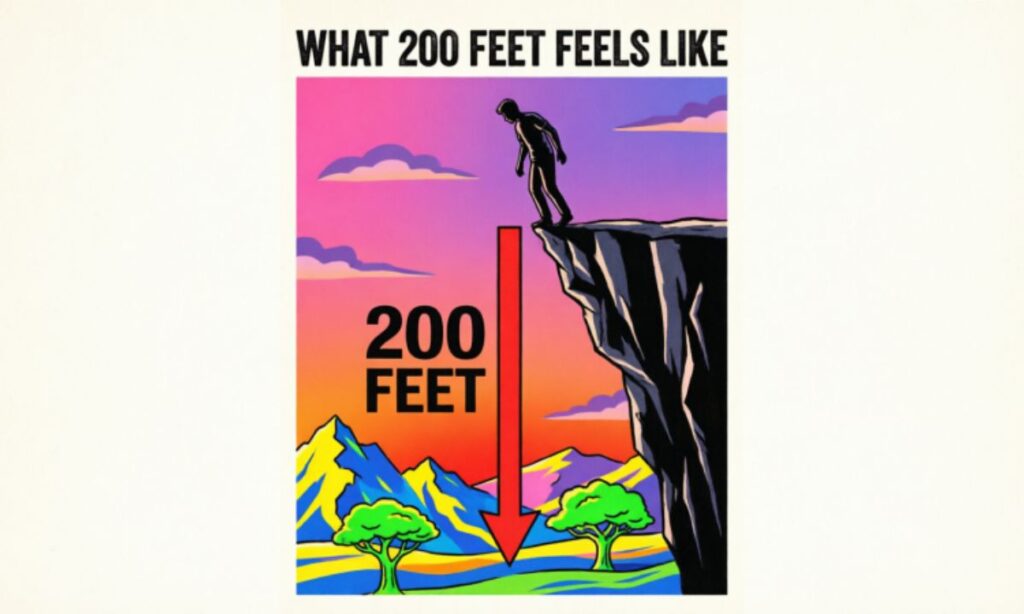
Picture yourself walking with a normal step, about 2.5 feet each stride.
You would need roughly 80 steps to cover the full 200 feet.
That is not a quick little walk across a room, it is a real trip.
At a normal walking speed of about 3 miles an hour, that trip takes about 45 to 50 seconds.
Not long, but long enough that you would notice it.
Try counting your steps next time you walk across a parking lot, you might be surprised how close you get to 80.
This distance is long enough to separate two buildings comfortably.
It gives you space to breathe, plan, or build something in between.
That is why architects and city planners use it so often.
9 Things That Are Exactly 200 Feet Long
Numbers are boring on their own, so let’s make this visual.
Below are nine real world things that line up with 200 feet almost exactly.
Some are everyday objects, some are places, and one is straight out of history books.
1. Five ISO Shipping Containers
A standard shipping container measures exactly 40 feet under international ISO rules.
Line up five of them and you get 200 feet on the dot.
You have probably seen these stacked at ports or riding on trains, they are everywhere in global shipping.
Standing next to five of these side by side feels like facing a wall of steel.
It stretches way past what your eyes can take in at once.
This is one of the easiest ways to actually see 200 feet with your own eyes.
2. Four 50 Foot Railroad Boxcars
Standard North American railroad boxcars run about 50 feet long each.
Four of them connected together also lines up with 200 feet.
Next time a freight train passes by, count four cars, that is your 200 feet right there.
Walking beside a line of boxcars like this feels endless.
Your eyes cannot really take in the whole thing from one spot.
It is a solid way to picture serious industrial length.
3. Wright Brothers Third Flight Distance
On December 17, 1903, Orville Wright made history at Kitty Hawk.
His third flight that day covered exactly 200 feet, based on records from the Smithsonian.
That short hop proved powered flight actually worked.
Standing on that same patch of ground today would feel almost too short for something so huge in history.
Modern planes cover that same distance before they even leave the runway.
It is a small stretch of land that changed the whole world.
4. Manhattan City Block Width
A standard Manhattan city block runs about 200 feet from one street to the next.
This comes from the original city planning grid laid out for New York.
Millions of people cross this exact distance every single day without even thinking about it.
Standing on one sidewalk and looking to the next block gives you a clean visual.
It feels structured, not too short, not too long.
This is one of the most relatable comparisons because so many people have actually walked it.
5. Football Field Stretch
A football field runs 300 feet between the two goal lines, not counting the end zones.
Walking from one goal line to about the far 33 yard line gets you close to 200 feet.
It is not an exact yard marker, but it lines up near midfield territory.
Standing at the goal line and looking that far down the field still feels like a serious distance.
Players sprinting that far are working hard, it is no small jog.
This gives you a sports based way to picture the same length.
6. A Building Around 20 Stories Tall
Most city buildings run close to 10 feet per floor.
That puts a building with about 20 floors somewhere around 200 feet tall.
Floor heights do shift a bit depending on the building, so think of this as a solid ballpark.
Standing at the bottom of a tower like this, you have to tilt your whole head back to see the top.
It feels dominant, almost like it is leaning over you.
This turns our flat 200 foot number into something vertical and real.
7. Two NFL Field Widths
An NFL field measures exactly 160 feet wide, based on the official 53 and a third yard rule.
Add in space along both sidelines for players, coaches, and equipment, and you get somewhere close to 200 feet total width.
That extra space is not fixed everywhere, it depends on the stadium, but it gets you in the neighborhood.
Standing at one sideline and looking across the whole width, plus the space around it, feels wide open.
It is built for fast movement in every direction.
This gives a strong sense of how big 200 feet feels sideways instead of straight ahead.
8. A Tall Redwood Tree
Coast redwood trees grow incredibly tall, and plenty of documented trees reach right around 200 feet.
Some grow even taller, some a bit shorter, these trees do not follow a fixed height.
You can see trees like this in protected groves in Northern California.
Standing at the base, the trunk alone can be wider than a car.
Looking straight up, the top disappears into the sky before your eyes can catch it.
It is one of nature’s best examples of what 200 feet of height actually feels like.
9. Niagara Falls, Doubled
The Horseshoe Falls at Niagara drops about 167 feet, based on official measurements.
That is already close to 200 feet on its own, no doubling required.
Stack that height on top of itself and you are well past 200 feet, showing just how massive this landmark really is.
Standing near the base, the sound alone is loud enough to shake your chest.
Mist rises off the water and covers everything nearby.
It turns a single number into a full sensory experience.
How Big Is 200 Feet?
Inside a building, 200 feet stretches across a huge warehouse or a full airport terminal.
It can span several aisles or gates without any real break in between.
Indoors, that kind of length feels almost too big for one continuous room.
Outdoors it feels a bit more normal, but still plenty big.
Think of a large parking lot or a sports complex, standing at one end and looking to the other.
People and cars at the far end start looking noticeably smaller.
How Tall Is 200 Feet?
In cities like New York or Chicago, 200 feet usually means a building around 20 stories high.
Looking up from the sidewalk, that height completely takes over your view.
It towers over smaller buildings nearby without much effort.
In nature, a 200 foot redwood tree gives you an even stronger feeling.
Your neck has to tilt all the way back just to catch the top.
It is one of those moments where a number finally feels believable.
How Far Is 200 Feet?
Most people cover 200 feet in about 80 steps, walking normally.
At an average pace, that takes around 45 to 50 seconds from start to finish.
Measuring your own stride first makes this trick even more accurate.
This kind of estimate comes in handy more than people expect.
You might use it for planning a yard, checking property lines, or spacing things out for an event.
Sports fields, parking areas, and job sites all lean on this same kind of judgment call.
200 Feet Comparison Table
Sometimes seeing things side by side makes the size click faster than any explanation.
| Comparison | What It Means |
| 200 ft vs 150 ft | Difference equals about one city bus |
| 200 ft vs 250 ft | Difference equals about one semi trailer |
| 200 ft vs 400 ft | Equals two full container lines end to end |
How to Measure 200 Feet Without a Tape Measure
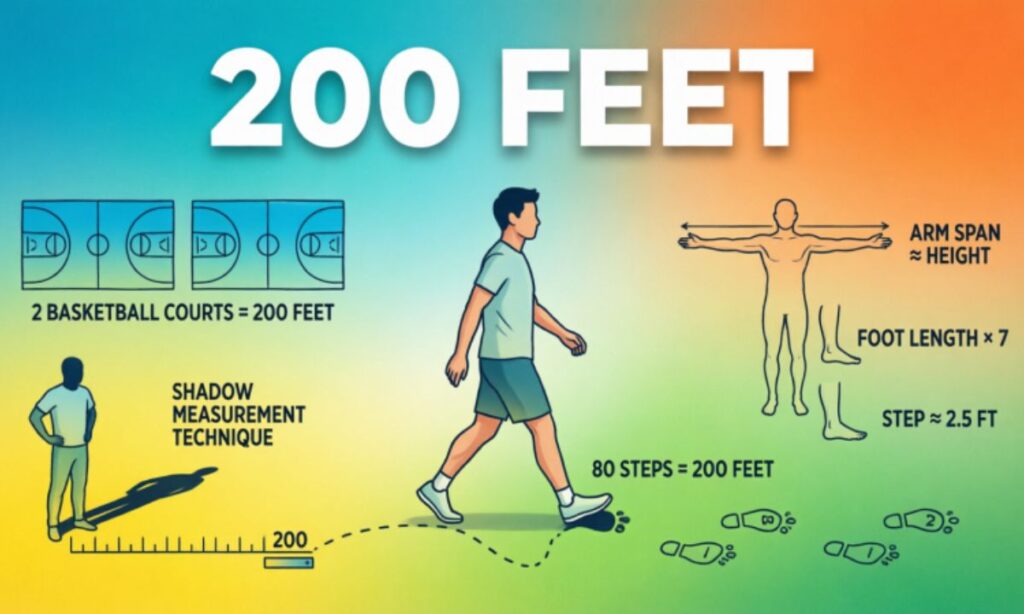
You do not always have a tape measure handy, and that is fine.
Here are three simple ways regular people use to estimate 200 feet with what they already have.
Method 1: Using Your Steps
Walk normally and count around 80 steps, assuming each one covers about 2.5 feet.
For better accuracy, measure out 10 steps once, then divide that distance by 10 to find your real stride.
Keep your pace steady, do not stretch your steps just to hit a number faster.
Method 2: Using Floor Tiles
Large indoor spaces often use tiles that are exactly one foot wide.
Walk in a straight line and count up to 200 tiles to hit the full distance.
Avoid walking diagonally, it throws off your count fast.
Method 3: Using Known Objects
Pick something you already know the length of, like a 40 foot shipping container or a school bus.
Line up five of those in your head, or visually, to estimate 200 feet.
This trick works great outdoors where big objects are easy to spot.
Why These Comparisons Actually Help
Your brain is wired to remember things it has seen, not numbers on a page.
That is exactly why comparing 200 feet to a redwood tree or a city block works so well.
It turns an abstract measurement into something your memory can actually hold onto.
Next time someone throws out a distance in feet, try connecting it to something real.
It makes conversations about size, space, and distance a lot easier to follow.
This trick works for any measurement, not just 200 feet.
Common Mistakes People Make Estimating 200 Feet
A lot of people guess distance based on how open a space feels, and that throws them off.
Wide open spaces, like fields or parking lots, tend to make things look shorter than they really are.
Tight spaces do the opposite, they can make short distances feel much longer.
Another common slip is assuming every step or stride is exactly 2.5 feet.
Stride length actually changes person to person, so a quick personal check makes any estimate way more reliable.
Small mistakes like these are why real comparisons, not just guessing, work so much better.
Where You Will Actually Run Into 200 Feet
This number pops up more often than people realize once you start paying attention.
Real estate listings use it for lot width, contractors use it for site planning, and event organizers use it for spacing out booths or seating.
Even hiking trail signs sometimes use it to describe how far a lookout point sits from the trailhead.
Knowing what 200 feet actually looks like helps you read these situations faster, without pulling out a phone or a measuring wheel.
It also helps when you are buying land, renting a space, or just trying to figure out if your couch will fit through a hallway.
The more real comparisons you keep in your head, the less guessing you have to do later.
FAQs
How long is 200 feet in meters? 200 feet equals 60.96 meters, the standard conversion used worldwide in construction and engineering.
How many steps is 200 feet? Most adults cover 200 feet in about 80 steps, based on an average stride of 2.5 feet per step.
How tall is 200 feet compared to a house? 200 feet is close to a 20 story building, while most houses are only one or two stories, so the difference is massive.
Is 200 feet longer than a school bus? Yes. A school bus runs about 40 feet, so five of them lined up would match 200 feet.
How long does it take to walk 200 feet? Around 45 to 50 seconds at a normal walking pace of about 3 miles an hour.
Conclusion
The easiest ways to really picture 200 feet are five shipping containers, a tall redwood tree, and a full Manhattan city block.
Shipping containers work so well because they are straight, standard sized, and seen everywhere in ports and rail yards.
Redwood trees give you a vertical gut check, forcing your eyes upward in a way plain numbers never could.
A Manhattan block feels personal too, since so many people have actually walked that exact stretch without realizing it.
200 feet shows up more in real life than people expect, from building projects to sports fields to backyard planning.
Once you have a few solid comparisons in your head, guessing distance gets a lot easier and a lot more accurate.
Keep this guide handy, so next time 200 feet comes up, you already know exactly what that looks like.