
If you’re staring at your phone trying to figure out what time it was 9 hours ago, here’s the quick answer: just subtract 9 hours from your current time.
If it’s past midnight in your count, the day rolls back to yesterday.
That’s it. That’s the whole trick.
But stick around, because there’s more to this than just simple math. Let’s break it down together.
Why Do People Search “What Time Was It 9 Hours Ago”?
We’ve all been there.
You wake up from a nap, check your phone, and think “wait, when did that text come in?”
This kind of time calculation pops up more than you’d think.
Maybe you’re checking a work shift. Maybe you’re tracking a delivery. Maybe a doctor told you to take medicine every 9 hours and you forgot when you started.
People search this question because life runs on time, and our brains aren’t always great at doing quick math on the spot. It’s a small question with a surprisingly big use in everyday life.
Understanding Time Arithmetic
Time arithmetic just means adding or subtracting hours from a clock.
It sounds fancy, but it’s something you already do without thinking, like when you say “I’ll be there in 3 hours.”
To find a time in the past, you subtract. To find a time in the future, you add.
The tricky part comes in when you cross midnight, because the date changes too. That’s really the only curveball here. Once you get that, the rest is smooth sailing.
What Time Was It 9 Hours Ago Using the 12-Hour Clock
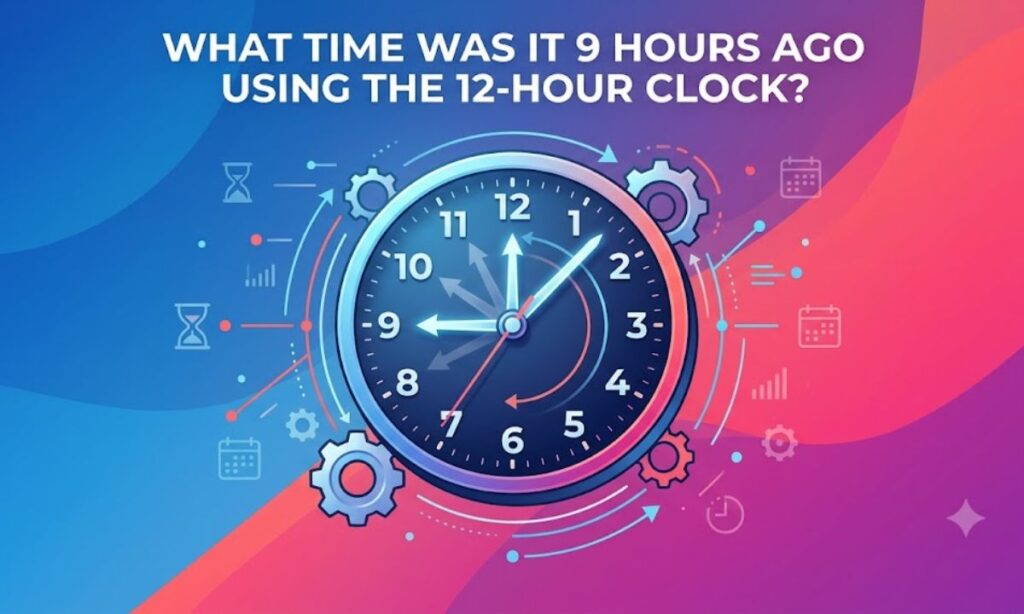
Most of us use a 12 hour clock, split into AM and PM.
So how do you handle the switch? Count back 9 hours from your current time. Watch closely when you pass 12:00. Flip between AM and PM when needed.
For example, if it’s 10:00 AM now, 9 hours ago was 1:00 AM. If it’s 8:00 PM now, 9 hours ago was 11:00 AM.
Once you do this a few times, your brain starts to just get it without needing to count on your fingers.
How to Calculate 9 Hours Ago Without a Calculator
You really don’t need an app for this.
Say it’s currently 6:00 PM. Just count backward one hour at a time and you’ll land on 9:00 AM.
Now try 5:30 AM. Count back 9 hours and you’ll cross midnight, landing on 8:30 PM the night before.
This is basic clock calculation, and once you practice it a couple times, it becomes second nature. Some people find it easier to subtract in two steps: take away 10 hours first, then add 1 hour back.
When the Previous Day Matters
This is where most people trip up.
Let’s say today is August 6, 2026, and it’s currently 7:00 AM. Subtract 9 hours and you land on August 5, 2026, at 10:00 PM.
The clock changed. The date changed too. That’s completely normal. This previous day adjustment matters a lot for things like:
• Payroll records
• Security camera logs
• Delivery tracking
• Flight schedules
Miss this step and you might think an event happened on the wrong day entirely, which can cause real headaches at work or with paperwork.
ALSO READ THIS:https://measureaxis.com/until-400-pm-2/
Breaking Down 9 Hours
Sometimes it helps to see 9 hours in smaller pieces. Here’s the breakdown:
• 540 minutes
• 32,400 seconds
• 32,400,000 milliseconds
These numbers matter more than you’d guess. Computers, apps, and servers don’t think in hours, they think in seconds and milliseconds behind the scenes.
So when your phone tells you “message sent 9 hours ago,” it’s actually doing this math using milliseconds, then translating it back into something you understand.
Using a Time Calculator
If mental math isn’t your thing, that’s completely fine. A time calculator does the heavy lifting for you.
Most tools just need two things: your current time, and the number of hours you want to subtract.
Hit calculate, and you get the exact time, plus a note if the date rolled back to the previous day.
This is super handy for planning work shifts, tracking deadlines, or figuring out overtime pay.
What Happens Across Different Time Zones?
Here’s where things get a bit more interesting.
Say someone in Pakistan and someone in New York both ask what time it was 9 hours ago, at the exact same moment. They’ll get two totally different answers, because their local time isn’t the same to begin with.
This is why time zone conversion exists. Instead of just subtracting hours, you first need to know the correct UTC offset or GMT offset for that location.
Businesses with remote teams deal with this constantly. One missed time zone conversion and someone joins a meeting at 3 AM by mistake, which nobody enjoys.
What Time Was It 9 Hours Ago in Everyday Life
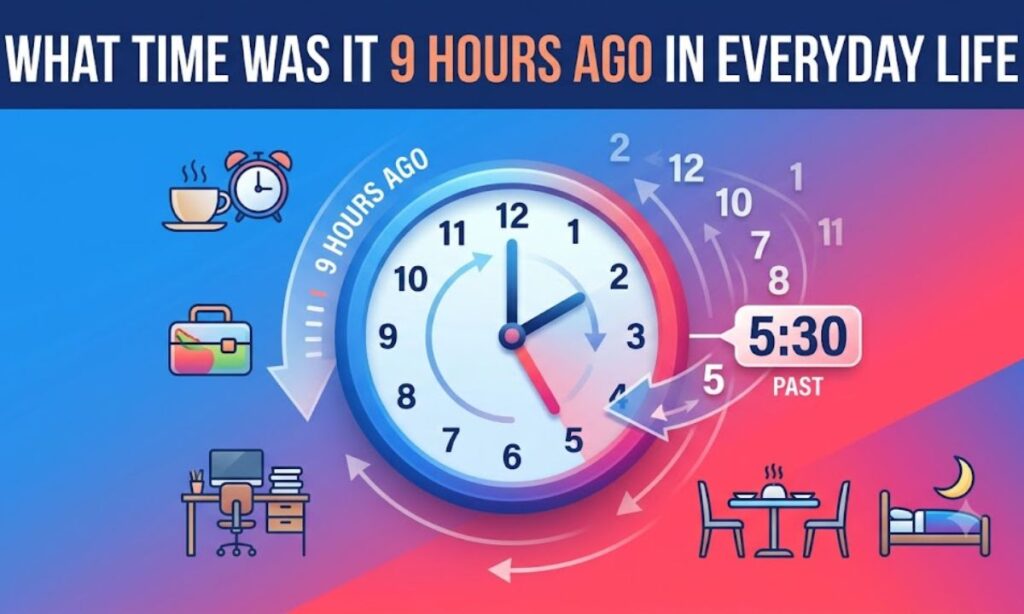
This question shows up more in daily life than people realize.
Say you woke up at 8:00 AM. Subtract 9 hours and you land on 11:00 PM the night before, which roughly tells you when you probably fell asleep.
Or say your dad calls and says he tried calling you about 9 hours ago. If it’s currently 6:00 PM, you now know he called around 9:00 AM.
Medicine schedules use this too. If a bottle says take every 9 hours and your last dose was at 7:00 AM, your next one lines up around 4:00 PM.
Common Mistakes People Make With This Math
Even simple subtraction trips people up sometimes.
Forgetting midnight is the biggest one. If it’s 5:00 AM and you subtract 9 hours, the answer isn’t 8:00 AM, it’s 8:00 PM the day before.
Mixing up AM and PM is another classic slip. Subtract 9 hours from 1:00 PM and you should land on 4:00 AM, not 4:00 PM.
Ignoring time zones causes confusion too, especially when chatting with someone overseas who assumes you’re both looking at the same clock.
Reverse Time Calculation Made Simple
Reverse time calculation sounds complicated, but it’s really just moving backward on the clock instead of forward.
Normal math goes from now to later. Reverse math goes from now to earlier.
So if it’s currently 9:30 PM and you reverse by 9 hours, you land on 12:30 PM.
The steps stay the same whether you’re subtracting 2 hours, 9 hours, or even a full day. Only the numbers change, the process stays identical.
Why Online Time Calculators Are So Popular
Years ago, people used wall clocks and calendars to figure this stuff out by hand.
Now most people just type “9 hours ago calculator” into Google and get an instant answer.
A good online time calculator handles date changes automatically, AM and PM switching, time zone conversion, and clock time conversion.
No mental math needed. When you’re busy or just want a fast answer, this is honestly the easiest route.
Example Calculations
Seeing real examples side by side makes the pattern click faster.
| Current Time | 9 Hours Ago |
| 6:00 AM | 9:00 PM (previous day) |
| 10:30 AM | 1:30 AM |
| 12:00 PM | 3:00 AM |
| 5:00 PM | 8:00 AM |
| 9:45 PM | 12:45 PM |
Notice the pattern? Morning times usually roll back into the night before. Afternoon and evening times tend to stay on the same calendar day.
Human Memory and Time
Here’s something interesting. Our brains don’t remember time the way a clock does.
You rarely think “it happened at exactly 10:17 AM.” Instead you think “it happened right before lunch” or “it happened late at night.”
Our memories attach to feelings and moments, not numbers. That’s exactly why doing a quick time subtraction can jog your memory.
Digital Messages and Time Stamps
Every app you use logs a timestamp behind the scenes.
WhatsApp, email, Instagram, Slack, they all track exactly when something happened.
So when your phone says “last active 9 hours ago,” your brain naturally wants to know the actual clock time.
This matters a lot for work too, especially when you’re managing customer replies, checking email response times, or reviewing project deadlines.
Time Zones Around the World
Picture four friends in a group chat. One’s in Pakistan, one’s in London, one’s in Sydney, one’s in New York.
They all ask what time it was 9 hours ago, at the same exact moment, and every single one gets a different answer. That’s because their regional time is completely different from each other.
This is why systems rely on UTC, a global time standard that apps convert into your local time automatically.
How Computers Perform Time Difference Calculation
Humans look at clocks. Computers look at numbers.
When software calculates a time difference, it usually converts everything into seconds or milliseconds first.
So instead of subtracting 9 hours, a computer actually subtracts 32,400,000 milliseconds, then converts that number back into a clock time you can read.
This happens constantly, every time you check a delivery status, load a message, or check your bank app.
Manual Formula
If you like doing this yourself, here’s the exact formula.
Previous Time = Current Time minus 9 Hours
If subtracting crosses midnight, adjust two things: the date, and whether it’s AM or PM.
That’s genuinely the whole formula. Every app, calculator, and website is just automating this one simple equation.
Frequently Asked Questions
What is 9 hours before now? It depends on your current time. Subtract 9 hours and check if the result lands on today or yesterday.
How many minutes is 9 hours? 9 hours equals 540 minutes.
How many seconds are in 9 hours? There are 32,400 seconds in 9 hours.
What time was it 9 hours ago from now? Take your current time, subtract 9 hours, and adjust the date if you cross midnight.
Is there a free online calculator for this? Yes, plenty of free time calculators are available online that handle this instantly, including date rollover and time zone conversion.
Conclusion
Figuring out what time it was 9 hours ago seems like a tiny question, but as you’ve seen, it touches everyday routines, digital messages, work shifts, and even how computers quietly do math in the background.
Once you understand the basic time subtraction rule and remember to check for that date rollover, the whole thing becomes second nature.
Next time someone asks what time that was again, you’ll have the answer before they even finish the sentence.