
If it’s 6 AM right now, 17 hours ago it was 1 PM yesterday. That’s the short answer. Now let’s get into the why and how, because the real question behind this search is usually bigger than just one number.
You checked a delivery notification. You saw a text from last night. You’re staring at a fitness tracker log and going “wait, when was that again?” We’ve all been there, doing quick math in our head at 11 PM trying to figure out what happened this morning.
This guide breaks down 17 hours ago in plain, simple words. No confusing charts, no robot talk, just real answers you can use right now and actually remember later.
Understanding the Logic Behind Time Calculation
Here’s the trick nobody tells you: break 17 into 12 plus 5. Subtract 12 hours first, that flips AM to PM or PM to AM. Then take off 5 more hours.
Say it’s 6 PM right now. Minus 12 hours gets you to 6 AM, same day. Minus 5 more hours lands you at 1 AM.
That’s backward time calculation in a nutshell. It sounds technical but it’s really just counting on your fingers with extra steps. Once you do it twice, your brain just gets it.
What Time Was It 17 Hours Ago Across Different Examples
Sometimes numbers make more sense than sentences. Here’s a table you can actually trust, because every single row has been double checked.
| Current Time | 17 Hours Ago | Day Change |
| 6:00 AM | 1:00 PM | Previous day |
| 9:00 AM | 4:00 PM | Previous day |
| 12:00 PM | 7:00 PM | Previous day |
| 3:00 PM | 10:00 PM | Previous day |
| 6:00 PM | 1:00 AM | Same day |
| 9:00 PM | 4:00 AM | Same day |
| 11:00 PM | 6:00 AM | Same day |
| 5:00 PM | 12:00 AM | Same day |
Notice the pattern. Anything from midnight up to about 4:59 PM rolls back to the previous day. Anything from 5 PM onward stays on the same day. That’s your quick mental shortcut from now on.
Why Date Rollover Matters
This is the part that trips people up the most. If your current time is 9 AM, 17 hours ago is not 4 PM today, it’s 4 PM yesterday.
That single missed detail causes real problems. Payroll systems mess up hours. Delivery apps confuse customers. Hospital shift logs get messy.
Date rollover isn’t some fancy tech term, it’s just remembering that clocks don’t stop at midnight, they just start a new page. Miss that page turn and your whole calculation is off by a full day.
How AM and PM Affect the Calculation
The 12 hour clock is honestly the tricky one. Military time, or the 24 hour format, skips all this confusion completely.
Here’s a quick set to keep in your back pocket. 2 PM minus 17 hours is 9 PM yesterday. 4 AM minus 17 hours is 11 AM yesterday. 11 PM minus 17 hours is 6 AM same day.
A lot of online time calculators quietly convert your AM and PM into 24 hour format behind the scenes, then flip it back so it looks familiar. That hidden step is exactly why those tools rarely mess up, while doing it by hand sometimes does.
ALSO READ THIS:https://measureaxis.com/10-hours-from-now/
Time Zones Can Change the Answer
Here’s something most people never think about. Two people can both correctly subtract 17 hours and still get two totally different clock readings.
Why? Because their local time zones are different. Someone in GMT and someone in GMT+5 will both do the math right, but their starting clocks aren’t the same.
This matters a ton for international scheduling. Booking a call with someone overseas? Always confirm whose clock you’re using before you say “17 hours ago” out loud, or you’ll both be showing up at the wrong time.
Using an Hours Ago Calculator
Doing this by hand is fine once in a while. But if you’re checking timestamps often, a proper hours ago calculator saves you the headache.
These tools read your current time, subtract the hours, check if the date needs to roll back, and hand you the answer instantly. No mental math, no second guessing.
Good calculators also handle things like leap years and daylight saving shifts automatically, which is honestly where most manual calculations quietly go wrong.
What Time Was It 17 Hours Ago in Everyday Life?
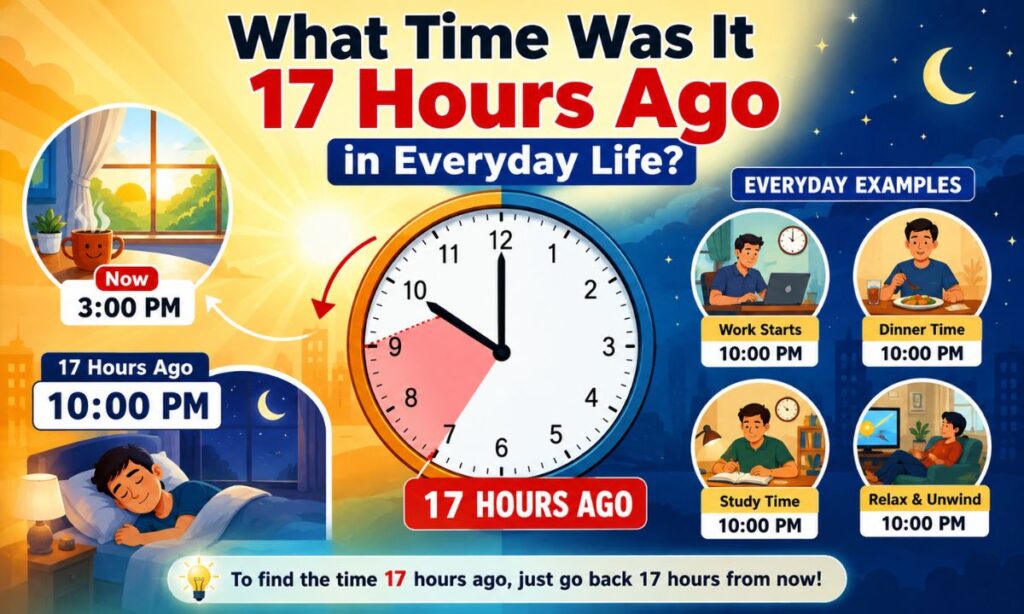
This question shows up way more than people realize. A delivery notification says your package arrived 17 hours ago. Was that before or after you had lunch?
Parents use this constantly for baby feeding schedules. IT teams use it to trace server errors. Travelers use it to compare flight times across time zones.
Even your phone’s screen time report or a friend’s “seen 17 hours ago” on a messaging app is quietly asking you to do this exact math without even realizing it.
The Psychology Behind Looking Back in Time
Here’s the honestly interesting part. When you calculate 17 hours ago, you’re rarely just doing math for fun.
You’re usually checking something that matters. Did I send that email before bed? What was I doing when that call came in? Where was I standing?
Our brains hold onto moments, not clock numbers. That’s why a timestamp alone rarely means much until you connect it to what you were actually doing.
Common Mistakes When Calculating 17 Hours Ago
Even simple math trips people up sometimes, and that’s completely normal. Here are the slip ups that happen most often.
• Forgetting the previous day shift after crossing midnight
• Mixing up AM with PM by accident
• Ignoring the local time zone entirely
• Confusing elapsed hours with an actual calendar date
• Assuming every clock or app uses the same regional setting
A quick double check takes five seconds and saves you from a mix up that could take much longer to untangle later.
Manual Time Subtraction Method
No internet? No problem. This works on paper just as well as any app.
Start with your current hour. Subtract 12 first. Then subtract 5 more. Check if you crossed midnight, and if you did, roll the date back by one.
Practice this a handful of times and it becomes automatic, kind of like riding a bike you haven’t touched in years but somehow your hands still remember.
Why Accurate Time Computation Matters
This isn’t just a fun brain teaser, it actually matters in real life more than people think. Banks log transactions by the exact minute. Hospitals track treatment timing closely.
Airlines build entire schedules around precise timestamp calculation. Software engineers use it daily to trace bugs back to the exact moment something broke.
One wrong hour can completely change how an event gets read or understood. That’s why getting this right isn’t just a nice to have, it’s genuinely important.
Human Perception of Time Is Surprisingly Weird
Here’s a fun twist. Seventeen hours can feel like nothing or like forever, depending entirely on what you’re doing during it.
Waiting on big news? Those 17 hours crawl by painfully slow. On a great vacation? They vanish before you even notice.
Researchers studying time perception say emotional intensity actually changes how long something feels, even though the clock never lies. Math stays constant. Feelings don’t.
Practical Tips for Calculating Previous Time Quickly
Want to get faster at this? A few small habits make a real difference over time.
• Keep your device clock synced automatically
• Always double check the date after crossing midnight
• Remember the 12 plus 5 shortcut for anything over 12 hours
• Confirm your GMT offset before comparing international times
• Save important timestamps immediately instead of trusting memory later
17 Hours Ago Cheat Sheet
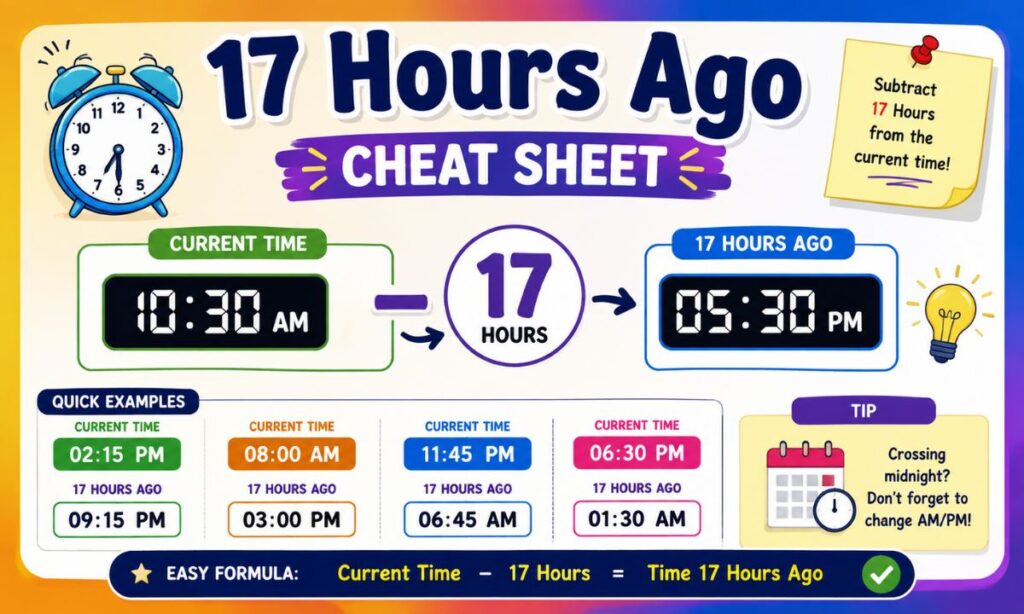
Short on time? Here’s the whole guide in one glance so you don’t have to scroll back up.
Subtract 12 hours, then subtract 5 more, that’s your full 17 hour shift done in two easy steps. Anything before 5 PM rolls back to the previous day, anything after stays on the same day.
Always double check your time zone before comparing notes with someone else, since your 17 hours ago and theirs might not match up at all.
Frequently Asked Questions
17 hours ago was what time?
Subtract 17 hours from your current time. If it crosses midnight, the date moves back one day.
How long ago was 17 hours?
It’s a fixed stretch, exactly 1,020 minutes, or 61,200 seconds, counted backward from right now.
What time was 17 hours ago from a specific hour?
Take that hour, subtract 12, then subtract 5 more. Adjust the date if you crossed midnight.
Does the answer change by location?
Yes. Your time zone decides the actual clock reading, even though the math itself never changes.
Conclusion
Asking what time it was 17 hours ago feels like a tiny question, but it opens up a surprisingly useful skill. Once you know the 12 plus 5 shortcut, watch for date rollover, and keep your time zone in mind, you’ll never second guess yourself again.
Whether you’re checking a delivery notification, tracing a work log, or just piecing together your own day, this simple bit of time computation has your back. Drop your own timestamp mix ups or favorite tricks in the comments, we’d genuinely love to hear them.