
Finding out the past time can be useful when you want to check when an event happened or calculate a previous schedule. It is a simple process that helps you understand time differences quickly.
With the right method, you can easily work backward from the current time without confusion.
This guide explains What Time Was It 6 Hours Ago in a clear and simple way. You will learn how to subtract six hours correctly using different time formats.
It can help with daily schedules, work records, travel, and other time-related tasks.
Whether you use a 12-hour or 24-hour clock, calculating the previous time follows the same basic idea. You simply move the clock back by six hours from the starting time.
A few examples can make the calculation even easier to understand.
In this article, we will cover What Time Was It 6 Hours Ago with simple examples and helpful tips. You can quickly check past hours without needing complicated calculations.
By the end, you will be able to work out the answer accurately in just a few seconds.
Understanding What Time Was It 6 Hours Ago
What time was it 6 hours ago is one of those questions your brain should answer instantly but somehow never does under pressure.
You’re staring at a missed call log or a work timestamp and suddenly six hours feels like a math test.
Here’s the honest truth. It’s just time subtraction, nothing fancier than that.
Take the hour on your clock right now, subtract six, and keep your minutes exactly as they are. That’s the whole trick behind figuring out time 6 hours earlier.
How to Calculate 6 Hours Ago
I used to overthink this every single time my phone showed a delivery update from “6 hours ago.” Then I broke it down into one dead simple habit.
Look at your current hour. Subtract six. Keep the minutes untouched.
If your hour count drops below zero, you just crossed into the previous day, and that’s the only moment worth double checking.
Say it’s 9:45 PM right now. Pull back six hours and you land on 3:45 PM, same day, no fuss.
Now try 2:20 AM. Subtract six and you actually land on 8:20 PM yesterday. That’s your classic midnight crossover, and once you spot the pattern you’ll never second guess it again.
ALSO READ THIS:How Long Is 5 Inches, Exactly
Why People Search “What Was 6 Hours Ago From Now”
People don’t randomly wonder about six hours for fun. They’re usually checking something real, like an email that says it landed six hours back, or a package update on a tracking page.
Fitness watches love throwing this at you too. Mine once told me I fell asleep “6 hours ago” and I had to actually do the math to figure out if that lined up with when I remembered dozing off.
Support tickets, system logs, backup confirmations, they all lean on relative phrases like this instead of a clean timestamp.
So instead of guessing and hoping, most folks just run the time difference calculation because memory after a long day is not exactly reliable.
Everyday Situations Where Time Six Hours Earlier Matters
You’d be surprised how often time six hours earlier sneaks into a completely normal day without you even clocking it.
It shows up in work logs, health routines, sleep data, customer chats, and even flight boards. Let’s walk through where it actually matters.
Work Shifts
Managers checking when a shift started, or an employee trying to remember their clock in time, both lean on this exact bit of time calculation.
A supervisor reviewing overnight coverage might ask “what time did the night shift actually begin,” and six hours back from now is often the fastest gut check.
Medication Schedule
Doctors often prescribe medicine every six hours, and knowing your last dose time actually matters for safety.
If it’s 4:00 PM and your last pill was six hours ago, that puts it at 10:00 AM, and that kind of precision genuinely helps avoid doubling up by mistake.
Sleep Tracking
Sleep apps and smartwatches constantly reference “six hours ago” when comparing your current alertness to when you actually dozed off.
This is where relative time feels more natural than a raw timestamp, since nobody thinks in exact clock digits while half asleep.
Customer Support
Support agents dig through timestamps on tickets and chat logs constantly, and “six hours ago” is a normal way customers describe when an issue started.
Being able to translate that phrase into an actual clock time speeds up how fast an agent can find the right conversation.
Flight Schedules
Travelers dealing with layovers or international routes often need to calculate an earlier time, especially when a flight status update says “departed 6 hours ago.”
Add a time zone shift into the mix and this becomes even more important, which we’ll get into shortly.
Time Arithmetic Made Simple
People hear time arithmetic and picture some complicated formula, but it’s really nothing more than basic subtraction.
Current time minus six hours equals your earlier time. That’s genuinely the entire formula.
The only twist is that clocks wrap around after midnight instead of dropping into negative numbers like a normal math problem would.
So 1:00 AM minus six hours becomes 7:00 PM the day before, and midnight minus six hours lands you at 6:00 PM the previous evening.
Examples Using Both 12-Hour and 24-Hour Clock
Different countries read clocks differently, and knowing both formats makes 24 hour time conversion way less confusing when you’re checking something international.
12-Hour Clock
Here’s how it plays out with a standard 12 hour clock.
10:00 PM minus six hours lands on 4:00 PM.
7:30 AM minus six hours lands on 1:30 AM.
1:15 AM minus six hours lands on 7:15 PM the day before.
24-Hour Clock
Now the same logic using a 24 hour clock, which a lot of logs and international schedules actually rely on.
22:00 minus six hours becomes 16:00.
07:30 minus six hours becomes 01:30.
02:15 minus six hours becomes 20:15 the previous day.
What Time Will It Be in 6 Hours?
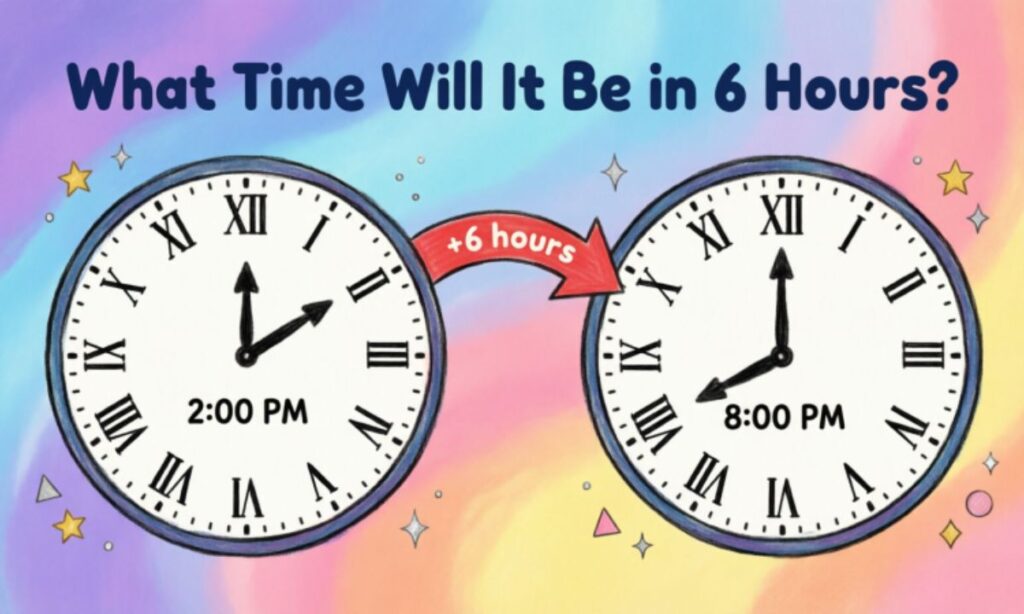
Funny enough, people ask the flip side of this question just as often. Instead of subtracting, you’re adding six hours forward.
9:00 AM plus six hours becomes 3:00 PM. Simple forward math, no midnight worry yet.
4:00 PM plus six hours pushes you to 10:00 PM, still the same day.
8:00 PM plus six hours crosses into 2:00 AM the next day, which is the forward version of that same midnight crossover we talked about earlier.
Time Zones Can Change Everything
Here’s something people overlook constantly. Saying “six hours ago” means nothing solid unless you know whose clock you’re using.
If you’re in Pakistan and a friend is texting from the US during Daylight Saving Time, your six hours and their six hours are not lining up the same way at all.
Businesses running across countries deal with this daily, juggling global time, shared meeting slots, and constant time zone adjustment between offices.
That’s exactly why scheduling apps quietly handle time conversion in the background so nobody has to do this math by hand during a client call.
Technology Depends on Accurate Time Calculation
Every app you touch is quietly running time calculation behind the scenes, way more than people realize.
Server logs, security alerts, backup confirmations, and login records all depend on precise timestamps to make sense of what happened and when.
Even something as small as seeing “last edited 6 hours ago” on a shared document relies on accurate subtraction and reliable time synchronization across systems.
This is why engineers obsess over getting timestamps right. A tiny error in time logic can throw off an entire chain of records.
Using an Hours Ago Calculator
Doing this math manually is fine occasionally, but an hours ago calculator saves real time when you’re checking multiple timestamps back to back.
You punch in your current time, tell it how many hours back you need, and it instantly spits out the answer, midnight crossover handled automatically.
This gets genuinely useful for reviewing project timelines, comparing elapsed time between events, or double checking historical records without doing mental gymnastics each time.
Some sites even build in automatic date adjustments, so you’re never stuck wondering if you should be looking at today or yesterday.
Common Mistakes People Make
Even though subtracting six hours sounds easy on paper, the same slip ups happen again and again.
Forgetting the date change. People subtract the hours correctly but completely forget the calendar flips to the previous day.
Mixing up AM and PM. This one is sneaky and happens more than anyone wants to admit, especially with a 12 hour clock.
Ignoring Daylight Saving Time. A six hour gap can quietly become five or seven hours depending on when DST kicks in.
Misreading 24 hour format. Switching between 12 hour and 24 hour clocks mid calculation is a fast way to land on the wrong answer.
Why Relative Time Feels Different From Exact Time
Humans naturally think in loose chunks like “a few hours ago” or “earlier this morning” instead of a locked in timestamp.
We remember things like two hours ago or yesterday afternoon, not 14:32 on a specific date, because that’s just how memory naturally works.
Computers don’t have that luxury though. Every current timestamp they log is precise down to the millisecond, no guessing involved.
That gap between how humans recall time and how machines record it is exactly why relative time phrases like “6 hours ago” became so common in the first place.
A Real World Moment That Makes This Click
I remember checking a work email that said “sent 6 hours ago” while I was mid conversation with someone about a deadline.
It was 3:00 PM, so I quickly worked out the email actually came in at 9:00 AM, right when the office typically opens.
That tiny bit of math changed the whole conversation, because suddenly the “delay” everyone was worried about wasn’t actually a delay at all.
Little moments like that are exactly why this simple skill matters more than people give it credit for.
Quick Reference Table
| Current Time | 6 Hours Ago |
| 12:00 AM | 6:00 PM (previous day) |
| 3:00 AM | 9:00 PM (previous day) |
| 6:00 AM | 12:00 AM |
| 9:00 AM | 3:00 AM |
| 12:00 PM | 6:00 AM |
| 3:00 PM | 9:00 AM |
| 6:00 PM | 12:00 PM |
| 9:00 PM | 3:00 PM |
| 11:59 PM | 5:59 PM |
Frequently Asked Questions
What time was it 6 hours ago?
Subtract six hours from your current clock time, keeping the minutes the same. If it crosses midnight, shift the date back one day too.
What does “6 hours ago” actually mean?
It refers to the exact point in time that happened six hours before this current moment, commonly used for tracking events and timestamps.
How do I avoid mixing up AM and PM during this math?
Write out the full time including AM or PM before you subtract, and double check it once you’re done, especially near the noon or midnight mark.
Does this change with time zones?
Yes. Six hours in your zone is not the same six hours in someone else’s, especially once Daylight Saving Time gets involved.
Is there a faster way than doing it manually?
An hours ago calculator handles the whole thing instantly, including any date changes, so you skip the manual guesswork entirely.
Final Thoughts
What Time Was It 6 Hours Ago looks like a tiny question, but it quietly touches work shifts, sleep tracking, medication timing, and even how your favorite apps log activity behind the scenes.
Once you get comfortable with the basic subtraction and spotting a midnight crossover, this becomes second nature fast, almost automatic.
Next time someone throws “what was 6 hours ago from now” at you, you’ll already know the answer before they finish the question. And if you ever want a shortcut, a reliable hours ago calculator is just a few taps away.