
Ever tried picturing 50 feet and just drawn a blank? You’re not alone. Numbers on a tape measure don’t mean much until you connect them to something you’ve actually seen.
That’s what this guide does. Fifty feet in real-life examples you already know, from railcars to whales, so the number finally sticks. By the end, you’ll have a picture in your head that never fades.
50 feet equals 600 inches, 15.24 meters, or 16.67 yards, and a railroad boxcar or an NBA basketball court hits that mark almost exactly.
Fifty Feet, Unit by Unit
Numbers only help if you can use them fast. So here’s the feet to meters and feet conversion math laid out plain, no digging required.
A foot is locked at 0.3048 meters by definition. So 50 feet in meters comes out to an exact 15.24, no rounding needed.
| Unit | 50 Feet |
| Inches | 600 in |
| Yards | 16.67 yd |
| Centimeters | 1,524 cm |
| Millimeters | 15,240 mm |
| Meters | 15.24 m |
| Kilometers | 0.01524 km |
| Miles | 0.00947 mi |
| Fathoms | 8.33 |
Need it for a build sheet or a school project? Grab the row you need and move on. That’s really all the math this deserves.
17 Things That Hit the Fifty-Foot Mark
Here’s the fun part. These length comparison picks run from machines on the highway to a whale in open water, and every one lands within a foot or two of fifty.
Standard Railroad Boxcar
A classic railroad boxcar carries about 50 feet of usable space inside, and that number stuck for a real reason. It hauls pallets and lumber while still clearing tight yards and tunnels.
The outside shell runs a bit longer once you count the couplers, closer to 55 feet. But the cargo space you’d actually load is your fifty-foot yardstick on wheels.
Railroads picked this size over the older 40-foot cars because it moved more freight without a bigger engine. Simple trade, big payoff.
New York City Subway Car
Hop on one of the numbered lines in New York and you’re riding in a car that measures 51 feet. Those older subway car models stayed short because the original tunnels were dug tight more than a hundred years back.
The lettered lines run bigger stock, 60 to 75 feet a car. The two fleets can’t mix and match, since the longer trains simply won’t clear the older curves.
also read this:2 CM: 11 Objects That Prove Exactly How Small It Is
Cessna Caravan Wingspan
Tip to tip, a Cessna Caravan’s wingspan stretches 52 feet, just past our fifty-foot mark. That wide wing is what lets this small plane haul cargo and land on short, rough dirt strips.
Package carriers built entire small-town delivery networks around this plane. Next time one taxis by, you’re looking at fifty feet of wing with a little room to spare.
Hockey Neutral Zone
On an NHL rink, the neutral zone between the two blue lines runs exactly 50 feet. It’s the stretch where a team picks up speed before crashing toward the net.
One clean pass from blue line to blue line covers that whole gap. In a sport built on speed, fifty feet disappears in a blink.
Beach Volleyball Court
A regulation beach court measures 16 meters end to end, right around 52 feet. Here’s the part that gets me every time: only two players are covering all of that sand.
That’s exactly why beach doubles wrecks your legs by the third set. Fifty feet of court, and nobody to share the running with.
Saguaro Cactus
Most saguaro cactus plants top out near 40 feet, but the true giants push past 50 after more than a century in the desert. Growth is brutally slow, sometimes barely an inch in the first ten years.
A saguaro might not even grow its first arm until it’s 75 years old. So a fifty-footer out there is older than almost anyone standing under it.
Spinosaurus
The Spinosaurus measured somewhere around 50 feet from snout to tail, which makes it the biggest meat-eating dinosaur we’ve found fossils for. That’s longer than a T. rex and longer than a Giganotosaurus too.
Estimates swing from about 41 to 59 feet since full skeletons are rare finds. Picture a boxcar with crocodile jaws and a sail down its back, and you’re close.
Super 8 Film Cartridge
A single cartridge of Super 8 film holds exactly 50 feet, wound tight in a shell small enough to fit in your palm. Run it at standard speed and you get about three minutes and twenty seconds of footage.
That gap between the tiny size and the run time still catches people off guard. Every backyard birthday shot on one of those cartridges was fifty feet of film start to finish.
And the format isn’t dead. A major camera brand released a new Super 8 model recently, so people are still loading these fifty-foot rolls today.
Highway Billboard
A standard highway billboard, the big bulletin size, runs 48 feet wide, just shy of our fifty-foot mark. It’s built that wide on purpose, so the message lands on a driver doing 70 miles an hour.
Basically every big board you pass on the interstate is close to fifty feet across. It’s hard to picture until you notice how small the trucks look underneath it.
A 50-Foot Flagpole
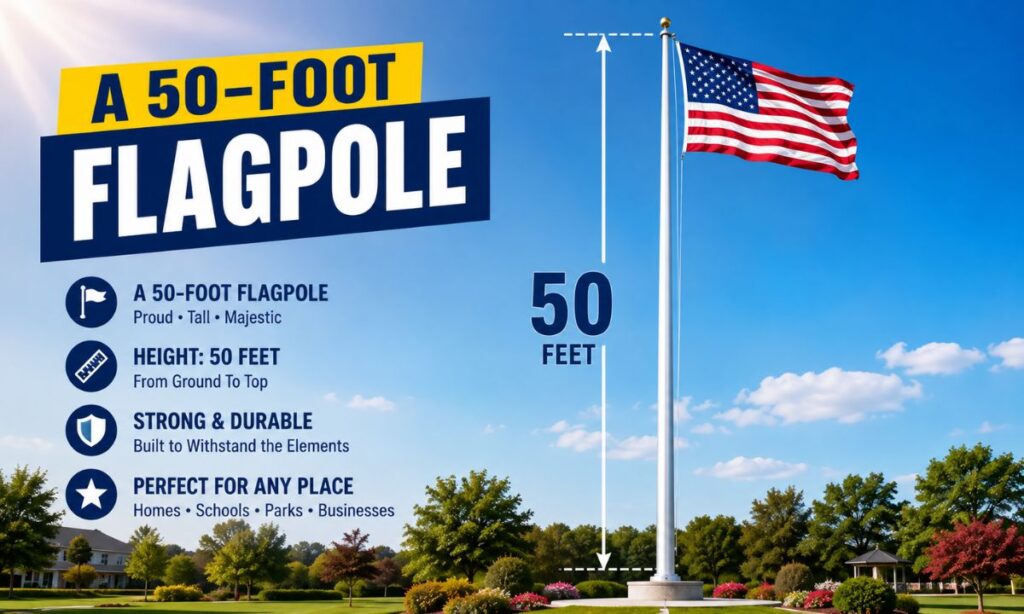
The flagpole outside a school, dealership, or city hall often measures a clean 50 feet tall. The flag size scales up with the pole, which is why places flying large banners choose this height.
Stand at the base and tip your head back. Wherever that flag snaps in the wind, that’s your fifty feet measured straight up.
Highway Light Pole
Highway light poles usually stand 40 to 50 feet tall, tall enough to throw light across several lanes at once. The bigger fixtures at interchanges go higher, but the standard roadside pole sits right in this range.
Look up next time you’re stopped at a light. That fixture overhead is roughly fifty feet of steel above your windshield.
A 50-Foot Roll of LED Strip Lights
Shop for LED strip lights and the 50-foot roll shows up everywhere. It traces a full ceiling line or wraps a long shelf with a little strip left over.
Here’s the catch nobody warns you about. Power a 50-foot run from just one end and the far tip dims, because voltage drops across that distance, so the fix is feeding power from both ends.
A 50-Foot Roll of Chain-Link Fence
Chain-link fence ships in 50-foot rolls as the retail standard. One roll usually covers the full side of an average yard.
Roll it out flat across the grass and you’ve got fifty feet laid right in front of you. It might be the easiest way on this whole list to actually see the distance.
A 50-Foot Party Tent
Event tents come in sizes like 20 by 40 and 20 by 50, so a 50-foot party tent is a common backyard rental. The length decides how many tables fit in a row underneath it.
Walk one end to the other at a wedding reception and you’ve just paced off fifty feet between handshakes.
The Width of a City Building Lot
Older neighborhoods are full of building lots that measure 50 feet wide at the street. This width became the go-to because it fits a modest house plus a driveway down one side.
It sounds roomier than it plays out, though. Once the city’s setback rules cut into that width, the house ends up narrower than the number on paper suggests.
NBA Basketball Court Width
Here’s one that surprises people. An NBA basketball court measures exactly 50 feet wide, sideline to sideline. Length gets all the attention, but the width is your fifty-foot mark hiding in plain sight.
Next game you watch, picture the court cut the short way. That’s fifty feet, and ten players are sprinting across it in seconds.
Humpback Whale
Adult humpback whales can stretch close to 50 feet from nose to tail, roughly the length of a school bus and a half. They’re one of the biggest animals most people will ever spot in the wild.
A breach from a whale that size sends up a splash you can feel from a boat. Fifty feet of muscle clearing the water is not a small thing to witness.
What 50 Feet Feels Like on Foot and Indoors
The quickest way to feel this number is your own stride length. An average adult step covers about 2.5 feet, so roughly 20 normal steps will carry you the full fifty.
You can time it too. Walking fifty feet takes around 11 seconds at a brisk pace, closer to 17 if you’re strolling and not in a rush.
Indoors, fifty feet rarely fits inside one room. Most rooms run 10 to 15 feet, so picturing this length inside a house usually means stringing three or four rooms together, or pacing a hallway end to end.
Make the Comparison Stick for Yourself
Reading fifteen or seventeen examples is one thing. Locking one into memory is another, and that’s the part that actually helps when you’re eyeballing a distance later.
Pick the one you see most in daily life. If you live near train tracks, the boxcar is your anchor. If you’re near a court more than a rail yard, let the basketball court width be the number you carry around.
• Walk it off once in your own yard or driveway so your body remembers it, not just your head
• Pick a landmark you pass often, a fence line, a tent rental, a light pole, and mentally tag it as “that’s fifty feet”
• Compare it to something taller than you’re used to, like the flagpole, so vertical distance feels as real as horizontal
• Revisit your chosen anchor every so often so the memory stays fresh instead of fading
Once one example clicks, the rest of this list falls into place around it. That’s really the whole trick.
Wrapping It Up
Fifty feet stops being an abstract number the moment you tie it to something real. A boxcar rolling past a crossing, a whale breaching offshore, a tent going up in a backyard, any of these work as your mental measuring tape.
Pick the one that fits your daily life best and let it anchor the rest. After that, every billboard, listing, and spec sheet that throws fifty feet at you will click into place without needing a tape measure at all.
Got a comparison from your own neighborhood that beats these? Drop it in the comments and let’s build this list out together.