
Have you ever wondered What Does 60 Feet Look Like? It can be hard to imagine this length without seeing it in real life. Comparing 60 feet with familiar objects makes it much easier to understand.
In this article, you will discover 15 simple and real-life comparisons that show how long 60 feet really is. From vehicles to everyday places, these examples will help you visualize the distance clearly.
Whether you are measuring a space or simply curious, What Does 60 Feet Look Like? gives you an easy way to picture this measurement. Let’s explore some interesting comparisons that make 60 feet easier to imagine.
60 Feet in Numbers, All in One Place
Let’s get the numbers out of the way first, since that is probably why you searched this.
60 feet equals 720 inches, 20 yards, and about 18.29 meters.
If you are working in centimeters, that is 1,828.8 cm, or 18,288 mm if you need it even smaller.
On a map, 60 feet barely shows up. It is only about 0.0114 miles, roughly one eighty eighth of a mile.
| Unit | 60 Feet Equals |
| Inches | 720 inches |
| Yards | 20 yards |
| Centimeters | 1,828.8 cm |
| Millimeters | 18,288 mm |
| Meters | 18.29 meters |
| Miles | About 0.0114 miles |
Keep this table saved somewhere.
You will need it the next time someone at work argues about a 60 feet to meters conversion and refuses to just Google it.
Now let’s move past the numbers and talk about how this length actually feels in real life.
ALSO READ THIS:50 Feet, Measured Out: 15 Real Things That Land Right at This Length
What 60 Feet Feels Like in Real Space
Numbers on a page do not tell your brain much. Your body understands length better than your eyes do.
A tall adult stands about 6 feet. Line up ten people head to toe on the ground, and that whole chain equals 60 feet.
Picture your living room for a second.
Most living rooms run somewhere between 12 and 15 feet across, so 60 feet is basically four living rooms pushed back to back.
That is why how long is 60 feet in a room is a trick question. It almost never fits in a single room, even a big one.
Outdoors it shrinks fast.
If you are wondering how long is 60 feet in miles, it works out to a tiny sliver, about one eighty eighth of a mile.
Tiny on a road trip. Massive when you are standing right next to it.
That contrast is the whole reason this length feels tricky. It depends completely on where you are standing.
15 Real Things That Measure a Full 60 Feet
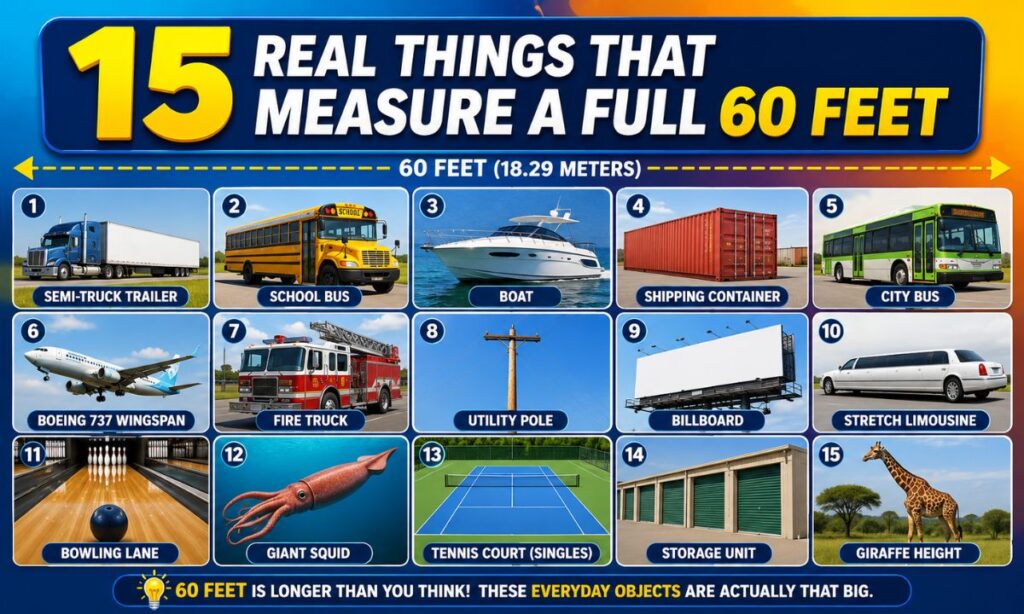
Here is the fun part.
These are real objects, some long, some tall, picked from land, water, farms, and even the sky, so you can picture 60 feet no matter where you are standing.
A Full-Grown Whale Shark
Whale sharks are the biggest fish swimming in our oceans today, and some of the largest ones on record have stretched close to 60 feet from nose to tail.
They get that big because they are filter feeders. They cruise slowly and sip up plankton, so they burn very little energy for their size.
Even at that size, their teeth are tiny, and divers swim right beside them without any danger at all.
A Racing Rowing Shell (The Eight)
A competition rowing boat, known as an eight, runs close to 60 feet from bow to stern, sometimes stretching a bit past it.
It is built long and razor thin on purpose, so it slices through water with almost no drag holding it back.
The hull is so light that the rowing crew can lift the entire boat over their heads together, even though it seats nine people including the coxswain.
Three African Elephants in a Row
An adult African bush elephant usually runs around 18 to 20 feet from trunk to tail. Line up three of them, and you land right around that 60 foot mark.
Big animals need a long gut to break down the huge amount of plants they eat every single day, sometimes hundreds of pounds worth.
A single elephant trunk holds tens of thousands of muscles, more than your entire body combined.
A Single Giant Bamboo Stalk
Some giant bamboo varieties can push a single stalk close to 60 feet tall. Technically it is grass, just extremely ambitious grass with big goals.
Bamboo races its neighbors for sunlight, and during peak growing season, it can shoot up a couple of feet in a single day.
Most of that height happens in one growing season. After that, the stalk spends its time thickening rather than climbing any higher.
A Farm Grain Silo
Plenty of farm silos stand close to 60 feet from the ground to the very top.
Height is the whole point here. Grain stores better when it is stacked vertically, and gravity does the heavy lifting when it is time to unload.
Loose grain inside can act almost like quicksand, which is exactly why farmworkers treat a full silo with serious caution.
A Small Harbor Lighthouse
Plenty of working harbor lighthouses rise about 60 feet into the sky.
That height is tall enough to throw a beam over nearby rooftops and out across open water, yet short enough to build on a rocky point without much trouble.
It is calculated against the curve of the earth itself, so ships out at sea pick up the light from a predictable, known distance.
A Drive-In Movie Screen
Older drive-in movie screens often measured close to 60 feet across.
That width existed so cars parked way in the back still got a clear, watchable picture without squinting.
A flat wall that big catches wind like a sail, so most were braced or angled slightly just to stay standing through a storm.
A 60-Foot Flagpole
Sixty feet is actually a standard flagpole height you can order off the shelf today.
It works well for city buildings and public parks, since it needs to clear the trees around it so the flag can actually be seen.
The taller the pole gets, the bigger the flag has to be to look right, so a 60 foot pole usually flies a genuinely large flag.
A Neighborhood Water Tower
Smaller neighborhood water towers often stand close to 60 feet to the top of the tank.
That height is not for looks. It uses gravity to push water pressure straight down into the homes below without needing extra pumps running all day.
Think of it like a giant battery, except instead of storing electricity, it stores pressure.
An Old-Style Windmill
A traditional tower windmill often reaches close to 60 feet up to the very top of its cap.
Builders went that high on purpose, to catch steadier wind that sits above the choppy gusts near the ground.
The whole cap could rotate so the sails always faced directly into the wind, and this trick worked long before electricity was even invented.
A Short Pedestrian Footbridge
A lot of footbridges over streams or quiet roads span close to 60 feet in a single clear stretch.
That reach is enough to cross most small waterways without needing a support post stuck in the middle.
A footbridge is designed to flex slightly under your weight, because a bridge too stiff to bend is actually more likely to crack under pressure.
A Mid-Size Theater Stage
The opening of a mid-size theater stage often runs close to 60 feet wide.
That width needs to fit full sets, a big cast, and the wings on either side where performers wait before their entrance.
The wing space can be almost as large as the part of the stage the audience actually sees during the show.
A Traveling Ferris Wheel
The traveling Ferris wheels you see at county fairs usually stand close to 60 feet tall.
They are built to fold down flat and ride on trucks, which naturally caps their height right around this mark.
A small crew can put one of these together and have it spinning within a few hours, then pack it right back up when the fair moves on.
A Grand Pipe Organ
The front face of a grand pipe organ can climb close to 60 feet in tall cathedrals and concert halls.
The tallest pipes need every inch of that headroom, since a pipe’s length directly sets its pitch, and the deepest notes call for very long pipes.
The lowest notes are so deep, you often feel them rumble in your chest before your ears even register the sound.
An Inflated Hot Air Balloon
A standard sport hot air balloon stands roughly 60 feet tall once it is fully inflated and ready to fly.
The envelope needs all that volume to trap enough warm air to lift the basket and its passengers off the ground.
The air inside only needs to sit about 100 degrees warmer than the air outside, and the whole balloon floats.
Modern Places You Bump Into 60 Feet Without Noticing
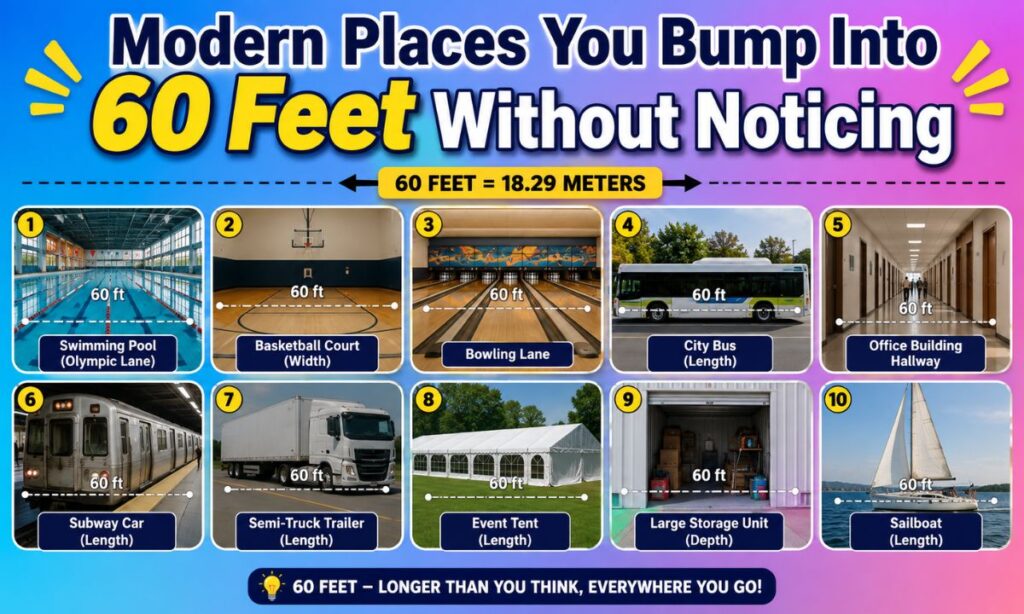
Not every 60 foot object is old fashioned or countryside themed.
A standard bowling lane, including the approach area, runs close to 60 feet from the foul line to the head pin.
Basketball courts get close too, since an NBA half court from baseline to half court line lands right around that same range.
Even a shipping container train car can stretch close to 60 feet, which is why loading docks measure distance in car lengths without even thinking twice.
Once you know these, city walks and sports games suddenly turn into a length quiz you can win.
Easy Ways to Mark Out 60 Feet Yourself
You do not need a tape measure to get a solid estimate.
These simple tricks answer how long is 60 feet visually, using stuff that is already sitting around you.
● Count your steps. An average adult stride is close to 2.5 feet, so about 24 normal steps gets you near 60 feet.
● Line up cars in your head. Many mid-size cars measure close to 15 feet, so four of them parked end to end covers a solid 60 foot stretch.
● Use a bowling lane. If you have ever bowled, you have already walked close to 60 feet without realizing it.
● Picture a school bus and a half. A standard school bus runs close to 40 feet, so one and a half buses gets you close to the mark.
Try this the next time you are outside. Pick a fence, a driveway, or a parking lot, and guess 60 feet before you check it. Most people are surprised how close they get once they have a real object in their head.
FAQs
How long is 60 feet in meters?
It is about 18.29 meters, just under 18 and a third meters.
How many steps is 60 feet?
For most adults, around 24 steps at a normal walking pace.
How long is 60 feet in miles?
About 0.0114 miles, roughly one eighty eighth of a mile. Tiny on a map, much bigger on foot.
Is 60 feet the same as 60 square feet?
No, and this trips people up a lot. Sixty feet is a length. Square feet measures area. A space that is 60 feet by 60 feet actually covers 3,600 square feet.
What is an easy object that is 60 feet long?
A racing rowing eight or a full grown whale shark both land right around that mark.
Why does 60 feet feel hard to picture?
It sits in an awkward zone. It is too long to fit inside a normal room, yet too short to feel like a real distance on a map, which is exactly why real objects help so much more than the raw number.
Wrapping It Up
Sixty feet stops being just a number once it has a face.
A grain silo on the drive to work. A footbridge in the park. A Ferris wheel lighting up at the county fair.
Once you have seen a few of these side by side, you will start spotting 60 feet everywhere you go, and the number will finally make sense in your gut, not just on paper.
Next time someone shrugs at a measurement like this, skip the math lecture.
Just hand them a whale shark.