
15 hours ago simply means you go back on the clock by 15 full hours from right now. If it’s 10 AM today, then 15 hours ago was 7 PM yesterday. That’s the short answer. Now let’s dig into why this question pops into so many heads, and how you can nail it every time without a headache.
You don’t need to be a math whiz for this one. You just need a clock, a bit of patience, and maybe a coffee.
What Does “15 Hours Ago” Actually Mean?
Picture yourself standing on a timeline. Now walk backward 15 steps, where each step is one hour. That’s it. That’s the whole idea behind time calculation
Say it’s 6 PM today. Walk back 15 hours and you land on 3 AM, same day. But if it’s 9 AM, walking back 15 hours pushes you into yesterday. You’ll hit 6 PM the day before.
This little jump across midnight is where most people trip up. It’s not the math that’s hard. It’s remembering the date flipped.
How to Calculate 15 Hours Ago Manually
No app, no calculator, no problem. Here’s a trick my uncle taught me while we waited for a delayed flight. He said, “Split it up, kid. Don’t fight the whole 15 at once.”
Here’s the manual time subtraction method:
● Subtract 12 hours first (this just flips AM to PM or PM to AM)
● Then subtract the leftover 3 hours
● Check if you crossed midnight
● Fix the date if you did
So if it’s 2 PM now, minus 12 hours gets you to 2 AM. Minus another 3 hours lands you at 11 PM the night before. Done in five seconds flat.
This trick works because your brain handles small jumps way better than big ones. Trust me, it saves a ton of confusion, especially at 2 AM when you’re half asleep and checking your phone.
What Time Was It 15 Hours Ago in Pakistan?
Folks in Pakistan run on GMT+5, also called Pakistan Standard Time. The math doesn’t change one bit just because the location does.
Say it’s 9 PM in Karachi right now. Subtract 15 hours and you land on 6 AM the same day. If it’s 8 AM, subtract 15 hours and you’re back to 5 PM yesterday.
The only time timezone actually matters is when you’re comparing two different places. If you’re just checking your own local clock in Lahore or Islamabad, the subtraction stays exactly the same no matter where you are on the map.
Understanding Time Zones and Why They Matter
Here’s where things get spicy. Say your friend in New York texts you at what feels like “15 hours ago” for them. But you’re sitting in Karachi, and your clock tells a totally different story.
Without proper timezone conversion, this turns into a full blown mess. I once missed a video call because I forgot my cousin in London runs five hours behind me. Fifteen hours ago for her wasn’t even close to fifteen hours ago for me.
A few things worth knowing:
● Local time only makes sense within its own zone
● Timezone offset is the number of hours a place sits ahead or behind GMT
● Apps like Google Calendar auto adjust for this, but manual chats and emails don’t
● Always double check before assuming “15 hours ago” means the same thing to both people in a conversation
This is exactly why big companies build timezone aware scheduling tools. Otherwise every meeting invite turns into a guessing game.
ALSO READ THIS:https://measureaxis.com/330-pm/
The Mathematics Behind 15 Hours
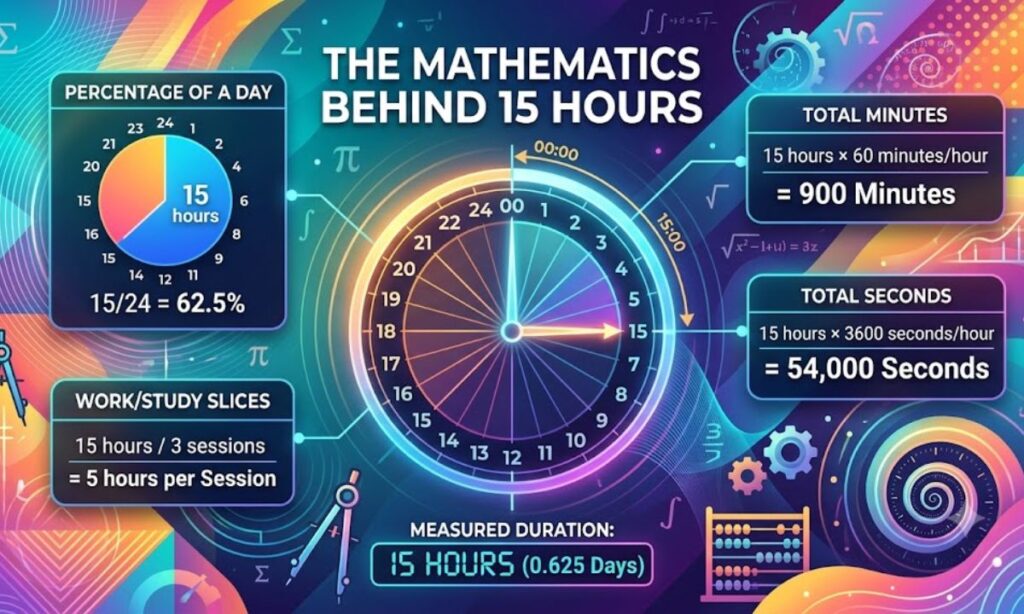
Let’s shrink this down into pure numbers for a second, because some of you like the nerdy stuff.
| Unit | Value |
| Hours | 15 |
| Minutes | 900 |
| Seconds | 54,000 |
| Milliseconds | 54,000,000 |
Here’s the time unit conversion breakdown:
● 15 hours times 60 equals 900 minutes
● 900 minutes times 60 equals 54,000 seconds
● 54,000 seconds times 1,000 equals 54,000,000 milliseconds
Programmers and app builders use these exact numbers when they write code for timers, alarms, or server logs. It looks boring on paper, but it’s the quiet engine behind every clock app on your phone.
What Time Was It 15 Hours Ago? Real Examples
Examples beat theory every single time. Here’s a quick table so you can just glance and go.
| Current Time | 15 Hours Ago |
| 12:00 AM | 9:00 AM (previous day) |
| 3:00 AM | 12:00 PM (previous day) |
| 6:00 AM | 3:00 PM (previous day) |
| 9:00 AM | 6:00 PM (previous day) |
| 12:00 PM | 9:00 PM (previous day) |
| 3:00 PM | 12:00 AM (midnight) |
| 6:00 PM | 3:00 AM |
| 9:00 PM | 6:00 AM |
Notice something? Anything before around 3 PM sends you back a full day. Anything after that keeps you on the same date. That one detail solves 90 percent of the confusion people run into.
When Was 15 Hours Ago From Now?
This question is a bit sneaky because the answer never sits still. It’s a relative time question, not a fixed one.
Ask it at noon and you get one answer. Ask it again at midnight and you get a totally different one. The target keeps moving because “now” itself keeps moving.
This is exactly why hours ago calculator tools exist online. They grab the current moment automatically and do the subtraction instantly, so you’re not stuck redoing math every time you refresh the page.
Tools That Can Help You Calculate 15 Hours Ago
Sometimes you just want the answer without doing any thinking. Fair enough. Here are your best options:
● Time difference calculator websites, type in your time and get an instant result
● Your phone’s built in clock app, most have a world clock feature
● Google search bar, typing “time in [city]” gives instant local time
● Reverse time calculator tools built specifically for backward subtraction
● Excel or Google Sheets, using simple time formulas
These tools remove the guesswork completely. One click, and you’re done. No scratch paper needed.
What Time Was It 15 Hours Ago and Why Do People Ask?
Nobody asks this question just for fun, usually. There’s almost always a real reason hiding behind it.
Maybe someone’s checking a security camera timestamp after a package went missing from their porch. Maybe a new parent is tracking a baby’s last feeding time, counting backward to figure out the next one. Maybe it’s a night shift worker trying to remember when their shift actually started.
I once used this exact math to prove to my landlord that a maintenance guy showed up way later than he claimed. Fifteen hours backward from the complaint email, and boom, timestamp didn’t match his story. Small win, but it felt great.
The Human Side of Time: Memory and Perception
Clocks are perfect. People, not so much.
Fifteen hours spent stuck in an airport can feel like a whole week crawled by. Fifteen hours spent laughing with old friends can vanish in what feels like a blink. Same exact number of hours, completely different feeling.
This gap between objective time and how our brain experiences it is well documented. Stress stretches minutes into what feels like hours. Fun compresses hours into what feels like minutes.
That’s part of why timestamps matter so much. They’re an anchor. When your memory gets fuzzy about how long ago something happened, the clock never lies, even if your gut feeling does.
What Was 15 Hours Ago Across Different Parts of the Day?
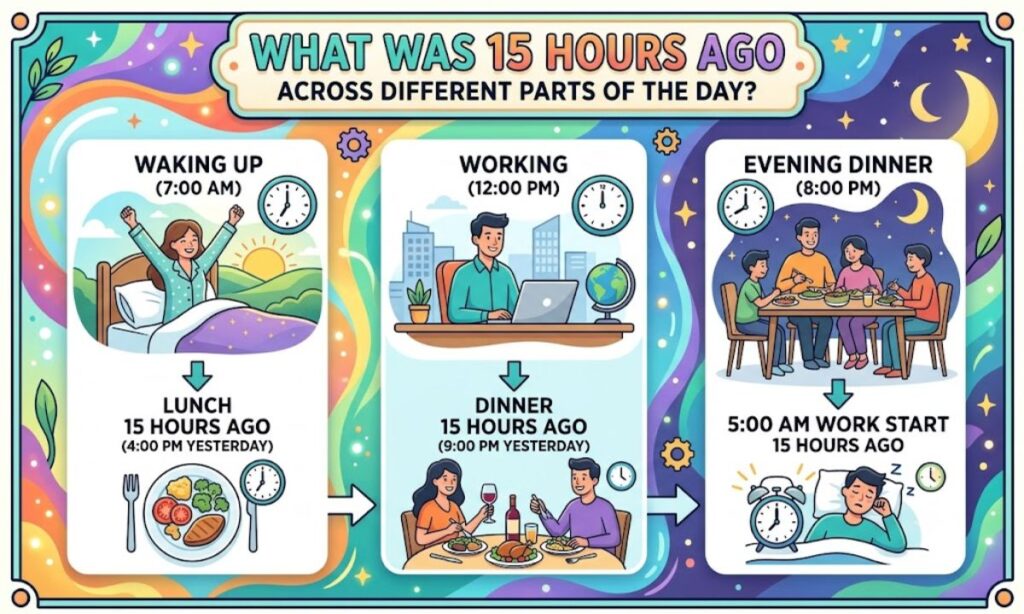
Morning check: If it’s currently morning, 15 hours ago usually lands you in the previous evening, right around dinner time.
Afternoon check: If it’s afternoon now, 15 hours ago often falls somewhere in the dead of night or early morning hours.
Evening check: If it’s evening right now, 15 hours ago typically lands you in the previous morning.
Night check: If it’s nighttime, 15 hours ago usually places you somewhere in yesterday afternoon.
Once you see this pattern a few times, it starts clicking almost automatically. Your brain builds a little mental map without even trying.
Common Mistakes When Calculating 15 Hours Ago
Even simple math trips people up sometimes. Here’s what usually goes wrong:
● Forgetting to flip the date when you cross midnight
● Mixing up AM and PM after subtracting
● Timezone differences get ignored when talking to someone in another country
● Skipping daylight saving adjustments where they apply
● Misreading 24 hour format clocks, especially military time
The fix is simple. Always double check your AM/PM and always ask yourself, “did I cross midnight?” That one question alone catches most errors before they happen.
How to Quickly Calculate 15 Hours Ago in Your Head
Here’s the fastest mental shortcut, tested and approved by many sleepy brains at 6 AM.
Step one, subtract 12 hours. This just swaps AM and PM without touching the number itself. Step two, subtract the remaining 3 hours from that new time.
Example: current time is 4 PM. Minus 12 gets you 4 AM. Minus 3 more gets you 1 AM. Total time spent, maybe four seconds.
This little two step trick beats trying to subtract 15 all in one messy jump. Your brain handles small bites way better than one giant bite.
Frequently Asked Questions
What time was it 15 hours ago?
Take your current time and subtract 15 hours. If you cross midnight, move the date back one day too.
How many minutes are in 15 hours?
900 minutes exactly.
Does daylight saving affect this calculation?
Yes, if the 15 hour window crosses a daylight saving switch, you may need to add or subtract an extra hour.
Is 15 hours ago always the previous day?
Not always. It depends on your current time. Anything before roughly 3 PM usually crosses into the day before.
Conclusion
What time was it 15 hours ago boils down to one simple move, subtract 15 hours and adjust the date if you cross midnight. That’s the whole trick.
We covered the manual method, the Pakistan time example, real world reasons people ask this question, and even why your brain remembers fifteen hours so differently depending on what you were doing during them.
Next time this question pops into your head, you won’t need a calculator. Just split it into 12 plus 3, and you’re there in seconds.
Got a moment from exactly 15 hours ago that stuck with you? Drop it in the comments, I’d love to hear it.