
You look at the clock. You do some quick math in your head. Then you second guess yourself. Is it AM or PM? Does the date change? Why does something this simple feel confusing sometimes?
Here’s the short answer right away. If you take your current time and add 12 hours, the hour number stays exactly the same. Only the AM or PM label flips. So 7:00 AM becomes 7:00 PM. And 7:00 PM becomes 7:00 AM the next day.
That’s it. That’s the whole trick. Now let’s slow down and walk through every part of it, so you never have to guess again.
What Time Is 12 Hours From Now?
Here’s the deal. Twelve hours is exactly half of a full day. A day has 24 hours, so 12 hours takes you from one side of the clock to the other side.
If it’s 6:00 AM right now, 12 hours from now is 6:00 PM. If it’s 6:00 PM right now, 12 hours from now is 6:00 AM tomorrow. The number never changes. Only AM and PM swap places.
There is one thing to watch closely. If your current time is in the PM hours, adding 12 hours pushes you into the next calendar day. That single detail trips up more people than the actual math does.
Why People Search “What Time Is 12 Hours From Now”
People don’t type this question just for fun. They type it because real plans depend on the answer. A night shift worker starting at 8:00 PM needs to know they clock out at 8:00 AM. A parent giving a baby medicine every 12 hours needs the next dose time to be exact.
Think about a nurse checking patient rounds. Think about a college student pulling an all nighter and trying to figure out when their sleep cycle should restart. Think about someone booking a flight and trying to guess what time they will land halfway around the world.
This tiny calculation quietly runs in the background of daily life. It shows up in work shift schedules, medication reminders, delivery windows, workout plans, and even gaming sessions that stretch past midnight. It is small, but it matters a lot to the person asking.
How to Calculate 12 Hours From Now
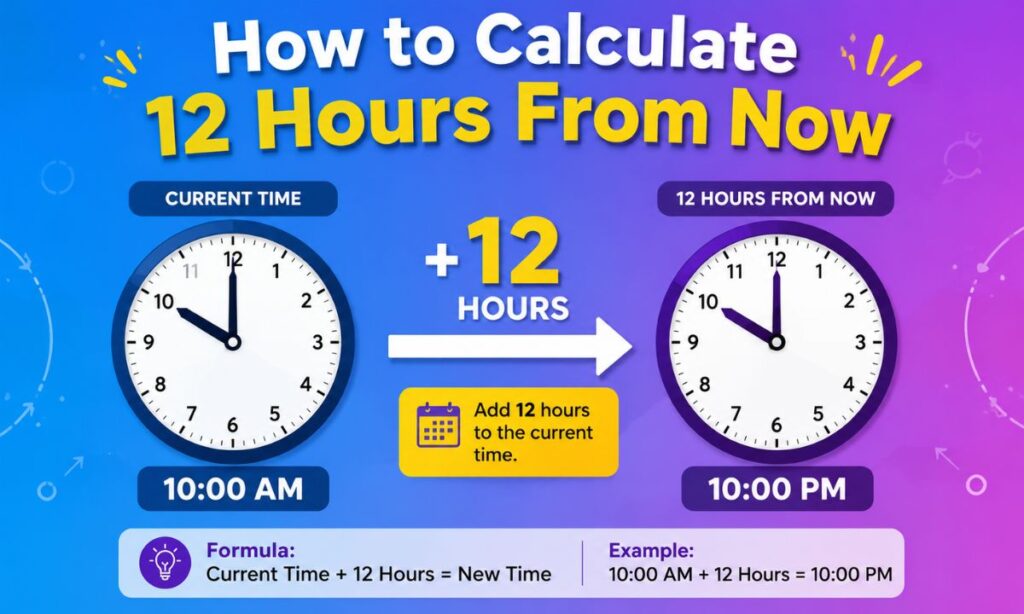
Calculating this by hand is easier than people expect. Look at your current time first. Let’s say it’s 9:20 AM. Add 12 hours and you land on 9:20 PM. The number 9:20 never moves.
Try another one. It’s 8:45 PM right now. Add 12 hours and you get 8:45 AM, but on the next day. Same number, flipped label, new date.
So here’s your three step rule. Keep the hour and minute the same. Swap AM to PM or PM to AM. Then check if the date needs to roll forward. Once this clicks, you’ll do it in your head without even trying.
Examples of 12 Hours From Now
Sometimes seeing real numbers helps more than reading rules. Here’s a quick table you can scan in five seconds.
| Current Time | 12 Hours From Now |
| 1:00 AM | 1:00 PM |
| 3:15 AM | 3:15 PM |
| 7:45 AM | 7:45 PM |
| 12:00 PM | 12:00 AM |
| 2:30 PM | 2:30 AM (next day) |
| 6:10 PM | 6:10 AM (next day) |
| 9:55 PM | 9:55 AM (next day) |
| 11:59 PM | 11:59 AM (next day) |
Notice the pattern? The number stays glued in place. Only the label and sometimes the date shift around it. Once you see it laid out like this, it stops feeling like math and starts feeling like common sense.
ALSO READ THIS:https://measureaxis.com/until-330-pm/
Understanding AM and PM
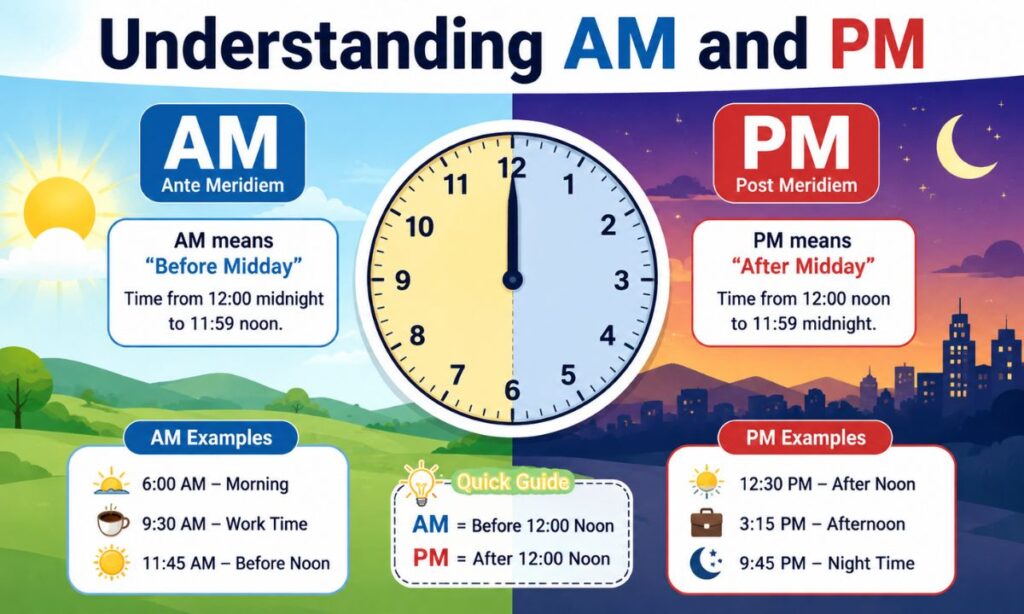
AM covers midnight all the way to noon. PM covers noon all the way to midnight. That part is simple enough. The confusing part is the two times that both use the number 12.
12:00 AM is midnight, the very start of a new day. 12:00 PM is noon, right in the middle of the day. People mix these two up constantly, and honestly, the naming system is partly to blame.
Here’s a trick that helps. Midnight starts the day, so think of it as the opening bell. Noon splits the day exactly in half, so think of it as halftime. If you remember that, you’ll never mix them up again.
Noon vs Midnight
Noon and midnight look similar on paper because they both show the number 12. But they sit on opposite ends of the clock. Noon is the middle of daylight hours. Midnight is the doorway into a brand new date.
Twelve hours after noon lands you exactly on midnight. Twelve hours after midnight lands you exactly on noon. They are like two ends of a seesaw, always balancing each other out.
This is also where most scheduling mistakes happen. Someone sets a reminder for 12:00 without picking AM or PM, and suddenly their alarm goes off at the wrong end of the day. A tiny label mixup, but it causes real headaches.
What Happens When You Cross Midnight?
Crossing midnight does more than change the clock. It changes the actual date on your calendar. This is the part people forget the most.
Say it’s Friday at 8:00 PM. Add 12 hours. You land on Saturday at 8:00 AM. The clock flipped from PM to AM, and the day flipped right along with it.
This matters a lot for medication schedules, flight bookings, and work shift handoffs. Missing this one detail can mean showing up a full day early, or worse, a full day late. Whenever your calculation crosses that midnight line, always double check the new date too.
Using a Time Calculator
Sometimes you just want the answer without doing any mental gymnastics. That’s exactly what a time calculator or an hours from now calculator is built for. You type in your current time, pick 12 hours, and boom, the answer pops up.
These tools are especially handy for bigger jumps. Adding 12 hours in your head is easy. Adding 37 hours or 68 hours while also tracking the date change gets messy fast. A calculator skips all that guesswork.
They also help when your brain is tired, which, let’s be honest, is exactly when you need this kind of math the most. Nobody wants to solve time zone puzzles at 2 AM after a long shift.
12 Hour Clock vs 24 Hour Clock
Some places use AM and PM. Other places skip that system completely and use numbers from 00 to 23. This is called the 24 hour clock, and a lot of airlines, hospitals, and the military rely on it.
Here’s a quick comparison so it clicks faster.
| 12 Hour Clock | 24 Hour Clock |
| 1:00 PM | 13:00 |
| 5:00 PM | 17:00 |
| 8:00 PM | 20:00 |
| 12:00 AM | 00:00 |
| 12:00 PM | 12:00 |
The same 12 hour rule still applies here. 07:00 plus 12 hours becomes 19:00. And 22:15 plus 12 hours becomes 10:15 the next day. Businesses love the 24 hour format because it wipes out almost every chance of AM and PM confusion.
Time Zones and 12 Hours From Now
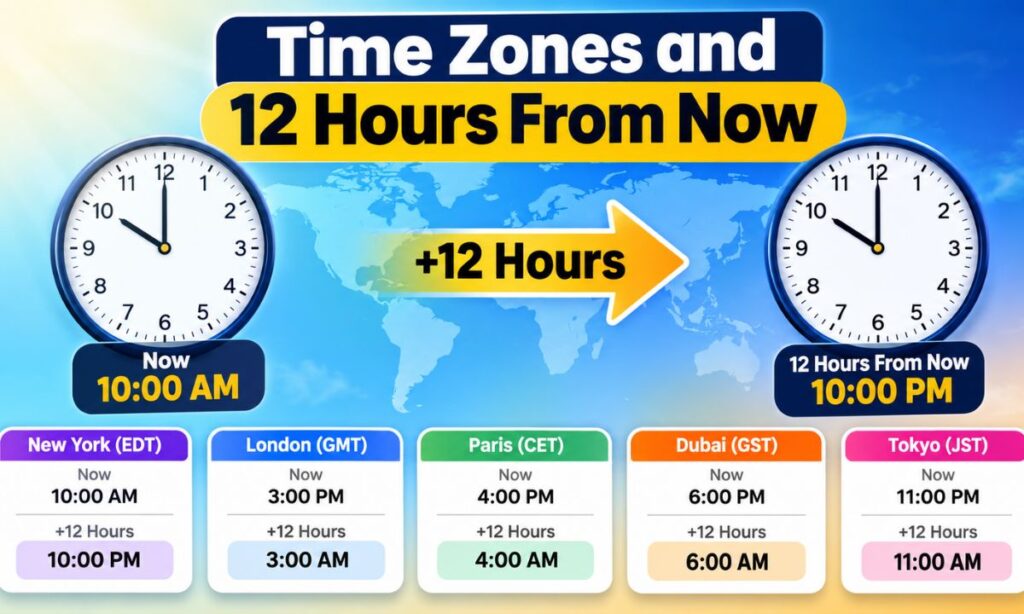
Here’s where things get a little trickier. If you’re chatting with someone across the world, just adding 12 hours to your own clock isn’t enough. You also need to factor in the time zone difference between the two of you.
Picture this. You’re in Karachi and your coworker is in New York. You can’t just add 12 hours and call it a day. You need to know the gap between your zones first, then apply the 12 hour shift on top of that.
This is exactly why remote teams lean on world clocks, smart calendars, and scheduling apps. These tools quietly do the heavy lifting, including tricky stuff like daylight saving time, so nobody accidentally books a meeting for 3 AM their coworker’s time.
Practical Uses of Knowing Future Time
This calculation isn’t just something you learn in school and forget. It shows up constantly in real life, often in ways you don’t even notice.
Healthcare workers use it to plan medication timing down to the minute. Parents use it for newborn feeding schedules that run on strict 12 hour loops. Students use it to plan late night study sessions and figure out when to actually stop and sleep.
Delivery drivers, factory workers on rotating shifts, and travelers chasing connecting flights all lean on this same simple math. It’s not flashy, but it quietly keeps daily life running on time.
How Many Minutes Are in 12 Hours?
Twelve hours breaks down into 720 minutes. You get that number by multiplying 12 by 60. Simple multiplication, nothing fancy.
Knowing this comes in handy for countdown timers, workout intervals, and productivity sessions like study sprints. It’s one of those small facts that suddenly becomes useful the moment you need it.
How Many Seconds Are in 12 Hours?
Twelve hours equals 43,200 seconds. That comes from 12 times 60 times 60. This number shows up a lot in coding, sports timing, and science experiments where precision actually matters.
It sounds like a huge number until you remember it’s just your average half of a workday, ticking by one second at a time.
How Many Milliseconds Are in 12 Hours?
Since each second holds 1,000 milliseconds, 12 hours equals 43,200,000 milliseconds. That’s a lot of ticks. Computers and apps use this level of detail when measuring things like loading speed or app performance.
You’ll probably never need this number in daily life. But if you’re into coding or app development, it’s a fact worth tucking away.
Common Mistakes People Make
Even though this math is simple, people trip up on it more than you’d think. Here are the mistakes that show up again and again.
● Forgetting to flip AM to PM or PM to AM after adding the hours
● Forgetting the date changes when the calculation crosses midnight
● Mixing up noon and midnight, since both use the number 12
● Ignoring time zone gaps when talking to someone in another country
● Misreading the 24 hour clock, especially numbers like 13:00 or 20:00
● Assuming the date always stays the same, even when it clearly shouldn’t
● Setting alarms without checking AM or PM, leading to missed wake ups
● Skipping daylight saving adjustments during the few weeks it applies
● Not double checking medication timing after a late night dose
● Trusting mental math during exhaustion, when a quick calculator check would be safer
Avoiding these slip ups gets a lot easier once you understand how the clock quietly cycles through a full day.
A Quick Real Life Example
Let’s make this real for a second. Say your friend works security and starts their shift at 10:00 PM sharp. You want to know when they clock out. Add 12 hours to 10:00 PM and you land on 10:00 AM the next morning.
Now imagine they ask you to call them exactly 12 hours after their shift starts, just to check in. You already know the answer without even opening a calculator. That’s the whole point of learning this trick properly instead of guessing every time.
Frequently Asked Questions
What time will it be in 12 hours?
It will be exactly 12 hours ahead of your current local time. The hour usually stays the same, but AM flips to PM or PM flips to AM.
How do you add 12 hours?
Keep the hour and minute the same, swap AM to PM or PM to AM, and check if the date needs to move forward.
What time was it 12 hours ago?
Subtract 12 hours from your current time and flip AM to PM or PM to AM the opposite way.
Is 12 hours exactly half a day?
Yes. A full day has 24 hours, so 12 hours is exactly half of that cycle.
Can time zones affect the calculation?
Yes. When you’re talking across countries, you need to factor in the time zone gap on top of the regular 12 hour shift.
Does daylight saving time change this math?
It can, but only during the specific weeks when clocks spring forward or fall back. Outside of that window, the regular 12 hour rule applies as usual.
Conclusion
Figuring out what time it is 12 hours from now isn’t really about complicated math. It’s about understanding one simple pattern, the hour stays the same, the label flips, and sometimes the date rolls forward too.
Once that clicks, you’ll use this trick constantly, whether you’re planning a work shift, timing medication, booking a flight, or just settling an argument with a friend about when their nap should end.
So next time someone throws this question at you, you won’t even blink. You’ll already know the answer, and now you know exactly why it works.