
Quick answer first: to find what time it was 16 hours ago, take your current time, subtract 16 hours, and if that number goes below zero, roll back to the day before. So if it’s 10 AM right now, 16 hours ago was 6 PM yesterday. That’s it. That’s the whole trick.
Now let’s talk about why this question pops into your head more than you’d think, and how to never mess up the math again.
Why Do People Search “What Time Was It 16 Hours Ago”?
You’re not just being curious for no reason.
Maybe your phone shows “Last seen 16 hours ago” on someone’s profile and you’re doing quiet detective work.
Or your sleep tracker says deep sleep kicked in 16 hours back, and you’re trying to connect that to when you actually went to bed.
Work logs, security cameras, delivery notifications, bank alerts, they all throw timestamps at us daily, and our brains need a way to translate 16 hours ago into an actual clock time we understand.
This isn’t a random math problem. It’s something almost everyone bumps into during a normal week.
How to Calculate 16 Hours Ago
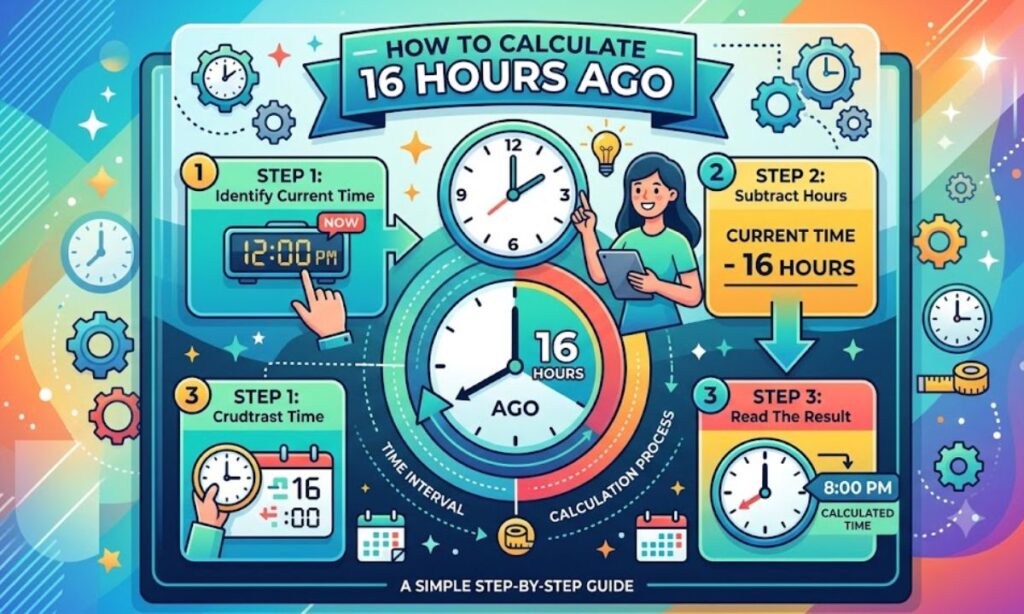
Here’s the no-nonsense version.
● Step 1: Look at the current time.
● Step 2: Subtract 16 hours from it.
● Step 3: If the subtraction pushes you past midnight, shift the date back one day.
Example: it’s 9 AM right now. Subtract 16 hours, and you landed at 5 PM yesterday.
Another one: it’s 11 PM right now. Subtract 16 hours, and you get 7 AM the same day.
See how the date sometimes changes and sometimes doesn’t? That’s the part people forget, and it’s the part that trips up almost every manual calculation.
Understanding Clock Arithmetic
Clocks don’t count like regular numbers. They loop.
After 12 comes 1 again, not 13, unless you’re using 24 hour time, more on that soon. This looping is called clock arithmetic, and it’s the reason simple subtraction can feel confusing.
Try this: start at 5 PM, subtract 8 hours, and you land at 9 AM. Subtract 8 more, and you’re at 1 AM the next day back. That flip from PM to AM, and from today to yesterday, happens fast if you’re not paying attention.
Once you get used to the loop, though, it stops feeling tricky. Your brain just starts doing it automatically.
Crossing the Midnight Boundary
This is the single biggest reason people get the answer wrong.
Subtracting hours doesn’t only move the clock hand. It can also move the calendar page. If your current time is 6 AM and you subtract 16 hours, you don’t land on 2 PM today, you land on 2 PM yesterday.
A lot of folks get the hour right but forget the day flipped. That one slip changes the whole answer.
Think of midnight as a wall. Once your subtraction pushes past that wall, you’re standing in yesterday, not today.
ALSO READ THIS:https://measureaxis.com/what-is-30-cm/
12-Hour Clock System vs 24-Hour Time
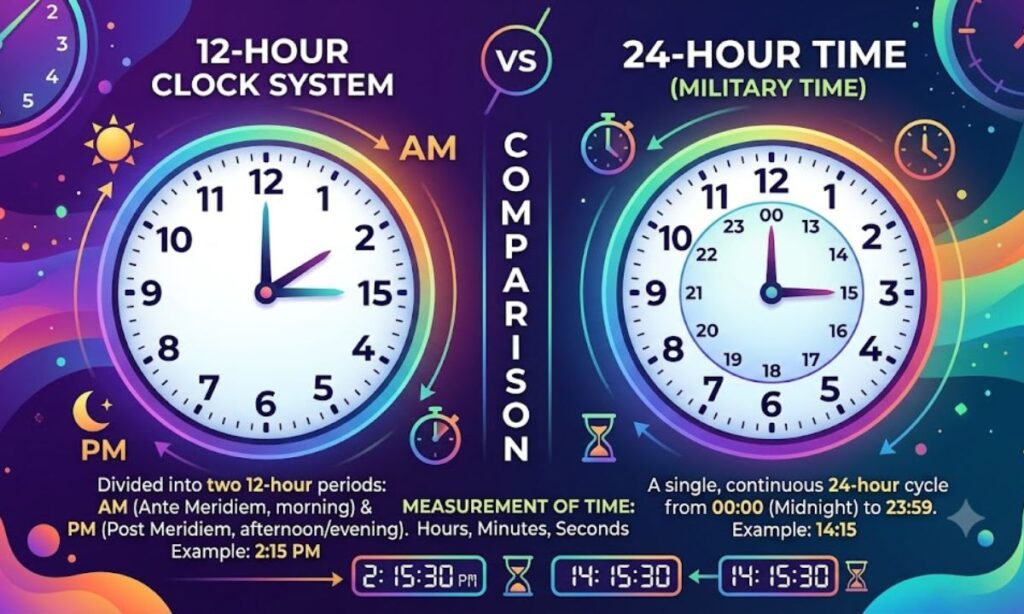
Some countries use AM and PM. Others use a straight 24 hour time, like 14:00 instead of 2 PM.
Both systems work fine, but mixing them up in your head is where mistakes creep in. The classic mix up is noon and midnight.
● 12:00 AM is midnight.
● 12:00 PM is noon.
People flip these two constantly, and it throws off the whole calculation. If you’re doing time math with someone using a 24 hour format, converting first can save you a headache later.
What Happens Inside a Time Difference Calculator?
Ever wonder what’s actually going on when you type a time into an online calculator and it spits out an instant answer?
It reads your current time, subtracts the hours you asked for, then checks if that subtraction rolled past midnight. If it did, the calculator quietly bumps the date back a day.
Then it formats everything nicely, either 12 hour or 24 hour style, and shows it to you like magic.
It’s not magic. It’s just fast, accurate math that skips the part where humans usually mess up, which is remembering to change the date.
Local Time and Time Zones Matter More Than You Think
Here’s something that catches people off guard. The same exact moment can look totally different depending on where you are.
If you’re in Lahore and your friend is in London, 16 hours ago gives you two completely different clock readings, even though you’re both talking about the exact same point in time.
That’s why apps and companies often store everything in UTC, a shared global reference time, behind the scenes, then convert it to your local time when you open the app.
You never see this happening. But it’s the reason your meeting invite shows the right time no matter which country you’re sitting in.
Real-Life Examples of Calculating 16 Hours Ago
Let’s run a few real numbers so this really sticks.
The current time is 8 PM. Subtract 16 hours. You land at 4 AM, same day.
The current time is 7 AM. Subtract 16 hours. You landed at 3 PM yesterday.
The current time is 1 AM. Subtract 16 hours. You landed at 9 AM yesterday.
Notice how identical math gives totally different results depending on where you started. That’s the whole game with time subtraction, the number stays the same, but the outcome depends completely on your starting point.
Why Human Memory Doesn’t Work Like a Clock
Here’s a fun little truth. Your brain is terrible at remembering exact times.
You probably don’t recall that you sent a text at 3:42 PM. You remember it was “right after lunch” or “while watching the game.”
Psychologists call this pattern temporal cognition, basically how our minds organize time around events instead of numbers. We remember feelings and moments, not digital timestamps.
That’s exactly why we lean on our phones so much. They remember the boring exact numbers so we don’t have to.
Timeline Reconstruction in Everyday Life
Ever lost your keys and tried to retrace your whole day? That’s timeline reconstruction in action.
You don’t think “I set them down at 4:17 PM.” You think “it was after I got home but before I made dinner.”
Your brain strings together little anchor points, meals, shows, phone calls, to rebuild a rough timeline. It’s honestly a pretty clever system, even if it’s not precise.
Digital records help fill the gaps. Delivery texts, bank alerts, call logs, they’re basically breadcrumbs your devices leave behind so your memory doesn’t have to do all the heavy lifting.
The Psychology Behind Time Perception
Ever notice how a fun weekend flies by but a boring meeting drags forever? That’s psychological time distortion, and it’s real.
Stressful or boring moments stretch out because your brain is paying close attention to every second. Fun moments compress because you’re distracted and enjoying yourself, so your brain isn’t logging every detail.
This ties into something called memory density. Busy, eventful days feel longer looking back because there’s more packed into your memory. Quiet, repetitive days blur together and disappear fast.
So sixteen hours on the clock is always sixteen hours. But how it feels to you can be a completely different story.
Technology Makes Time Calculations Effortless
Years ago, people used wall clocks and mental math to figure out past times. Now your phone does it before you even finish typing the question.
Modern tools read the current timestamp, subtract the hours, correct for any midnight crossover, adjust for your time zone, and show you a clean answer, all within a split second.
It’s easy to take this for granted. But that little bit of instant convenience used to take actual pen and paper work.
Common Situations Where You Need to Calculate 16 Hours Ago
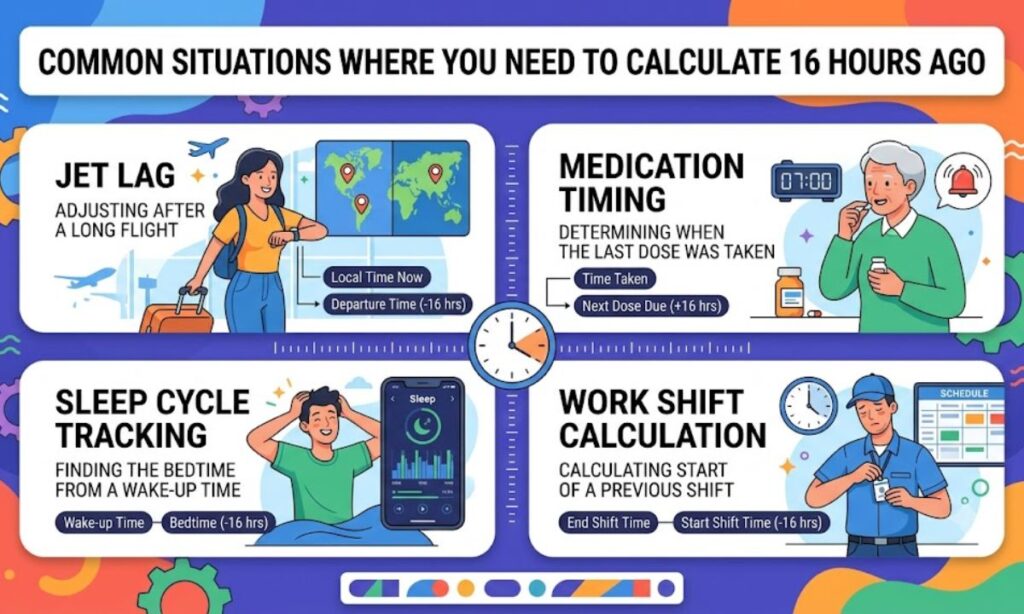
This question shows up more often than people realize. Here are the everyday spots where it actually matters.
Work Schedules
Night shift workers and overnight staff constantly check logs, attendance records, and shift changes. Getting the math wrong here can mean confusion over who worked when.
Sleep Tracking
Fitness watches love to tell you when your deep sleep, light sleep, or REM cycle started. Translating 16 hours ago into a real clock time helps you actually understand your sleep pattern.
Social Messaging
Active 16 hours ago shows up on almost every messaging app. Knowing how to quickly convert that gives you a real sense of when someone was actually online.
Meeting Time Verification
Teams spread across countries deal with this constantly. One person’s morning is another person’s midnight, so double checking the math avoids awkward missed meetings.
Security and Digital Records
Cameras, banking apps, and cloud logs depend on exact timestamps. A small miscalculation here isn’t just annoying, it can cause real confusion during an investigation or audit.
Manual Calculation vs Digital Tools
Doing this by hand isn’t hard for small numbers, but it’s easy to slip up.
Manual math means you’re relying on your own memory to catch the midnight flip and the AM/PM switch. One distraction and you get the wrong answer.
Digital tools handle all of that instantly. They never forget to change the date, and they never mix up noon and midnight.
If you’re just curious about something casual, doing it in your head is fine. If you’re dealing with work logs, flights, or anything official, let a calculator handle it.
Practical Tips for Accurate Time Calculations
A few small habits go a long way here.
● Always start with the exact current time, not a rounded guess
● Subtract carefully and double check your math
● Watch for the midnight boundary, it’s the most common mistake
● Don’t mix up 12 AM and 12 PM
● If you’re talking to someone in another country, convert to their local time too
● When precision actually matters, use a real calculator instead of doing it in your head
Small habits like these stop tiny errors from turning into bigger mix ups later.
Why Understanding Time Matters
Time isn’t just numbers ticking by. It’s how we organize work, catch up with friends, track our health, and piece together our own memories.
Whether you’re checking when a message came in, figuring out your sleep pattern, or double checking a work log, knowing how to calculate time backward gives you real, useful context.
And once you understand both the simple math and the way your brain actually experiences time, the whole idea of “what time was it 16 hours ago” stops feeling confusing and starts feeling like second nature.
Conclusion
So next time someone throws what time was it 16 hours ago at you, you’ve got it covered. Subtract the hours, watch for that midnight flip, and you’re done.
It’s a small question with a simple answer, but now you also know why our brains struggle with it, why our phones don’t, and where this actually matters in real life.
Got a moment where a time mix up caused total chaos? Drop it in the comments, everyone’s got one of those stories.