
Quick answer: take your current time, add 18 hours, and if you cross midnight the date rolls to the next day too.
That’s it. That’s the whole trick.
But stick around, because there’s more to this than just math. There’s real life tangled up in it too.
Understanding What Time Is 18 Hours From Now
18 hours from now just means adding 18 hours to whatever the clock says right now.
If it’s 8:00 AM, you land on 2:00 AM the next day. If it’s 3:00 PM, you land on 9:00 AM tomorrow.
Simple on paper. But once midnight gets involved, people freeze for a second like they forgot how clocks work.
That pause is normal. Our brains think in days first, hours second. So jumping into tomorrow feels weird even when the math is dead easy.
For the record, 18 hours breaks down to 1,080 minutes or 64,800 seconds. Just in case you wanted the receipts.
Why People Search “18 Hours From Now Is What Time?”
Nobody googles this for fun at 2 AM. There’s always something behind it.
Maybe it’s a flight landing time. Maybe it’s a work deadline breathing down your neck. Maybe it’s a delivery window, a gaming event, or a medication dose you can’t afford to mess up.
Real talk: a mom waiting for her kid’s flight to land counts every single hour. A project lead needs to know the exact minute a report is due. This question isn’t really about the clock. It’s about not messing up something that matters.
ALSO READ THIS: What is 175 Degrees Celsius in Fahrenheit?
How to Calculate 18 Hours From Now Manually
You don’t need an app for this. Grab your current time and follow two steps.
Step One: Note the Current Time
Look at the clock right now. Let’s say it’s 10:00 AM.
Write it down or just keep it in your head. This is your starting point.
Step Two: Add 18 Hours
Split it into chunks. Add 12 hours first, then add the leftover 6.
10:00 AM plus 12 hours gets you to 10:00 PM. Add the last 6 hours and you land on 4:00 AM the next day.
Breaking big numbers into smaller chunks makes the math feel way less scary.
What Time Will It Be in 18 Hours If Midnight Is Crossed?
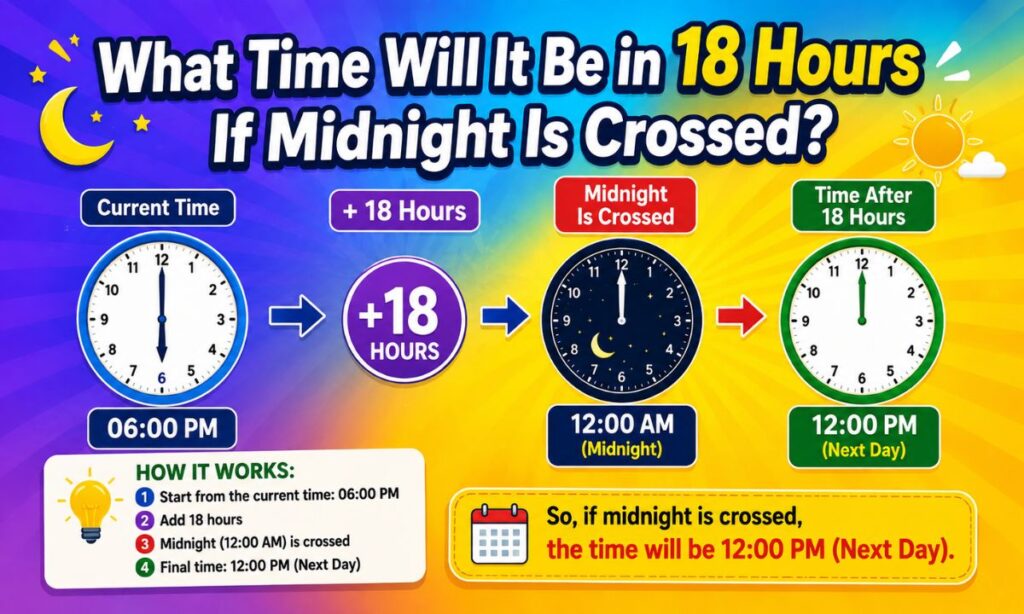
Midnight is where people usually trip up. Let’s fix that.
Say it’s 7:00 PM right now. Midnight is only 5 hours away, which leaves 13 hours still to add.
Add those 13 hours after midnight and you land on 1:00 PM the next day. Two calendar days, one simple math problem.
Midnight isn’t some magic wall. It’s just where one day politely hands the baton to the next.
What Time Is 18 Hours From Now Using the 24-Hour Clock?
The 24-hour clock (also called military time) skips the AM and PM confusion completely.
Say it’s 16:00 right now. Add 18 and you get 34. Since clocks reset after 24, subtract 24 from 34 and you get 10.
That means the answer is 10:00 the next day. This trick is sometimes called modulo 24 arithmetic, which sounds fancy but is really just clock math looping back around.
The Role of Modular Arithmetic in Time Calculation
Think of a clock as a circle, not a straight line. Once you go all the way around, you start back at the beginning.
Try this one. It’s 22:00 and you add 18 hours. That’s 40. Subtract 24 and you get 16:00 the next day.
This looping trick is called normalization. Fancy word, simple idea. You’re just keeping the number inside the 24 hour range where it belongs.
Common Examples of 18 Hours From Now
Sometimes a table clicks faster than a paragraph ever could.
• 6:00 AM becomes 12:00 AM (next day)
• 8:00 AM becomes 2:00 AM (next day)
• 10:00 AM becomes 4:00 AM (next day)
• 12:00 PM becomes 6:00 AM (next day)
• 3:00 PM becomes 9:00 AM (next day)
• 6:00 PM becomes 12:00 PM (next day)
• 9:00 PM becomes 3:00 PM (next day)
Bookmark this list. It saves you from doing math when you’re half asleep.
Using an Online Hours From Now Calculator
Not everyone wants to do mental gymnastics before coffee, and that’s fair.
An hours from now calculator does the heavy lifting instantly. Type in your time, hit enter, done.
These tools handle date rollover, leap years, and formatting without you lifting a finger. Sometimes convenience just wins, and there’s zero shame in that.
Why Date Rollover Matters
Here’s a mistake people make constantly. They nail the time but completely forget the date changed.
Say it’s June 15, 2026 at 9:00 PM. Add 18 hours and you land on June 16, 2026 at 3:00 PM.
Both the time and the date flipped. Miss that detail on a flight booking or a meeting invite, and you’ve got a real headache on your hands. Not a huge disaster, but definitely an awkward one.
What Time Is 18 Hours From Now in GMT+5?

Let’s run the numbers for GMT+5, since a lot of readers live in that zone.
Say it’s 8:00 AM GMT+5. Add 18 hours and you get 2:00 AM the next day, still in GMT+5.
The math stays exactly the same as long as you’re not hopping zones. The moment someone else joins from a different time zone, things get a little more interesting.
Time Zones and Future Time Calculations
Time zones are where future time math gets genuinely tricky.
You might be sitting in GMT+5 calculating 18 hours ahead, but your friend in UTC or Eastern Time sees a completely different local hour for that same moment.
This is exactly why global teams lean on scheduling software instead of doing it by hand. One wrong conversion and someone shows up to a meeting a full day off.
Real-Life Uses of 18-Hour Time Projection
This isn’t just a classroom math problem. People use future time projection constantly without even labeling it that way.
Travel Planning
Long layovers and overnight flights make this calculation essential. Knowing your exact arrival window keeps you from missing a connection.
Work Deadlines
“Submit within 18 hours” sounds simple until you actually have to pin down the exact date and time it’s due.
Sleep Schedules
Shift workers and new parents often count forward from bedtime to figure out exactly when a rest window ends.
Reminder Systems
Your phone’s calendar app runs this math behind the scenes every single time you set a reminder for “in 18 hours.”
Event Coordination
Global livestreams and online classes depend on accurate time math, or half the audience shows up on the wrong day entirely.
Human Perception of Waiting for 18 Hours
Funny thing about time. It doesn’t always feel like what the clock says.
Waiting on exam results or a job offer? Those 18 hours crawl by like molasses. But if you’re working, traveling, or hanging with friends, that same stretch disappears before you notice.
Psychologists call this time perception, and it’s wild how emotion warps something as fixed as a clock.
Future Timestamp Calculations
Computers don’t do AM and PM. They think in raw numbers called timestamps.
To get a future timestamp, you take the current one and add 64,800 seconds, which is the exact equivalent of 18 hours. Then it converts back into something readable for humans.
Every reminder app and scheduling tool on your phone is quietly running this exact math in the background, all day, every day.
Does Daylight Saving Time Change the 18 Hour Math?
Here’s something most articles on this topic skip completely, and it’s actually the trickiest part.
Daylight saving time can shift your 18 hour calculation by a full hour if the clock change happens to fall inside your window. Add 18 hours starting right before a “spring forward” or “fall back” moment, and your simple math can land an hour off from what a calendar app shows you.
This is exactly why scheduling apps pull data from time zone databases like IANA tz database instead of just doing flat addition. If your plans hinge on exact timing, always double check against a live calculator during DST transition weeks in March and November.
18 Hours From Now Compared To Other Time Gaps
Seeing 18 hours next to other common durations helps put it into perspective.
• 12 hours from now is basically the flip side of the clock, AM turns to PM or vice versa
• 24 hours from now lands you at the exact same time, just tomorrow
• 18 hours sits right in that in between zone, almost a full day but not quite
That “almost but not quite” gap is exactly why 18 hour math trips people up more than a clean 12 or 24 hour jump.
Common Mistakes When Adding 18 Hours
Same slip ups show up again and again. Here are seven worth watching for.
Forgetting the Next Day
People nail the hour but completely blank on updating the date.
Mixing AM and PM
A shockingly common one, especially late at night when your brain is running on fumes.
Ignoring Time Zones
A killer for remote teams juggling multiple time zones on one calendar invite.
Incorrect 24-Hour Conversion
Switching between military time and standard AM/PM trips up more people than you’d expect.
Skipping Midnight Logic
Crossing midnight without adjusting the date is one of the most repeated errors out there.
Forgetting Daylight Saving Shifts
As covered above, DST changes can quietly throw your math off by a full hour.
Trusting Mental Math for Big Decisions
Great for casual planning, risky for flights, medical doses, or contracts. Always double check those with a real tool.
Tools That Help Calculate Future Time
You’ve got options here, and none of them require a math degree.
• Hours from now calculators
• Date and time calculators
• Timestamp calculators
• Calendar apps with built in reminders
• Scheduling tools for global teams
These tools strip out the guesswork completely, especially once time zones or big number durations get involved.
Frequently Asked Questions
18 hours from now is what time?
Add 18 hours to your current local time. If it crosses midnight, the date moves forward too.
What is 18 hours from now?
It’s the exact future moment you land on after adding 18 hours to right now. People use it constantly for planning and deadlines.
What time is 18 hours from now?
Add 18 hours to your current time. A calculator gives you the instant answer without any manual math.
What time will it be 18 hours from now?
It depends on your current time and time zone. Cross midnight and the date shifts to the next day too.
Final Thoughts on What Time Is 18 Hours From Now
The question sounds tiny, but it touches flights, deadlines, sleep, and global meetings all at once.
The core idea never changes. Take your current time, add 18 hours, and watch for midnight and date rollover along the way.
Factor in time zones and daylight saving shifts, and you’ve basically got the full picture nailed down.
Eighteen hours is 1,080 minutes of real, upcoming life. That’s arrivals, deadlines, and plans quietly ticking closer while you go about your day.
Next time someone asks you this, you won’t just answer it. You’ll actually get why it matters.