
If it’s 1:30 PM right now, you’ve got 1 hour left.
If it’s 2:00 PM, you’re looking at 30 minutes.
If it’s 2:25 PM, just 5 minutes stand between you and 2:30.
And if the clock already says 2:35 PM, sorry, you missed it. Next stop is 2:30 PM tomorrow.
That’s the short answer.
Now let’s get into why this tiny question matters more than it looks like it should.
We’ve all stared at a clock waiting for something.
A meeting. A pickup time. A doctor’s visit. Even just your coffee break.
And somehow that last stretch of minutes always feels longer than it should.
This guide breaks down exactly how to figure out your time remaining, why your brain plays tricks on you while you wait, and which tools actually make the whole thing painless.
How Long Until 2:30 PM? Understanding the Basics
Here’s the deal.
Your answer always depends on one thing: your current time.
Everything else is just subtraction.
You take your current time, you take your target time (2:30 PM), and the gap between them is your time remaining.
People phrase this question a hundred different ways.
“How many minutes until 2:30?” “How many hours left?” “What’s the time difference?”
They’re all asking the exact same thing.
So here’s a quick cheat sheet you can glance at anytime.
| Current Time | Time Left Until 2:30 PM |
| 1:00 PM | 1 hour 30 minutes |
| 1:30 PM | 1 hour |
| 1:45 PM | 45 minutes |
| 2:00 PM | 30 minutes |
| 2:10 PM | 20 minutes |
| 2:20 PM | 10 minutes |
| 2:25 PM | 5 minutes |
| 2:29 PM | 1 minute |
| 2:30 PM | Time’s up |
| 2:45 PM | Passed by 15 minutes |
Bookmark that table.
It’s basically your answer key for the rest of the day.
ALSO READ THIS:https://measureaxis.com/300-pm/
How Long Until 2:30 PM Using Manual Time Calculation
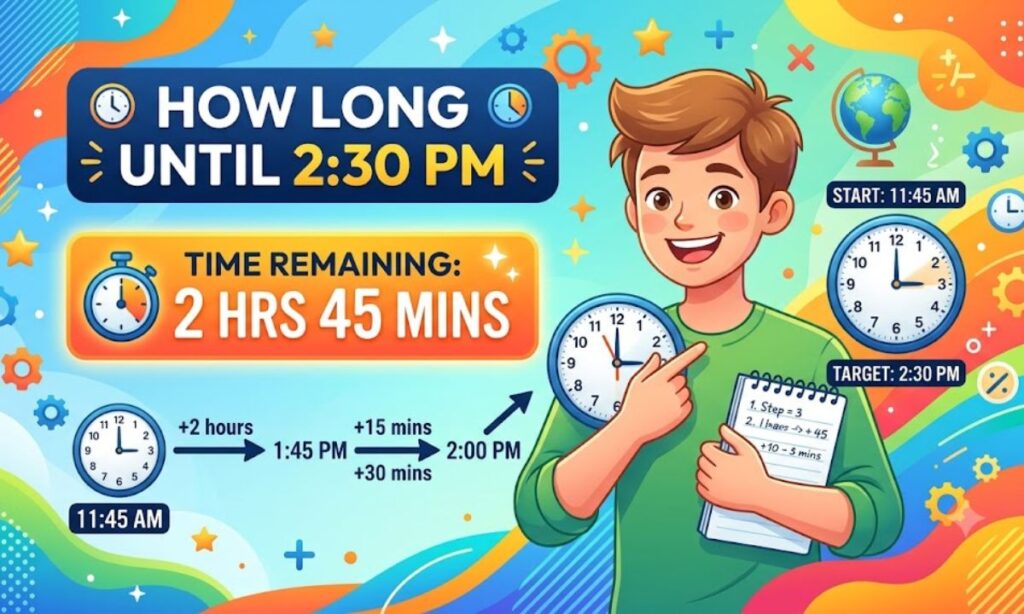
You don’t need an app for this.
Half the time, doing the math yourself is quicker than unlocking your phone.
Here’s the trick.
Break the gap into two easy chunks instead of one big scary one.
Say it’s 1:48 PM right now. Watch this:
From 1:48 PM to 2:00 PM is 12 minutes.
From 2:00 PM to 2:30 PM is another 30 minutes.
Add them up and you get 42 minutes total.
That’s it. That’s the whole trick.
Round to the nearest ten, split the hour, done.
This kind of manual time calculation isn’t just a party trick either.
It sharpens basic mental math, and honestly, it feels kind of satisfying when you get it right without a calculator.
Why People Search “How Long Until 2:30 PM”
Nobody wakes up thinking about 2:30 PM.
But by early afternoon, it somehow becomes the number stuck in your head.
Think about your own day for a second.
Maybe you’ve got a call at 2:30. Maybe it’s when your kid gets out of school. Maybe it’s just when your shift finally ends.
Here are the most common reasons people type this exact question into Google:
● Waiting on a team meeting or client call
● Counting down to a doctor appointment
● Getting ready for school pickup
● Prepping for a job interview
● Catching a flight and tracking boarding time
● Finishing up before a lunch break ends
● Studying before an exam starts
● Waiting on a performance review
See the pattern?
The clock doesn’t care what 2:30 PM means to you. But you sure do.
Best Tools to Check the Time Until 2:30 PM
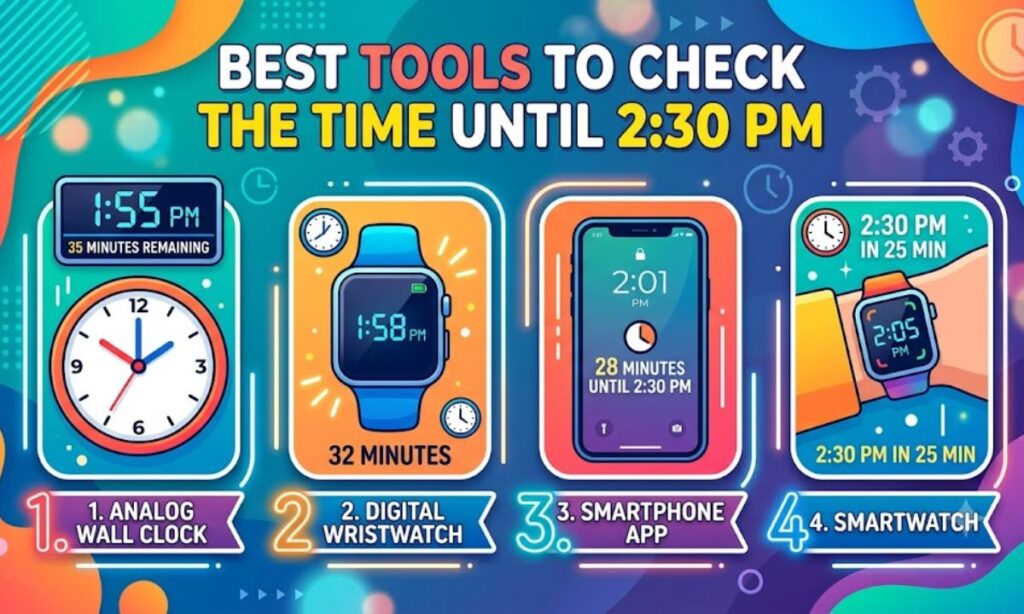
Technology basically ruined the need for mental math, in a good way.
There are tools now that do this instantly, down to the second.
Here’s what people actually use:
● Countdown timer apps on your phone
● A digital clock widget on your desktop
● Calendar reminders that ping you ahead of time
● Your smartphone clock app, which usually has a built in timer
● Smartwatch alerts that buzz your wrist
● Browser extensions that show a live countdown in your tab
● Smart assistant devices like Alexa or Google Home
● Simple online countdown timers you can Google right now
Most of these auto adjust for your local timezone, so you’re not doing extra math on top of your math.
Pair a calendar reminder with a countdown clock and you basically never miss anything again.
How Long Until 2:30 PM and Better Time Management
Knowing exactly how much time you’ve got left isn’t just trivia.
It’s genuinely useful for planning your next move.
Say it’s 1:45 PM and your meeting is at 2:30.
You now know, for a fact, you’ve got 45 clean minutes.
That’s enough time to:
● Reply to a few emails
● Skim your notes one more time
● Grab a snack before you’re stuck in a room for an hour
● Tidy up your desk so your camera background doesn’t embarrass you
● Knock out one small task off your list
This is basically the whole idea behind time blocking.
When you can see the deadline clearly, procrastination gets a lot harder to justify.
Funny enough, tight windows often make people work faster than wide open ones.
Give someone two hours and they’ll stretch a task to fill it. Give them twenty minutes and suddenly they’re focused.
How Long Until 2:30 PM in Your Daily Routine
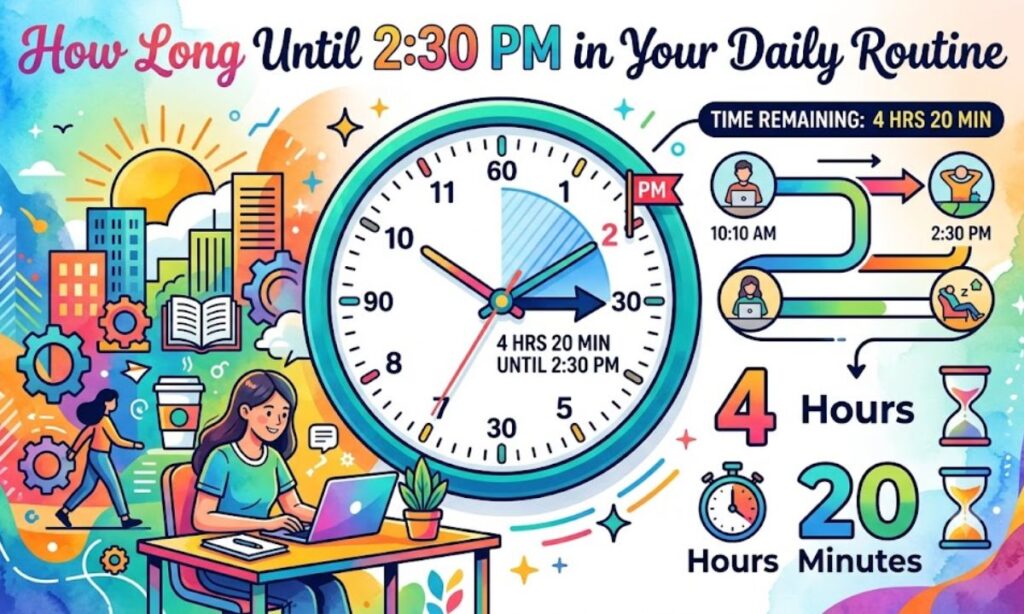
For a lot of people, 2:30 PM quietly becomes the hinge point of the day.
It’s not the start, it’s not the end, but it’s where things shift.
Maybe it’s when your energy dips after lunch.
Maybe it’s your cue to switch from deep work to meetings.
Either way, it sneaks into your daily routine more than you’d think.
A few real examples of what 2:30 PM means to different people:
● An employee wrapping up before a status update with their manager
● A student switching from lunch to afternoon classes
● A parent leaving the house in time for school pickup
● A freelancer starting their last focused work block of the day
● A traveler double checking their flight boarding window
The clock time is identical for everyone.
What it represents is completely different depending on whose day you’re looking at.
The Psychology of Waiting
Here’s something wild.
Ten minutes watching a good show flies by. Ten minutes waiting for test results crawls.
Same clock. Same ten minutes. Totally different experience.
That’s time perception messing with you, and it’s a real, studied thing in psychology.
Psychologist William James wrote about this back in the 1890s, noting that our sense of time speeds up or slows down based on how much is happening and how emotionally invested we are in the moment.
More recent researchers studying time perception have found that anxiety and anticipation are two of the biggest culprits behind the clock is moving in slow motion feeling.
So when you’re nervously refreshing the clock before a 2:30 PM interview, that’s not just in your head.
Your brain is genuinely processing those minutes differently because you care about the outcome.
One fix that actually helps? Set a visible countdown once, then stop checking.
Constantly glancing at the time makes the wait feel longer, not shorter.
Productivity Tips While Waiting Until 2:30 PM
Waiting doesn’t have to mean wasted time.
Even a short window can get real work done if you use it right.
Try this if you’ve got an hour to kill before 2:30:
● Knock out one small task you’ve been putting off
● Read a few pages of something you actually enjoy
● Do a five minute stretch or walk around the block
● Prep whatever you need for your next meeting
● Clear out old emails sitting in your inbox
● Jot down tomorrow’s to do list while it’s fresh in your head
This fits neatly into a method called time blocking, where you assign specific chunks of your day to specific tasks instead of just winging it.
Even fifteen minutes, used on purpose, adds up more than you’d expect over a week.
The goal isn’t to fill every second.
It’s to stop wasting the ones you’ve already got.
Countdown Tools That Make Life Easier
Let’s go a little deeper on the actual tools, since this is where most people land looking for a fix.
You’ve got two broad categories here.
Ones you check manually, and ones that ping you automatically.
Manual check tools:
● Your phone’s built in clock app
● A browser countdown widget pinned to your tab bar
● A simple online time until calculator
Automatic alert tools:
● Calendar reminders synced across your devices
● Smart assistant voice alerts
● Smartwatch vibration alerts
● Desktop notification timers
If you’re someone who forgets things easily, lean automatic.
If you like being in control and checking on your own terms, manual works just fine too.
Manual vs. Automatic Time Calculators
There’s no wrong answer here, honestly.
It really just comes down to how your brain likes to work.
A time calculator or time difference calculator gives you instant, exact results.
No guessing, no rounding, especially handy when seconds actually matter, like a live broadcast countdown.
Doing it manually, though, keeps your brain a little sharper.
It’s the same reason some people still do math without a calculator, just to stay in practice.
Here’s a quick side by side so you can pick your lane:
| Method | Best For | Downside |
| Manual calculation | Quick mental math, no phone needed | Easy to miscount if rushed |
| Countdown timer app | Set it and forget it | Needs your phone or device on hand |
| Calendar reminder | Recurring meetings and appointments | Requires setup ahead of time |
| Online time calculator | Precise, second by second accuracy | Needs internet access |
Pick whichever fits your day.
Some people even mix two, a calendar reminder for the heads up and a manual glance for the final countdown.
Real Life Examples
Let’s make this practical with a few everyday scenarios.
Scenario one.
It’s 1:30 PM and you’ve got a client call at 2:30. You’ve got a full hour, enough time for one solid focused work session before you switch gears.
Scenario two.
It’s 2:10 PM and your dentist appointment is at 2:30. Twenty minutes left, just enough to finish your coffee and head out the door without rushing.
Scenario three.
It’s 2:29 PM and your presentation starts at 2:30. One minute. Do not, under any circumstances, start a new task right now.
Small scenarios like these are exactly why this question gets searched so often.
It’s never really about the number. It’s about what’s riding on it.
Frequently Asked Questions
How long until 2:30 PM today?
Subtract your current time from 2:30 PM. If it’s 1:00 PM right now, you’ve got 1 hour and 30 minutes left.
How many minutes until 2:30 PM?
Convert the hours into minutes and add whatever’s left over. A countdown timer or online calculator does this instantly if you’d rather skip the math.
How many hours until 2:30 PM?
Just compare your current time to 2:30 PM directly. From 12:30 PM, for example, that’s exactly two hours.
What’s the best countdown timer to use?
Depends on your habits. Phone clock apps work great for quick checks, while calendar reminders are better if you tend to forget things entirely.
Why does waiting sometimes feel so much longer than it actually is?
Because your emotions mess with your sense of time. Anxiety, excitement, and boredom all speed up or slow down how minutes feel, even though the clock never changes.
Final Thoughts
“How long until 2:30 PM” seems like a tiny, throwaway question.
But it’s really just a stand in for something bigger, how you plan your day and manage the time you’ve actually got.
Whether you’re prepping for a meeting, watching the clock before an appointment, or just counting down to your next break, knowing your exact time remaining keeps you one step ahead instead of scrambling.
Set a reminder, do the quick math, or just glance at a countdown timer.
However you get there, every minute between now and 2:30 PM is yours to use well.
Got a 2:30 PM deadline of your own today? Drop it in the comments, I’m curious what’s got everyone watching the clock this time.