
Thirty feet equals 9.14 meters, or 360 inches, and it is roughly the length of a small yacht or the width of a two lane street.
That is the short answer. But numbers on a page do not really tell your brain anything. You need to see it, walk it, or stand next to it before it clicks.
This guide gives you real, honest comparisons for how long is 30 feet, so you can picture it the moment you read it. No made up facts. Just simple, true examples you can check for yourself.
How Long Is 30 Feet?
Thirty feet is the same as 10 yards, 360 inches, or 9.14 meters. It is a distance most people cover in about 12 normal walking steps.
Think of it as roughly two parked cars lined up bumper to bumper, plus a bit extra. That mental picture sticks a lot better than a number.
Builders, drivers, and homeowners run into 30 feet all the time, whether it is measuring a fence line or checking if a trailer will fit in the driveway.
Conversion Table
| Unit | Value |
| Feet | 30 ft |
| Inches | 360 in |
| Centimeters | 914.4 cm |
| Meters | 9.14 m |
| Yards | 10 yd |
| Millimeters | 9,144 mm |
Feet and inches are the go to units in the US. Most of the rest of the world sticks with meters, and engineers reach for millimeters when precision really matters.
What Does 30 Feet Look Like?
Picture standing at one end of a small backyard pool and looking to the other end. That gap is close to 30 feet.
Another easy way to picture it is a residential street. Stand on one curb and look across to the other side. That crossing distance is a solid real world stand in for 30 feet.
It is long enough that you notice the walk, but short enough that it never feels like a hike. That balance is exactly why this measurement shows up so often in everyday life.
also read:8 Common Things That Are 21 Inches Long
11 Things That Are Exactly 30 Feet Long
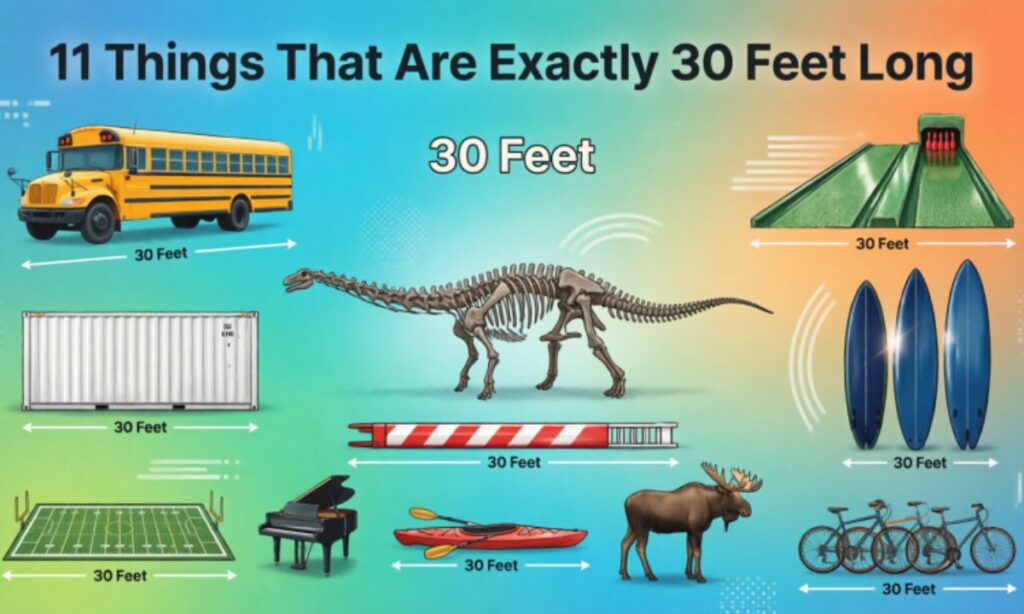
Some of these are spot on measurements. A few others land close to 30 feet rather than dead on, and we will say so honestly instead of stretching the truth to make a neat list.
Each one gives you a different way to feel the distance, whether you are indoors, outdoors, on the road, or near the water.
1. NBA Basketball Court Width
An NBA court is 50 feet wide, but the free throw line to half court stretch measures around 28 feet, just a hair under 30.
Players run that gap on nearly every possession, so if you have ever watched a fast break, you have already seen this distance in motion.
Stand at the free throw line in any gym and look toward center court. That is your 30 foot reference, built right into the game.
2. Bowling Lane Approach + Foul Line Area
The approach zone before the foul line in bowling is 15 feet long. Add the run up space many bowlers use behind the starting mark, and you land close to 30 feet total.
This is not a single official number, but it is a realistic distance you can walk off at any bowling alley.
Next time you are there, count your steps from the back wall to the foul line. It is a fun way to feel the measurement while waiting for your turn.
3. Semi Trailer Loading Dock Clearance Zone
Loading docks need serious room for trucks to back in safely. Many facilities design their clearance zones at around 30 feet, giving drivers space to maneuver without clipping anything.
This is common in warehouses and shipping centers, though the exact number can shift based on the site and the truck size.
Stand near one of these zones and the scale becomes obvious fast. It is built for machines, not people, so it feels wide open.
4. Standard Residential Street Width
Most residential streets fall somewhere between 26 and 32 feet curb to curb, with 30 feet being a very common middle ground in city planning codes.
You cross this distance every time you walk from one side of your street to the other.
It is one of the easiest comparisons on this list because almost everyone has a street like this nearby. Go outside and check your own block.
5. Young Blue Whale Length
Blue whale calves are born at about 23 to 26 feet long, but thanks to a wild growth rate of roughly 200 pounds a day, a young calf can reach close to 30 feet within its first couple of months.
That is one of the fastest growth rates of any animal on the planet, which is honestly wild to think about.
Picture something the length of a city bus, only it is a baby whale still nursing. That image alone makes 30 feet feel enormous.
6. Construction Scaffold Span
Scaffold frames are built in modular sections, and a common setup uses six frames at 5 feet each, adding up to a 30 foot span.
You will spot these running along the side of buildings under construction in almost every city.
Standing near one, the horizontal stretch is obvious. It gives workers a long, steady platform without needing extra support in the middle.
7. Pedestrian Bridge Section
Prefabricated pedestrian bridges are often manufactured in set lengths, and 30 foot sections are a common size for parks, trails, and small creek crossings.
These bridges get shipped in one piece and dropped into place, which keeps installation quick and cheap.
Walking across one gives you a short, noticeable journey. You can literally feel the distance under your feet with every step.
8. Tennis Court Singles Width
A tennis singles court is 27 feet wide, just a few feet short of 30, but close enough to give you a strong visual reference.
Stand on one sideline and look across to the other. That width is used in every professional and recreational match played on that court.
It is a great comparison because tennis courts are everywhere, from parks to backyard setups, so you have probably stood on one already.
9. Utility Pole to House Service Span
The short cable run from a utility pole to a nearby home, called a service drop, is often around 30 feet depending on how far the house sits from the street.
This connection is easy to overlook, but it is one of the most common real world examples of this exact distance.
Next time you are outside, follow the line from the pole to your roof. There is a decent chance it lands close to 30 feet.
10. Small Yacht Class Length
Recreational boat builders commonly produce yachts in the 30 foot class, a popular size for coastal cruising and weekend trips.
These boats are big enough for a cabin and small kitchen, but still manageable for a couple of people to handle without a large crew.
Standing next to one at a marina, the length feels sleek and longer than expected, especially once you see it floating on open water.
11. Mobile Home Transport Section
Manufactured homes are often shipped in halves, and each transport section frequently measures close to 30 feet long due to road length limits for hauling.
Truckers move these sections along highways before the two halves get joined at the final site.
Seeing one on the road is a strong reminder of the scale. It looks like a stretched out room rolling down the highway.
How Big Is 30 Feet?
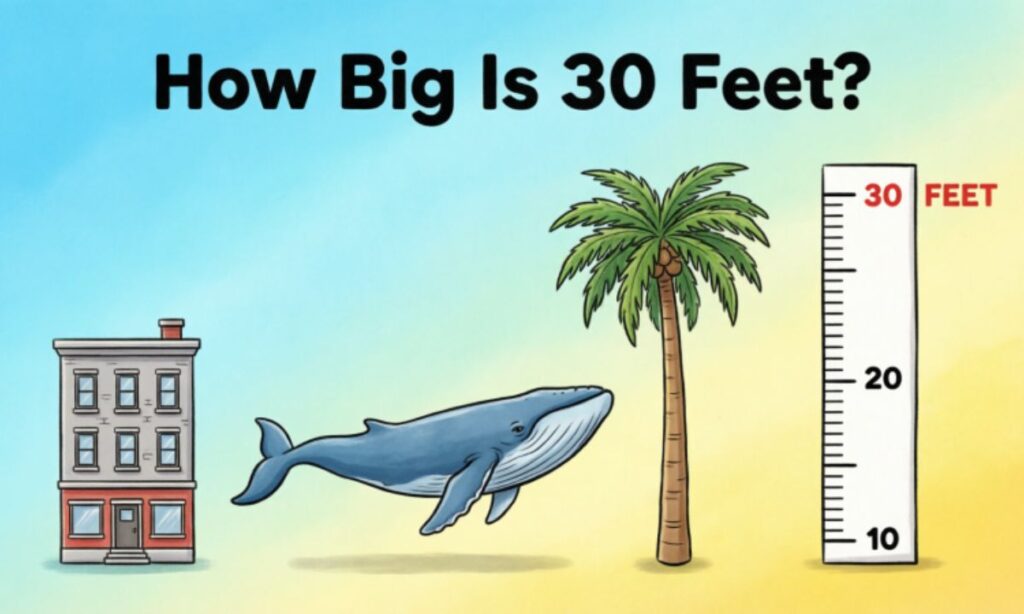
Indoors, 30 feet feels massive. It can stretch across two or three rooms in an average home, which is why it rarely shows up as a single indoor measurement.
Outdoors, it feels far more natural. A yard, a driveway, or a short walk down the sidewalk brings this distance down to something manageable and easy to picture.
Context really does change everything here. The same 30 feet can feel huge inside and completely normal outside.
How Tall Is 30 Feet?
Vertically, 30 feet is roughly equal to a three story building. That is enough height to make most people pause and look up.
Ladders, scaffolding, and small cranes commonly work in this height range, especially on residential construction jobs.
Looking straight up at something 30 feet tall hits differently than looking across the same distance on the ground. Height always feels bigger than length.
How Far Is 30 Feet?
Walking 30 feet takes about 12 steps for the average adult, using a normal stride of roughly 2.5 feet per step.
At a typical walking pace of 3 miles per hour, covering that distance takes around 5 to 6 seconds.
It is quick enough that you barely think about it, yet noticeable enough that you feel the movement in your legs and the change in your surroundings.
30 Feet Comparison Table
| Comparison | Real World Example |
| 30 ft vs 25 ft | Extra 5 feet is close to the length of a standard sofa |
| 30 ft vs 35 ft | 35 ft adds roughly the length of a small car hood |
| 30 ft vs 60 ft | 60 ft is about two of these lengths placed end to end |
How to Measure 30 Feet Without a Tape Measure
You do not always need fancy tools to get a solid estimate. A few simple tricks using your body or your surroundings can get you close enough for everyday purposes.
Method 1: Using Your Steps
An average adult step covers about 2.5 feet. Walk in a straight line and count 12 steps, keeping your stride natural instead of stretching it out.
This method works great outdoors on driveways, yards, or sidewalks where you have room to walk freely.
Method 2: Using Floor Tiles
Most garage and patio tiles measure 1 foot wide. Count 30 tiles in a straight row, sticking to one direction instead of cutting diagonally.
This trick is especially handy indoors, where pacing off steps is not always practical.
Method 3: Using Your Body
Your arm span is roughly equal to your height. If you are 6 feet tall, five arm spans laid end to end will get you close to 30 feet.
Mark each span with a finger or a small object on the ground so you do not lose count halfway through.
Common Mistakes When Estimating 30 Feet
People often misjudge this distance because it sits in an awkward middle zone. It is too long to eyeball accurately, but too short to feel truly massive.
Here are a few slip ups worth watching for:
- Rushing your steps, which shortens your stride and throws off the count
- Measuring diagonally instead of in a straight line
- Assuming every standard object matches the exact size mentioned online, when real world sizes often vary
Taking a few extra seconds to measure carefully saves you from bigger mistakes later, especially on projects involving fences, driveways, or furniture.
FAQs
1. How long is 30 feet in meters?
Thirty feet equals 9.14 meters, a conversion commonly used in construction, design, and everyday measuring.
2. How many steps is 30 feet?
It takes about 12 steps for the average adult, with each step covering roughly 2.5 feet.
3. How tall is 30 feet compared to a house?
Thirty feet is close to the height of a three story building, taller than most single family homes.
4. Is 30 feet bigger than a school bus?
Not quite. Most school buses run between 35 and 45 feet long, so a 30 foot bus would be on the shorter end.
5. How long does it take to walk 30 feet?
About 5 to 6 seconds at a normal walking pace of 3 miles per hour.
Conclusion
Thirty feet is one of those distances that feels small on paper but grows the moment you actually measure it out. A short street crossing, a young whale calf, or a small yacht all bring the same number to life in totally different ways.
Once you connect a measurement to something you have actually seen, it sticks for good. Save this page next time you need a quick, honest reference for how long is 30 feet.