
You are standing in front of a vending machine.
You wonder if that tall skinny can is the same size as a normal one.
Or maybe you are packing a cooler and trying to figure out how many cans will actually fit.
This guide answers all of it. Every coke can size, every can dimension, no boring detours.
History of Coke
Coca Cola started in 1886 in Atlanta, Georgia.
A pharmacist named John Pemberton mixed up a syrup and sold it as a headache cure for five cents a glass.
The can we know today did not show up until the mid 1950s, when Coca Cola first started using aluminum cans for its drinks.
Before that, soda came in glass bottles, and canned beer had already been around since the 1930s using steel.
Once aluminum took over, the whole game changed because it was lighter, cheaper to ship, and easier to shape into the exact standard can size we drink from today.
The Standard 12 oz Coke Can
Here is the one everyone knows by heart, the 12 oz coke can.
Grab a ruler and check it yourself, the numbers below are what you will find.
• Height: 4.83 inches or 122.2 mm
• Body diameter: 2.6 inches or 66.1 mm
• Lid diameter: 2.125 inches or 54 mm
• Wall thickness: about 0.0033 inches or 0.08 mm
• Empty weight: about 14.9 grams
• Full weight: about 375 grams
That lid being smaller than the body is not random. It is called necking, where machines squeeze the top inward in stages to save aluminum.
Multiply that tiny savings across billions of cans a year and you get real money saved.
A sealed, unopened can at room temperature holds around 45 to 50 psi of pressure inside, and that number climbs if the can gets warm or shaken.
That pressure is exactly why the walls can be so thin without the can collapsing.
Every Coke Can Size, Measured
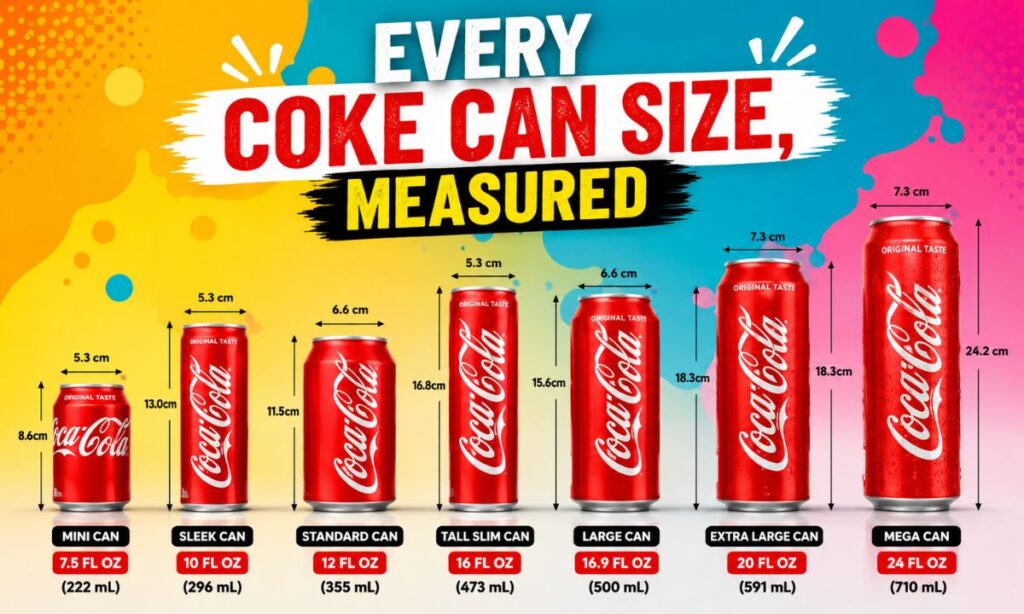
Coke does not just come in one size, not even close.
Here is a full breakdown of the coke can sizes you will actually run into.
• Mini 7.5 oz: height 3.48 inches, diameter 2.34 inches, volume 222 ml, mostly sold in the USA
• 8 oz can: height 3.69 inches, diameter 2.6 inches, volume 237 ml, a specialty US size
• Standard 12 oz: height 4.83 inches, diameter 2.6 inches, volume 355 ml, sold worldwide
• Slim 12 oz: height 6.13 inches, diameter 2.25 inches, volume 355 ml, popular in US and Europe
• Tallboy 16 oz: height 6.19 inches, diameter 2.6 inches, volume 473 ml, mostly US
• 24 oz can: height 8.68 inches, diameter 2.6 inches, volume 710 ml, mostly US
Notice something fun, the slim can and standard can hold the exact same amount of soda.
The only thing that changed is the shape, and that is a marketing trick as much as an engineering one.
ALSO READ:15+ Things That Are 100 Feet (ft) Long
Anatomy of a Coke Can, More Than Just a Cylinder
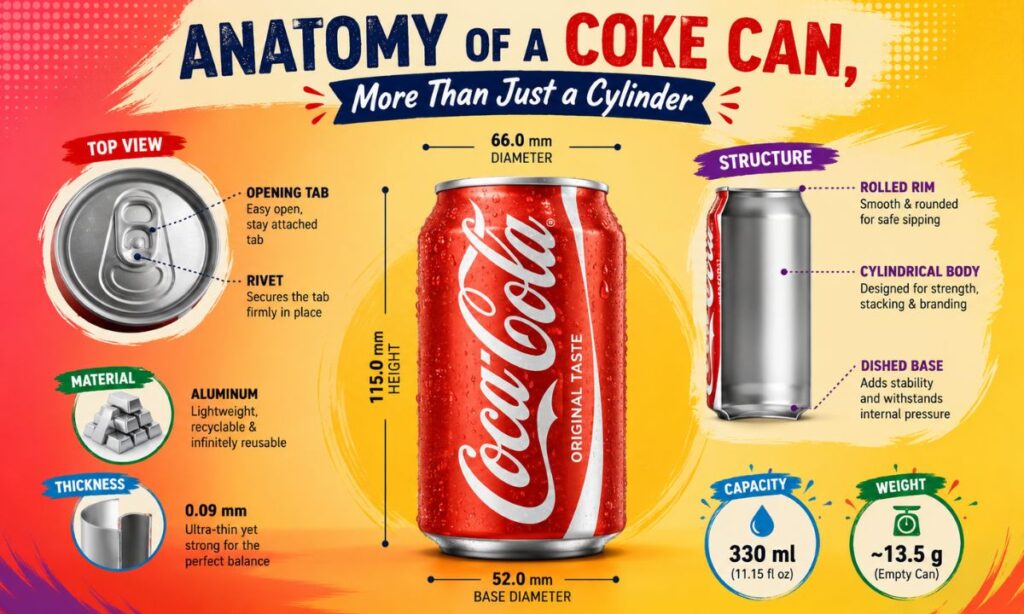
Most people think a can is just a metal tube, but there is more going on than that.
The can body is one solid piece of aluminum, drawn and stretched into shape from a flat disc.
The neck is the narrow part near the top, shaped by the necking press mentioned earlier.
The lid, called the end in the industry, is a separate piece sealed onto the body using a double seam, which locks everything together and keeps it airtight.
The dome bottom curves inward instead of sitting flat, which spreads out the pressure evenly so the can does not bulge or tip over.
And the pull tab on top is scored so it pops open cleanly, usually measuring about 1.3 inches long.
Coke Can Dimensions by Country
Not every country drinks from the same size can, and that surprises a lot of people.
• United States: 12 oz or 355 ml, height 4.83 inches, the most common size worldwide
• United Kingdom and Europe: 330 ml, height about 4.65 inches, noticeably shorter than the US can
• Australia: 375 ml, height about 4.96 inches, taller than the UK version
• Japan: 350 ml, height about 4.8 inches, very close to the US standard
• South America: 350 ml, height about 4.8 inches, though it varies a bit by country
That gap between the US can and the UK can is not your imagination.
The UK can really is smaller, and that difference comes down to cost savings on both aluminum and liquid.
Slim & Sleek Cans, Same Drink, Different Shape
Slim cans are everywhere lately, especially with Diet Coke and premium Coke lines at restaurants.
Same 355 ml of soda as a regular can, just taller and skinnier looking.
• Standard 12 oz: height 4.83 inches, diameter 2.6 inches, classic look
• Slim 12 oz: height 6.13 inches, diameter 2.25 inches, modern premium look
That slim shape is not about fitting more soda in, it is pure packaging psychology.
A taller thinner can just feels more upscale in your hand, even though you are drinking the exact same drink.
The Engineering Behind the Precision
Making a can sounds simple until you learn how tight the tolerances really are.
The wall of a Coke can is roughly 0.003 to 0.004 inches thick, thinner than most credit cards.
That thin wall still has to survive up to 90 psi of pressure if the can gets shaken or heated, which is why a flat bottom would be a disaster and the dome shape is required.
The necking process happens in several small steps, not one squeeze, because doing it all at once would crack the metal.
The lid size, known in the industry as the 202 end, became a standard specifically to cut down on aluminum while keeping the seal tight.
And here is a wild fact, a Coke can from the 1970s weighed about 21 grams empty, while today’s can weighs under 15 grams, all without losing any strength.
Coke Can vs Other Beverage Cans
How does the Coke can stack up against its rivals on the shelf.
• Coke 12 oz: height 4.83 inches, diameter 2.6 inches, volume 355 ml
• Pepsi 12 oz: height 4.83 inches, diameter 2.6 inches, volume 355 ml
• Red Bull 8.4 oz: height 5.1 inches, diameter 2.06 inches, volume 250 ml
• Budweiser 12 oz: height 4.83 inches, diameter 2.6 inches, volume 355 ml
• Coke Tallboy 16 oz: height 6.19 inches, diameter 2.6 inches, volume 473 ml
Turns out most 12 oz cans, no matter the brand, share the exact same can dimensions.
That is because can manufacturers build shared industry molds, so the cans fit the same vending slots and shelves no matter whose logo is on the front.
How Coke Can Dimensions Changed Over Time

The can in your hand today looks nothing like the one your grandparents drank from.
• 1930s: Steel cans arrive for beer, opened with a tool called a church key
• Mid 1950s: Coca Cola begins using cans for soda, following the aluminum shift already happening in the beverage world
• 1960s: The pull tab is invented, so nobody needs that church key tool anymore
• 1980s: The stay on tab replaces the pull tab, which cuts down on litter since the tab no longer separates
• 1990s onward: Wall thickness keeps shrinking as metal quality improves
• 2009: Coca Cola launches the mini 7.5 oz can in the US
• 2012 to now: Slim and sleek cans spread worldwide for premium product lines
The quiet hero in all this is called lightweighting.
Nobody talks about it much, but today’s cans use way less metal than the originals while holding just as strong.
Sustainability and Recycling of Coke Cans
This part barely gets talked about, but it matters a lot.
Aluminum cans are one of the most recycled containers on the planet, and a can you toss in the bin today can be back on a store shelf in about 60 days.
Compare that to plastic, which often takes decades to break down or never fully recycles at all, and you start to see why aluminum wins on the environmental side.
Every ounce of metal that gets shaved off a can through lightweighting also means less energy used to make and ship it, which adds up across billions of cans a year.
What It Costs to Make a Can
People rarely think about the actual cost behind that shiny can in your hand.
Raw aluminum, forming, printing, and sealing all add up, but because cans are made by the billions, the cost per can stays surprisingly low, often just a few cents worth of metal per unit.
That low cost is exactly why lightweighting matters so much to manufacturers, since shaving off even half a gram per can saves serious money at that kind of scale.
Practical Uses for Knowing Coke Can Measurements
Knowing these numbers is not just trivia, people actually use them.
• Crafting and DIY: speaker builds using stacked cans, pendant lamps cut from can bodies, planters, pen holders, and wall art
• Storage and shipping: a normal fridge shelf holds about 8 to 10 cans standing up, a 24 pack case measures roughly 19 by 5 by 5 inches, and a standard pallet holds close to 7,000 cans
• Design and tech work: CAD modeling reference since everyone already knows the size, photography scale reference, and vending machine slot calibration since machine slots are built around this exact can width
Fun Facts You Probably Did Not Know
Coca Cola pours out roughly 2 billion servings every single day around the world.
Aluminum cans are fully recyclable and can return to store shelves within about 60 days of being tossed in a bin.
A Coke can survives close to 90 psi of pressure under stress, yet its wall is thinner than a fingernail, which is genuinely wild when you think about it.
Frequently Asked Questions
Is a Coke can the same size as a beer can?
Yes, a standard 12 oz beer can shares the same basic can dimensions as a Coke can.
What does the 202 end size mean?
It is an industry code for the lid diameter, meaning 2 and 2 sixteenths of an inch across.
How many Coke cans fit on a fridge shelf?
Usually 8 to 10 standing up, or up to 14 if you lay them on their sides.
Why is the UK smaller than the US can?
It comes down to cost, a smaller can uses less aluminum and less liquid per unit.
Are slim cans and standard cans really the same volume?
Yes, both hold 355 ml, the shape is just different for looks.
Conclusion
A Coke can looks simple, but every single measurement on it exists for a reason.
From the dome bottom to the necked top, from the mini 7.5 oz to the 24 oz giant, nothing on that can is an accident.
Next time you crack one open, you are holding decades of small tweaks and smart engineering in your hand.
So go ahead, guess the height before you check, most people are off by half an inch or more.