
You need something measured right now and there’s no ruler around.
It happens to everyone.
Maybe you’re eyeing a gap on your shelf, or maybe you’re just trying to picture how big 9 inches actually is without pulling out a tape measure.
Good news. Nine inches shows up all over your house already, in things you touch every single day.
A dinner plate, a pencil case, a hardcover book sitting on your nightstand. All roughly the same length as each other.
Once you learn a few of these 9 inch objects, you’ll never need to guess again.
Let’s get into it.
Quick Conversion
Here’s 9 inches broken down into every unit you might need, so you don’t have to do the math yourself.
9 inches equals 22.86 centimeters.
In millimeters, that’s 228.6 mm.
As a fraction of a foot, 9 inches is 0.75 feet, or three quarters of a foot.
In yards, it comes out to 0.25 yards, exactly one quarter.
And in meters, 9 inches is 0.2286 meters.
Keep this chart in your back pocket. It’s the fastest way to convert 9 inches to cm or any other unit without opening a calculator app.
Everyday Things That Are 9 Inches Long
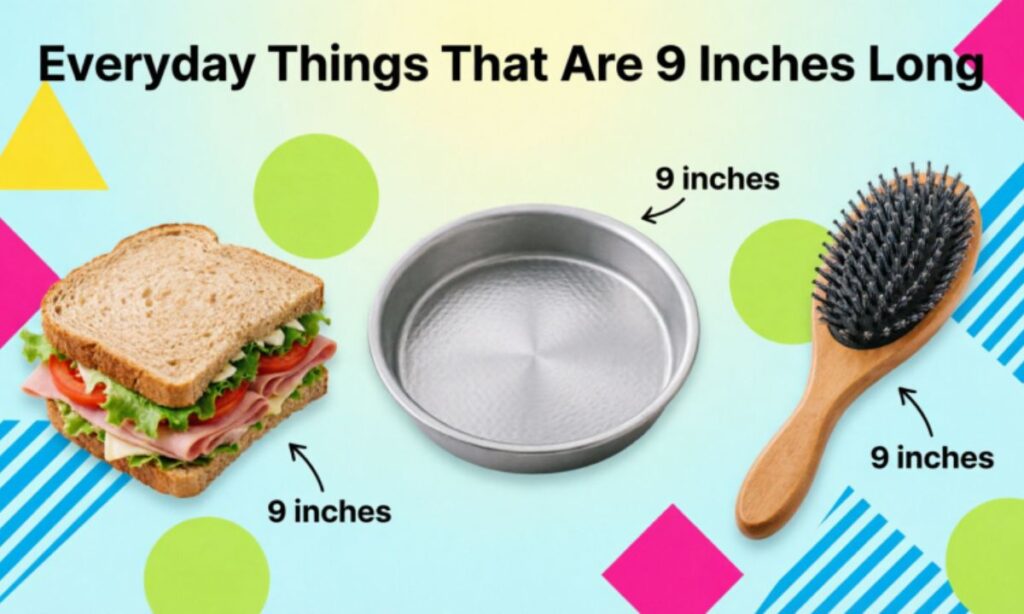
Below are eighteen ordinary objects that measure close to 9 inches, or exactly 9 inches, depending on the item.
Some are dead on. Some are close enough that your eye won’t tell the difference.
Either way, these are solid visual measurement tools you already own.
1. A Standard Pencil Case
Grab a basic zip up pencil pouch from any school bag.
Most of them measure close to 9 inches in length.
That’s not random. Pencils and pens usually run about 7.5 to 8 inches long, so the case needs a little extra room to zip shut comfortably.
Next time you’re packing a bag, you’re holding a 9 inch reference tool without even realizing it.
2. A Hardcover Novel
Pull any hardcover off your shelf and stand it upright.
A lot of hardcover books, especially the kind sold at big bookstores, land close to 9 inches tall.
This isn’t an accident. Publishers stick to certain trim sizes because bookshelves, shipping boxes, and store displays are all built around those measurements.
Sizes do shift a bit by publisher and genre, so treat this one as a solid estimate, not an exact ruler.
3. A Men’s Size 7 Shoe Insole
Here’s one that catches people off guard.
A US men’s size 7 shoe has an insole that runs close to 9 inches from heel to toe.
American shoe sizing actually traces back to an old system using barleycorns, where three barleycorns equaled one inch.
Every size up adds about a third of an inch, which is a fun bit of trivia for your next game night.
4. A Standard #10 Business Envelope
That plain envelope sitting in your office drawer is closer to 9 inches than you’d guess.
A #10 envelope actually measures 9.5 inches long and 4.125 inches wide.
Shave off half an inch in your head and you land almost exactly on 9 inches.
It’s one of the most overlooked household measurement objects, mostly because nobody thinks to measure their own mail.
5. A Standard Dinner Plate
Most dinner plates in American kitchens run somewhere between 9 and 11 inches across.
The classic 9 inch plate is usually the smaller, more traditional size in a dinnerware set.
Fun fact worth knowing, research on eating habits has shown plate size can actually change how big your portions look and feel.
So next time you’re trying to eat a little lighter, a smaller 9 inch dinner plate might genuinely help.
6. 9 Inch Paperback Book
Regular paperbacks usually sit around 6.75 inches tall.
But trade paperbacks, the slightly bigger ones used for literary fiction and nonfiction, run close to 9 inches tall.
Run your thumb down the spine of one and you’ll feel the difference right away compared to a pocket paperback.
It’s a handy book size comparison if you’re ever debating which format to buy.
7. A Small Loaf of Bread
A standard small sandwich loaf, the kind from your grocery store bakery aisle, usually measures close to 9 inches long.
Home bakers already know this trick. Most mini loaf pans are labeled 9×5 inches for exactly this reason.
Next time you’re making toast, you’re holding a 9 inch food reference in your own two hands.
It’s oddly satisfying once you notice it.
8. A Standard Spatula
Every kitchen drawer has one of these.
The flat, wide flipping spatula used for pancakes, burgers, and eggs typically runs between 8.5 and 9 inches, tip to handle.
Cooking needs a bit of reach over a hot pan, and 9 inches turns out to be the sweet spot most brands settled on.
Too short and your pancake folds. Too long and it’s clumsy. Nine inches just works.
9. 9 Inch Cake Pan
Ask any home baker and they’ll tell you.
The go to size for layer cakes, birthday cakes, and carrot cakes is a 9 inch round cake pan.
It’s practically the baking world’s version of a standard measurement.
If you’ve got two of these pans stacked in your cupboard, you already own a built in 9 inch measuring tool.
10. 9 Inch Small Tablet or E-Reader
Compact tablets and e-readers often land somewhere close to 9 inches when you measure the full device height, bezels included.
Screen size gets measured diagonally, so it’s easy to mix up with the overall height of the device.
That smaller form factor is built on purpose, since it needs to fit in one hand comfortably during a long reading session.
Hold one up next to a ruler sometime. You’ll be surprised how close it lands.
11. A School Ruler
This one is basically a cheat code.
Every standard 12 inch ruler already has the 9 inch mark printed right on it.
You don’t need the whole ruler, just look three quarters of the way down.
It’s the most accurate reference on this entire list, since it’s literally built for measuring.
12. One and a Half US Dollar Bills
Here’s a trick you can use almost anywhere cash gets used.
A single US dollar bill measures 6.14 inches long.
Lay one and a half bills end to end and you land around 9.2 inches, close enough for quick, casual estimating.
Every US bill is the same size no matter the value, so this works with ones, fives, or hundreds.
13. Three Baseballs Side by Side
A regulation MLB baseball measures between 2.86 and 2.94 inches across.
Line up three of them and you get somewhere between 8.58 and 8.82 inches, close enough to call it 9 inches for everyday purposes.
Sports gear makes a great measurement reference because official equipment has to follow strict size rules.
It’s also a fun visual if you’ve got a couple of baseballs lying around the garage.
14. Nine US Quarters
A US quarter measures exactly 0.955 inches across.
Line up nine of them and you get roughly 8.6 inches, close to our target length.
Coins are manufactured with tight precision, so this trick works every single time, whether the coins come from your car’s cupholder or a jar on your dresser.
It’s one of the easiest improvised measuring tools around, since almost everyone has spare change somewhere.
15. Three Sticky Notes
A classic Post it note measures 3 inches by 3 inches.
Line up three of them in a row and you get a perfect 9 inches, no rounding needed.
It’s genuinely the simplest math trick on this whole list.
Any color works the same, so grab whatever sticky notes you’ve got sitting on your desk.
16. 9 Inch Cutting Board
Smaller cutting boards, often labeled 9×12 inches, usually have a short side that measures exactly 9 inches.
These compact boards are built for quick jobs like slicing fruit or chopping herbs, not full meal prep.
They’re common in small kitchens and dorm rooms where counter space runs tight.
That 9 inch edge also happens to match up nicely with a standard salad plate, which makes transferring food a lot less messy.
17. A Face Towel or Hand Towel
Standard hand towels usually measure 16 by 28 inches when laid flat.
Fold one lengthwise into thirds and each section lands just over 9 inches wide.
It won’t be a perfectly exact measurement, but as a quick folded reference, it’s surprisingly close.
Try it with a cotton towel, a microfiber one, or even paper hand towels. The trick holds up either way.
18. Nine Paper Clips in a Row
A standard wire paper clip measures exactly 1 inch long.
Line up nine of them end to end and you land exactly on 9 inches, no rounding required.
Paper clips stay the same size no matter where you buy them, which makes this one of the most precise, budget friendly measuring tricks on the whole list.
Keep a box of these at your desk and you’ve basically got a backup ruler forever.
ALSO READ:Pringles Can Dimensions: Height, Diameter, and Size Guide
Why Knowing 9 Inches Without a Ruler Actually Matters

The best measuring tool is whatever’s already sitting in your hand.
Here’s where this actually comes in handy in real life.
Shopping for furniture online. You’re staring at a 9 inch gap between your wall and a radiator, wondering if a narrow shelf will fit. Picture a dinner plate. Instantly clearer.
Home projects around the house. Spacing out picture frames, measuring shelf gaps, or estimating clearance all get easier once you’ve got a real world length stuck in your head.
Cooking and baking. Knowing your cake pan is 9 inches means you can swap recipes and adjust ingredient amounts without guessing and ruining dessert.
Shipping a package. A lot of flat rate boxes are built around 9 inch limits, so knowing this before you get to the post office can save you a wasted trip.
Buying stuff for kids. Shoe sizes, tablet cases, school supplies, 9 inches comes up constantly once you start shopping for growing kids.
This kind of everyday knowledge is what people mean by practical measurement skills. It’s not about memorizing numbers, it’s about having a mental map you can actually use.
The 9 Inches Challenge
Ready for something fun?
Walk around your house right now and try to find three things that measure close to 9 inches, without touching a ruler.
Use only the objects from this list.
Maybe you grab your cake pan. Maybe you line up three sticky notes on your desk. Maybe you pull a trade paperback off the shelf and check the spine.
It’s weirdly addictive once you get started.
Share your results with a friend or family member and see who can spot the most 9 inch objects in under five minutes.
You will genuinely never look at your kitchen drawer the same way again.
Conclusion
Nine inches is hiding in plain sight, tucked into your kitchen drawer, your bookshelf, and even your wallet.
Once you know what to look for, you’ll never struggle to picture this length again.
Keep two or three of these references filed away in your head and you’re set for life, no ruler required.