
Quick answer: Most standard water bottles in the USA are 8 inches tall with a 2.5-inch diameter and hold 16.9 oz (500ml). Sizes range from tiny 8 oz bottles at 5.5 inches all the way up to 2-liter giants at 12.5 inches tall.
Ever grabbed a water bottle at the store and got home only to find it does not fit your car cup holder? Or stuffed one into your gym bag and it barely zipped shut? Yeah, we have all been there. Water bottle dimensions matter more than most people think, and getting them wrong is a mini disaster nobody talks about.
This guide breaks down every size, from the little 8 oz bottle your kid takes to school to the massive 2-liter jug you haul on a hiking trail. We cover height, diameter, cap size, weight, and even how to measure your own bottles at home. No fluff, just the real numbers you need.
Standard Water Bottle Dimensions and Sizes
Common Water Bottle Sizes in the USA
Americans reach for the 16.9 oz (500ml) bottle more than any other size. It fits almost every car cup holder, slips into most backpack side pockets, and weighs just about 1.1 pounds when full. That sweet spot between portable and practical is why manufacturers made it the default.
Beyond that fan favorite, you will find 12 oz, 20 oz, 32 oz, and 1-liter options filling store shelves. The 32 oz size has quietly become the gym crowd’s best friend over the last few years. Fitness folks love it because one fill in the morning cuts refill trips in half during a workout.
Think of reusable bottle choices the same way you think of shoe sizes. There is a size for every foot, and there is a bottle size for every lifestyle. Commuters lean toward 16.9 oz, outdoor enthusiasts grab 32 oz, and serious hikers pack 1.5 to 2 liters for all-day treks.
Bottle Size Specifications
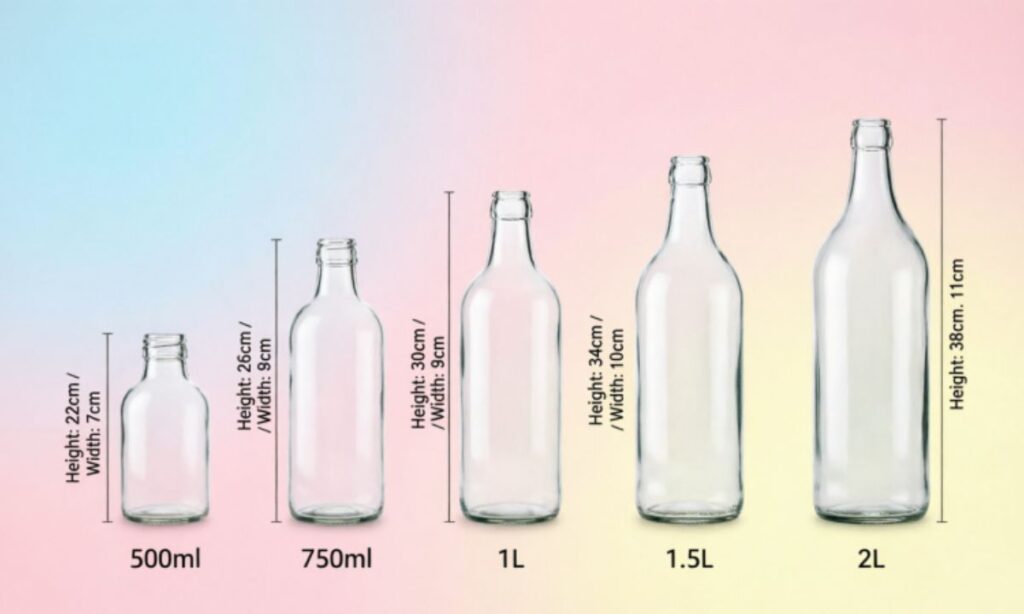
| Bottle Capacity | Height (in) | Diameter (in) | Height (cm) | Diameter (cm) | Cap Size | |
| 8 oz (237 ml) | 5.5 in | 2.25 in | 14 cm | 5.7 cm | 28 mm | |
| 12 oz (355 ml) | 7 in | 2.5 in | 17.8 cm | 6.4 cm | 28 mm | |
| 16.9 oz (500 ml) | 8 in | 2.5 in | 20.3 cm | 6.4 cm | 28 mm | |
| 20 oz (591 ml) | 8.9 in | 2.75 in | 22.6 cm | 7 cm | 28 mm | |
| 32 oz (946 ml) | 10.5 in | 3.25 in | 26.7 cm | 8.3 cm | 30 mm | |
| 1 Liter (33.8 oz) | 11 in | 3 in | 27.9 cm | 7.6 cm | 30 mm | |
| 1.5 Liter | 12.25 in | 3.5 in | 31.1 cm | 8.9 cm | 30 mm | |
| 2 Liter | 12.5 in | 4 in | 31.8 cm | 10.2 cm | 33 mm |
How Tall Are Different Bottles?
Small Water Bottle Height (8-12 oz)
Small water bottle dimensions sit between 5.5 and 7 inches tall. The 8 oz bottle at 5.5 inches fits perfectly in a child’s lunchbox without wobbling around.
The 12 oz version at 7 inches is the one parents pack for youth sports, short school trips, and snack time at the park. Kids can wrap their whole hand around the 2.25 to 2.5 inch bottle diameter without struggling.
These sizes also work great for portion control. If you are tracking your daily intake and want to sip slowly instead of chugging, a small bottle forces you to be intentional. Refilling three times a day with a 12 oz bottle gets you to 36 oz without even thinking about it.
Standard Water Bottle Height (16.9-20 oz)
The standard water bottle height of 8 inches became the industry benchmark for one simple reason: it fits a standard car cup holder perfectly. Designers at major brands literally measured cup holders first, then built the bottle around them.
The 20 oz bottle pushes that to 8.9 inches and a slightly wider 2.75-inch bottle diameter. It is still commuter-friendly and slips into most holders, but you might find it a tight squeeze in older car models with narrower holders.
Both sizes cover your hydration needs for about 2 to 3 hours of regular activity. Office workers, commuters, and students tend to stick to this range because it hits the perfect balance between not too heavy and not too small to be annoying.
Large Water Bottle Height (32 oz to 1 Liter)
Here is where things start getting serious. A 32 oz water bottle stands about 10.5 inches tall with a 3.25-inch diameter. A 1-liter bottle stretches to 11 inches with a 3-inch base.
These taller bottles do not fit most standard car cup holders. But they slide into backpack side pockets like they were born there. If your backpack has a mesh side pocket, these are the bottles it was designed for.
Gym-goers and runners love this range because one fill covers a solid workout session. You are not stopping mid-set to refill, and you are not lugging around a jug that makes your bag look like you are moving apartments.
Extra Large Water Bottle Height (1.5-2 Liters)
The 1.5-liter water bottle stands 12.25 inches tall with a 3.5-inch diameter, and the 2-liter version hits 12.5 inches with a chunky 4-inch base. These are not toss in your bag and go bottles.
They are built for situations where water access is limited. Long hikes, all-day outdoor festivals, construction work in summer heat. The extra large bottle dimensions mean you will need a dedicated large compartment in your pack.
Some come with shoulder straps or carry handles because when full, the 2-liter model weighs close to 4.5 pounds. That is like carrying two bags of sugar on your shoulder.
ALSO READ:20 Everyday Items That Are 7 Inches Long
Water Bottle Length and Diameter Measurements
Slim vs. Wide Profile Bottles
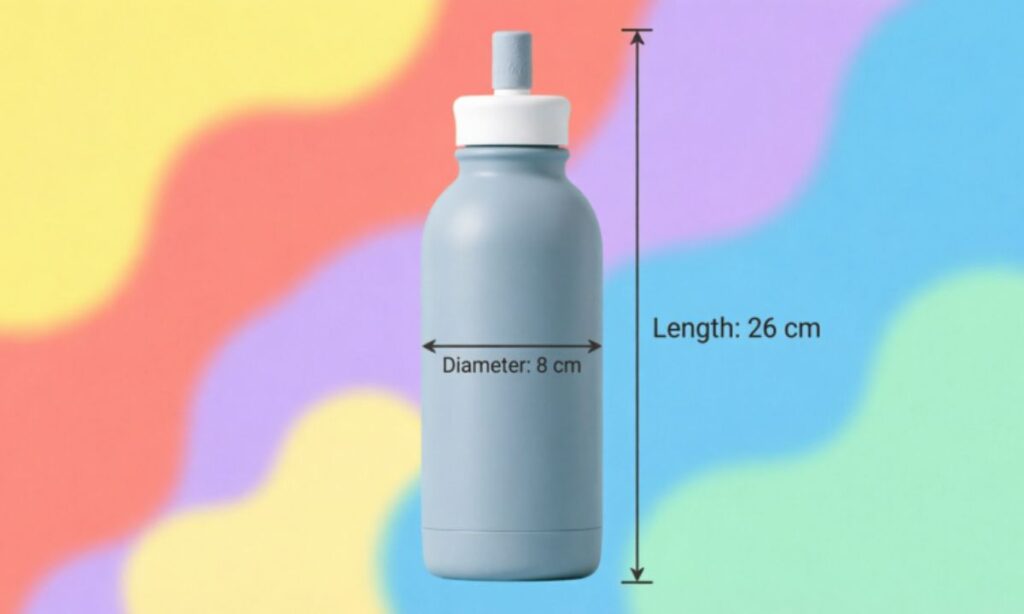
Slim profile bottles measure 2.25 to 2.5 inches in diameter. These are the ones that slide into bike cages, fit snugly in car holders, and feel natural to grip during a run. Brands like CamelBak and Nalgene offer slim versions specifically for cyclists and runners for this reason.
Wide profile bottles push the diameter to 3.5 to 4 inches. They are sturdier, tip less easily on a desk, and often have better insulation because there is more wall space for double-walled construction.
Think of it this way: a slim bottle is your city apartment, compact and efficient. A wide bottle is the suburban house, more room but you need more space to park it.
Bottle Opening and Cap Dimensions
Standard bottle caps come in three sizes: 28mm, 30mm, and 33mm. Smaller bottles under 20 oz almost always use the 28mm cap. Bottles at 1 liter and above switch to 30mm or 33mm for easier filling.
Wide-mouth openings on popular bottles like Hydro Flask and Stanley measure about 2 to 2.5 inches across. These let you drop in ice cubes without wrestling with the opening, and cleaning is way easier.
Cap size also determines what accessories work. Straw lids, built-in filters, and infuser inserts all depend on the cap thread diameter. Before you buy an accessory, check that your bottle cap dimensions match.
Specific Water Bottle Size Dimensions
500ml (16.9 oz) Water Bottle Dimensions
The 500ml water bottle measures exactly 8 inches tall with a 2.5-inch diameter. This is the gold standard of single-use and reusable bottles worldwide. It fits everywhere.
When full, it weighs about 1.1 pounds. Light enough to forget it is in your hand, heavy enough that you feel like you are doing something good for yourself.
A Nalgene 16 oz, a basic store-brand 500ml, and a branded reusable version will all be within a quarter inch of each other in height. That standardization is what makes this size so dominant.
1 Liter Water Bottle Dimensions
A 1-liter water bottle stands 11 inches tall with a 3-inch diameter at the base. It holds 33.8 oz and weighs about 2.2 pounds when full, not counting the bottle itself.
This size is the daily driver for gym members and office workers who hate making multiple trips to the water fountain. One fill in the morning, one in the afternoon, and you have hit your basic hydration target.
Brands like Hydro Flask, Klean Kanteen, and Stanley all offer flagship models in this size. The 1-liter bottle height of 11 inches is tall enough to hold plenty but short enough to still feel manageable.
1.5 Liter Water Bottle Dimensions
The 1.5-liter water bottle measures 12.25 inches tall with a 3.5-inch diameter. It holds 50.7 oz of water, which covers most people’s entire recommended daily intake in a single fill.
This size is popular among nurses on long shifts, teachers who cannot easily leave the classroom, and warehouse workers. Fill it once and done.
The 1.5-liter bottle dimensions are too large for standard cup holders and most bag side pockets. Some designs go collapsible when empty to save space on the return trip.
2 Liter Water Bottle Dimensions
A 2-liter water bottle reaches 12.5 inches tall with a 4-inch diameter. Full, it weighs close to 4.4 pounds plus whatever the bottle itself weighs.
This size lives on desks more than in backpacks. It is the set it next to my laptop and sip all day bottle for remote workers or people with a dedicated workspace.
If you do carry one, look for versions with a carrying handle or a shoulder strap loop. The 2-liter bottle height alone makes it awkward to grip by the body for long periods.
ALSO READ:5 Inches: How Long Is It? 16 Common Items to Visualize
Plastic Water Bottle Dimensions
Disposable Plastic Bottle Sizes
Disposable plastic bottle dimensions match the standard sizes almost exactly. The 500ml version stands 8 inches tall and weighs a mere 15 to 20 grams empty.
The 1-liter disposable version stands 11 inches tall with slightly thicker walls to handle the extra liquid pressure. Case-packed bottles are designed to stack and ship efficiently.
Thin walls on disposable bottles mean the outer diameter is slightly smaller than reusable versions of the same volume. Always measure the actual bottle you plan to use.
Reusable Plastic Water Bottle Dimensions
Reusable plastic water bottles use BPA-free materials with thicker walls, which adds a few millimeters to the outer diameter. A reusable 20 oz bottle measures 8.9 inches tall with a 2.75-inch diameter.
These bottles often include measurement markings on the side, which disposable bottles skip entirely. The thicker walls mean they hold their shape through hundreds of washes without warping.
Popular options from Contigo, CamelBak, and Nalgene all fall within a few millimeters of these standard measurements. Ergonomic grip zones can affect how they feel but rarely change the base-to-cap height.
Sports Bottle Dimensions
Sports water bottle dimensions typically run from 20 to 32 oz in capacity with heights between 8.9 and 10.5 inches. The openings are wider, usually 2 to 3 inches across, so you can fill them with ice fast before a game.
Squeeze bottles for cycling and soccer use flexible plastic that slightly changes shape under pressure. The external dimensions stay consistent when at rest, but the flexibility is the point. You squeeze, you drink, you keep moving.
Built-in filters, fruit infusers, and straw lids do not change the external bottle dimensions but they do add an inch or two to overall height when attached.
Water Bottle Weight and Dimensions
Empty Bottle Weight by Material
Plastic bottles weigh 15 to 20 grams empty. That is almost nothing, which is why single-use plastic bottles took over the market before sustainability concerns pushed people toward alternatives.
Stainless steel bottles range from 200 to 400 grams empty depending on size and whether they are single-wall or double-wall insulated. A double-wall 32 oz Hydro Flask weighs about 340 grams empty.
Glass bottles land between 300 and 500 grams when empty. They feel premium and do not affect taste, but dropping one on tile is a gamble you will lose. Bottle material weight is a real consideration if you are carrying your bottle all day.
Filled Water Bottle Weight
Water weighs 1 kilogram per liter, or about 2.2 pounds per liter. That math is simple and it never changes regardless of bottle brand.
A filled 500ml bottle weighs 1.1 pounds of water plus the bottle. Add a 200 gram stainless steel shell and you are carrying about 1.6 pounds total.
The 2-liter filled weight hits nearly 4.4 pounds of water alone. Pair that with a heavy stainless steel or glass bottle and you are looking at 5 to 6 pounds total.
How to Measure Water Bottle Dimensions
Measuring Height
Bottle height measurement goes from the flat base to the top rim, not including the cap. Stand the bottle on a flat surface, hold a ruler or measuring tape vertically alongside it, and read to the top of the opening.
Some brands include the cap in their listed height specs. If the listed number seems oddly tall, measure without the cap and compare. Knowing the cap-off height is what matters for cup holder and bag pocket compatibility.
Always measure at the bottle’s tallest point. Some bottles have raised bases or angled tops that can throw off a measurement if you eyeball it.
Measuring Diameter and Circumference
Bottle diameter measurement uses a ruler placed straight across the widest point of the bottle body. For most bottles, that widest point is at the base.
If you only have a flexible measuring tape, wrap it around the bottle and divide the circumference by 3.14 to get the diameter. That is your pi calculation and it works every time.
Cup holder compatibility almost always comes down to the base diameter. Even if the bottle is narrower in the middle, the base is what sits in the holder. Always measure the base.
Measuring Capacity
Fill the bottle with water using a measuring cup to verify the actual capacity. Brands sometimes list capacity to the absolute brim, which means in real use you fill it slightly less to avoid spills.
1 liter equals 33.8 ounces. That conversion is the one you need most when comparing international brands to US-labeled bottles. A 750ml European bottle is about 25.4 oz.
Knowing your exact bottle capacity helps you track daily water intake without an app. Three fills of a 16.9 oz bottle gets you to 50 oz. Two fills of a 1-liter bottle lands you at 67 oz.
Does Your Bottle Actually Fit? Real Compatibility Guide
Standard car cup holder diameter is typically 3 to 3.5 inches. Any bottle with a base diameter of 3 inches or less fits comfortably. The 500ml, 20 oz, and slim 32 oz bottles all clear this.
Bike bottle cages are designed for bottles with a 2.6 to 2.8 inch diameter and a maximum height of about 9.5 inches. Standard 500ml and 20 oz slim bottles work perfectly. Anything wider or taller will not click in securely.
Backpack side pockets vary by brand, but any bottle under 3 inches in diameter and under 11 inches tall will fit most mid-size hiking packs. Bottles above that need to go in the main compartment or in a dedicated side carry system.
Conclusion
Picking the right water bottle is not complicated once you know the numbers. The standard 16.9 oz bottle at 8 inches tall is the universal fit for daily life. Go up to 32 oz or 1 liter for the gym and outdoor activities. Push to 1.5 or 2 liters only when you know refills will not be possible.
Always check the base diameter before assuming something fits a cup holder, bike cage, or bag pocket. Material matters for weight, and filled weight matters more than most people expect, especially on long carry days.
Now you know exactly what you are buying before it arrives at your door. Measure once, buy right, hydrate well.