
You saw ‘10 ounces’ on a label.
Maybe on a recipe card.
Maybe on a shipping box.
And you had zero clue what that actually feels like in your hand.
Here’s the quick answer.
10 ounces equals 0.625 pounds.
It equals 283.5 grams.
It’s about the weight of a large avocado, a paperback novel, or your phone with a case on it.
Now let’s get into the fun part.
Twenty real objects.
One easy skill you’ll actually use.
Quick Conversion Reference
Bookmark this table.
You’ll come back to it.
| Conversion | Value |
| 10 oz to pounds | 0.625 lbs |
| 10 oz to grams | 283.5 g |
| 10 oz to kilograms | 0.2835 kg |
| 10 oz to milligrams | 283,495 mg |
| 10 fluid oz to milliliters | 295.7 mL |
| 10 oz to cups (liquid) | 1.25 cups |
| 10 oz to tablespoons | about 20 tablespoons |
These numbers matter more than you think.
Shipping, cooking, and package labels all lean on them.
Keep this table handy and you’ll never second guess a conversion again.
Dry Ounces vs. Fluid Ounces
Here’s where people trip up.
A fluid ounce measures volume.
A dry ounce measures mass.
They are not the same thing, even though the word ‘ounce’ shows up in both.
Water is the exception that makes this confusing.
10 fluid ounces of water weighs almost exactly 10 dry ounces.
But swap in honey and the math changes fast.
10 fluid ounces of honey weighs closer to 15 dry ounces because honey is way denser.
So next time a recipe says ‘10 oz,’ check which kind it means.
It genuinely changes your result.
ALSO READ:Florida Dimensions: How Big Is the Sunshine State, Really?
10 Ounces Explained: 20 Everyday Things That Weigh 10 Ounces
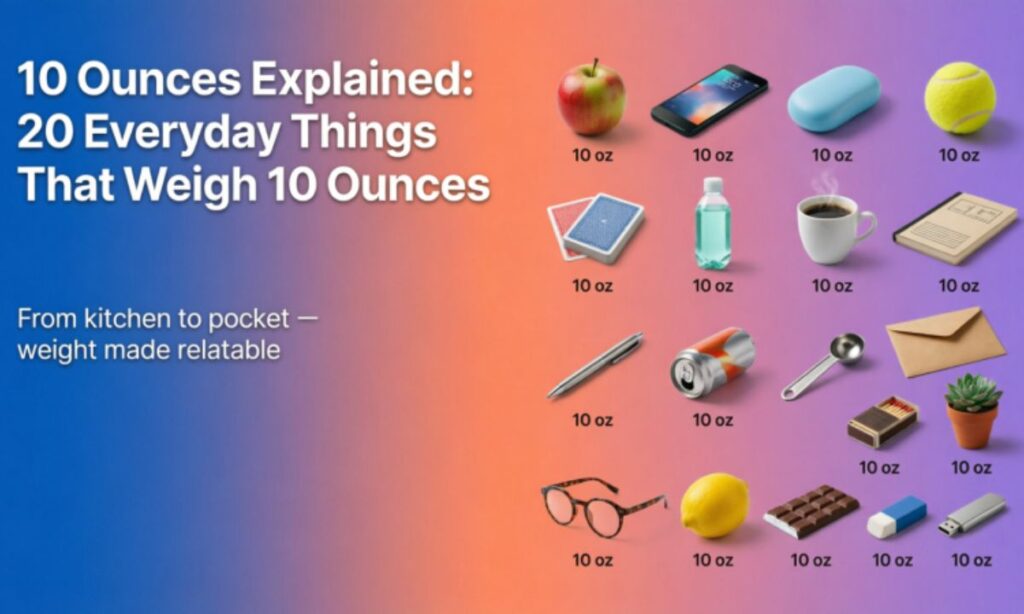
These aren’t random picks.
Each one was chosen because it sticks in your memory the second you hold it.
1. A Fully Loaded Men’s Wallet
Grab your wallet.
Now stuff it with cards, cash, and receipts.
A loaded leather bifold lands right around 10 ounces once everything’s inside.
2. A Newborn Baby’s Brain
Here’s the honest number.
A newborn’s brain weighs about 350 to 400 grams, which is closer to 12 to 14 ounces.
So it’s a touch heavier than our 10 ounce mark, not dead on.
Still, it’s one of the most fascinating comparisons on this list. A tiny organ already wired with billions of neurons.
3. A Full Family Size Tube of Toothpaste
Check your bathroom counter.
Most family size tubes from Colgate, Crest, or Sensodyne sit between 8 and 10 ounces full.
It’s one of the easiest household items to test this on.
4. A Hardcover Children’s Picture Book
Think Goodnight Moon.
Think The Very Hungry Caterpillar.
These glossy board covered classics weigh 9 to 11 ounces, right in our zone.
5. Two Official MLB Baseballs
One official baseball weighs 5 to 5.25 ounces.
Stack two and you’ve got your benchmark.
Baseball fans already have this weight memorized without knowing it.
6. A Large Ripe Avocado
A big Hass avocado from the grocery store runs 9 to 11 ounces.
This is probably the most practical example on the whole list.
You’re already buying these anyway.
7. A Bottled Nail Polish With Packaging
A standard bottle of OPI or Essie, box included, clocks in around 10 ounces total.
Small and dense, way heavier than it looks.
8. A Premium Fountain Pen With Its Case
A nice pen, think Lamy or Pilot Metropolitan, paired with a slim case lands close to 10 ounces.
Heavier than most people guess from something so thin.
9. A Can of Soda, Three Quarters Full
A full 12 fl oz can weighs about 13 ounces total.
Drink it down to the three quarters line and you’ve hit 10 ounces exactly.
10. A Medium Sized Apple
Grab a Fuji, Granny Smith, or Honeycrisp.
Most medium apples weigh 9 to 11 ounces.
Nature basically built a perfect reference object here.
11. A Paperback Novel
Your average trade paperback, somewhere between 280 and 350 pages, weighs right around 10 ounces.
Next time you toss one in your bag, now you know the weight you’re adding.
12. A Large Flagship Smartphone With a Case
The iPhone 16 Pro Max weighs about 7.99 ounces bare.
Add a slim case, roughly 1.5 to 2 ounces, and you land at 10 ounces.
This might be the most familiar object on the entire list.
13. An Empty Ceramic Coffee Mug
A classic 12 ounce mug, the kind sitting in every office kitchen, weighs 9.5 to 11 ounces empty.
Fill it with coffee and the weight jumps fast.
14. A Hockey Puck With a Rubber Grip Sleeve
A regulation NHL puck weighs 6 ounces.
Add a rubber training grip, common in practice gear, and you’re near 10 ounces.
15. An Xbox Series X or PlayStation 5 Controller
Both controllers land almost identically, around 9.9 to 10.2 ounces.
Millions of people grip this exact weight for hours and never think twice about it.
16. Ten Standard Wooden Pencils
One pencil weighs roughly 1 ounce.
Line up ten and there’s your 10 ounces.
Simple and easy to remember if you’ve got a pencil cup on your desk.
17. Twelve Double A Batteries
Each AA battery weighs about 0.83 ounces, roughly 23 grams.
Twelve together lands just under 10 ounces.
18. A Half Used Paper Towel Roll
A fresh roll weighs around 12 to 14 ounces.
Use half of it and you’re sitting right at 10 ounces.
19. Five Fun Size Snickers Bars
Each fun size bar weighs about 2 ounces.
Five of them equals 10 ounces of pure chocolate and caramel benchmark.
Probably the tastiest entry on this list.
20. Five Tennis Balls
Each ball weighs about 2 ounces.
A regulation can holds three balls at 6 ounces.
Grab five loose balls and you’ve hit 10 ounces on the dot.
21. A Standard Deck of Playing Cards, Times Three
One deck weighs about 3.3 ounces.
Stack three decks and you land just under 10 ounces.
A compact reference that card players and magicians already carry around.
What Does 10 Ounces Feel Like in Your Hand?

Here’s a fast way to calibrate it.
It’s lighter than a full water bottle, which runs 16 to 18 ounces with the bottle included.
It’s heavier than a bare smartphone sitting alone in your palm.
It feels solid but not tiring.
You can carry it one handed for a long stretch without your arm getting sore.
That’s exactly why product designers love this weight range for baby bottles, travel toiletries, and pocket gadgets.
10 Ounces in the Kitchen
Ten ounces looks completely different depending on what you’re measuring.
Weight and volume don’t move together, and that trips up a lot of home cooks.
| Ingredient | 10 oz Weight | Approximate Volume |
| Water | 283.5 g | 1.25 cups |
| All purpose flour | 283.5 g | about 2.25 cups |
| Honey | 283.5 g | about 0.75 cup |
| Shredded cheese | 283.5 g | about 2.5 cups |
| Rice, uncooked | 283.5 g | about 1.5 cups |
| Olive oil | 283.5 g | about 1.3 cups |
Notice how flour takes up nearly three times the space that honey does at the exact same weight.
That’s density doing its thing.
It’s also why bakers weigh ingredients instead of trusting cup measurements alone.
Common recipes calling for 10 ounce portions include canned diced tomatoes, frozen chopped spinach, and shredded chicken from about one and a half cooked breasts.
If you’re measuring a liquid like water or broth, just fill to the 1.25 cup line and you’re done.
Shipping and Retail: Why 10 Ounces Matters
If you sell anything online, this number is worth knowing cold.
USPS First Class Package pricing changes at certain weight thresholds.
Staying under 13 ounces keeps you in the cheaper tier, and 10 ounces gives you comfortable buffer room.
UPS and FedEx also factor in dimensional weight, not just actual weight.
A 10 ounce item shipped in an oversized box can cost more than a heavier item in a tight box.
Size and weight both count.
This is exactly why so many consumer products land in this range on purpose.
It fits standard packaging, stays under shipping thresholds, and feels premium without feeling heavy.
Memorize 0.625 pounds and 283.5 grams if you ship products regularly.
How to Estimate 10 Ounces Without a Scale
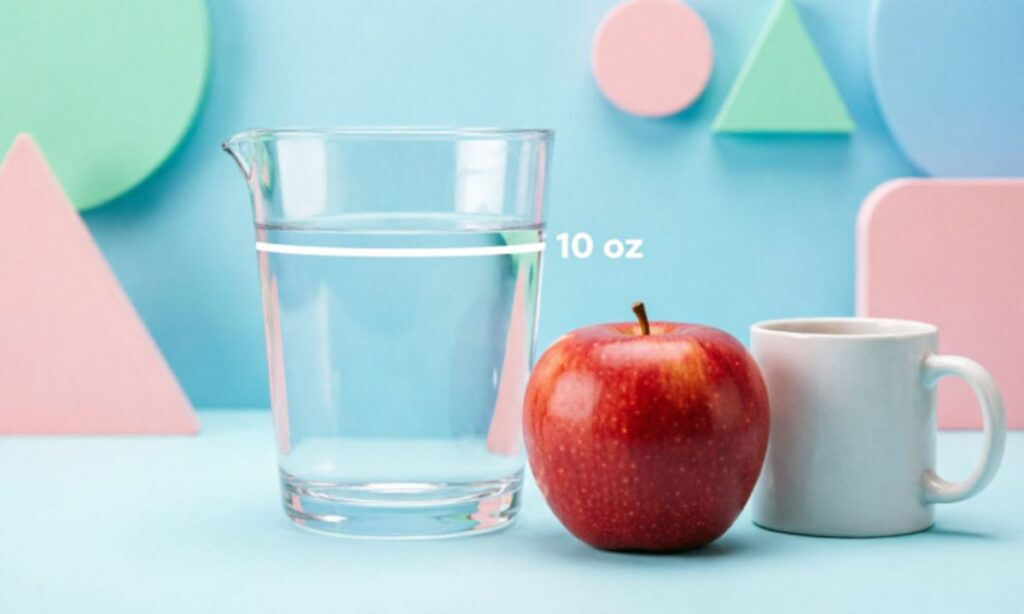
No kitchen scale nearby?
These four tricks work in a pinch.
• The coin method: one quarter weighs 0.2 ounces, so 50 quarters equals 10 ounces
• The water method: fill a cup to the 1.25 cup line, since water’s weight and volume line up closely
• The soda can method: drink a full can down by about a quarter and what’s left is close to 10 ounces
• The phone and case method: a large smartphone plus a medium case usually lands right at 10 ounces
Once you’ve felt this weight a few times across different objects, your hand starts to remember it.
It’s a small skill, but a genuinely handy one.
Fun Facts About 10 Ounces
A few extra nuggets worth knowing.
• 10 ounces equals exactly five eighths of a pound
• The word ounce comes from the Latin uncia, meaning one twelfth, tied to the old Roman pound
• One ounce equals 28.35 grams exactly, so 10 ounces always equals 283.5 grams
• Most of the world cooks in grams, so this conversion is worth memorizing if you follow international recipes
• 10 ounces sits right between the two most common small package sizes, 8 ounces and 12 ounces, which is likely why so many products land here
Quick Quiz: How Well Do You Know 10 Ounces?
Test yourself before scrolling to the answers.
1. How many grams are in 10 ounces?
A) 250 g B) 283.5 g C) 310 g D) 198 g
2. Which object weighs closest to 10 ounces on its own?
A) A full soda can B) A bare iPhone Pro Max C) A large ripe avocado D) A single AA battery
3. How many wooden pencils reach 10 ounces?
A) 5 B) 20 C) 10 D) 15
4. What is 10 fluid ounces in cups?
A) 1 cup B) 1.75 cups C) 2 cups D) 1.25 cups
Answers: 1-B, 2-C, 3-C, 4-D.
A large avocado weighs 9 to 11 ounces, a bare Pro Max is about 8 ounces, and a full soda can is closer to 13 ounces, which is why the avocado wins question two.
Frequently Asked Questions
Is 10 ounces the same everywhere?
For everyday food and shipping, yes, since the avoirdupois ounce used in the US equals 28.35 grams worldwide.
Precious metals use a different system called the troy ounce, which equals 31.1 grams, so gold and silver math works differently.
Does humidity change how much something weighs at 10 ounces?
Technically yes, but barely.
Dry goods like flour or rice can absorb tiny amounts of moisture over time, but nothing your kitchen scale will notice day to day.
Why don’t the numbers on nutrition labels always add up?
US labels round to the nearest gram or calorie, and the FDA allows rounding within set limits.
So if the math looks slightly off, trust the grams column over the ounces column.
Conclusion
Ten ounces isn’t just a number on a label anymore.
It’s two baseballs.
It’s your phone tucked in its case.
It’s a ripe avocado sitting on your counter.
Now that you’ve got twenty real objects to picture, you’ll never squint at a package weight again.
Test a few of these at home.
Drop a comment below with the object that surprised you the most, and share this with a friend who still can’t picture what 10 ounces feels like.