
Ever tried to picture how small 3mm actually is and just drawn a blank?
You’re not alone.
3mm is one of those tiny measurements that shows up everywhere but nobody really pictures right.
This guide breaks it down with things you already touch every single day.
No ruler needed, no confusing math, just simple everyday comparisons that stick in your head.
How Big Is 3mm?
3mm equals 0.3 centimeters or about 0.118 inches.
That’s roughly the thickness of a stack of four credit cards or a small charging cable.
It sounds small because it is small, but your fingers can still feel it and your eyes can still see it clearly.
Think of it like the width of a grain of rice standing on its side.
Small, yes, but not invisible.
Once you connect it to something real, 3mm stops being an abstract number and starts making sense.
3mm Conversion Chart
| Unit | Converted Value |
| Centimeters | 0.3 cm |
| Inches | 0.118 in |
| Micrometers | 3000 µm |
| Meters | 0.003 m |
| Feet | 0.0098 ft |
Keep this chart handy if you’re converting measurements for a project or a purchase.
Even a tiny difference in millimeters can throw off a fit, especially with jewelry or electronics parts.
Common Things That Are About 3mm in Size
| Common Item | Approximate Size |
| Stack of four credit cards | 3mm |
| Pencil tip diameter | 3mm |
| Small button thickness | 3mm |
| Grain of rice thickness | 3mm |
| Two stacked coins | 3mm |
| Small screw head (M3) | 3mm |
| Jewelry bead | 3mm |
| Earphone wire thickness | 3mm |
| Phone charging cable | 3mm |
| Mechanical pencil tip guard | 3mm |
| Small LEGO piece thickness | 3mm |
| Thin craft foam sheet | 3mm |
This table gives you a quick visual reference before we dig into each one.
How Big Is 3mm?
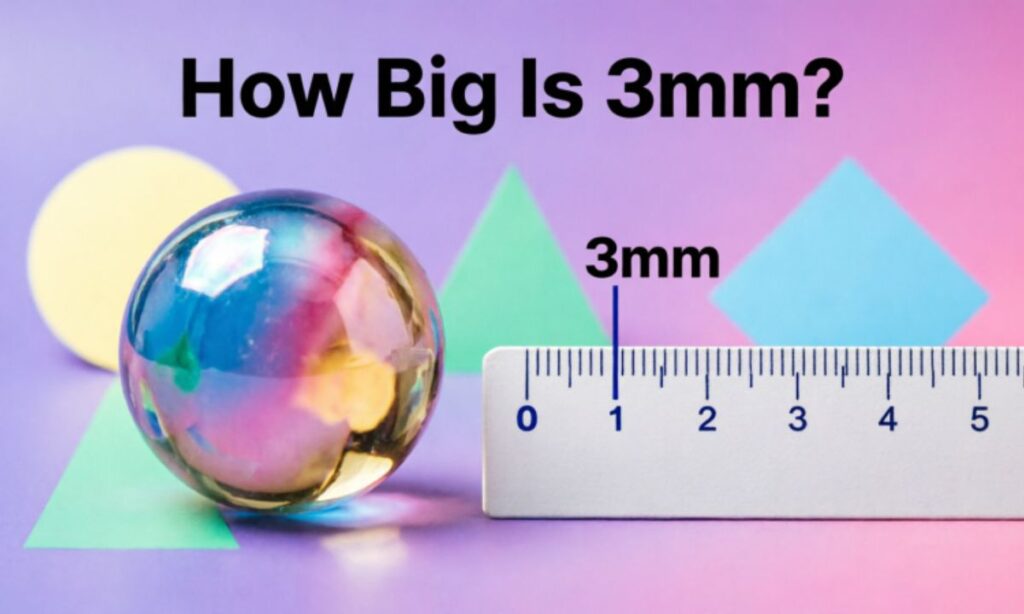
Let’s slow down and really nail this down because a lot of guides rush past it.
3mm sits right between “barely there” and “actually noticeable.”
It’s thicker than a sheet of paper but thinner than your pinky nail.
That in between spot is exactly why it trips people up.
You’ll spot 3mm in jewelry sizing, screw dimensions, cable thickness, and even DIY crafts.
Once you know where to look, you’ll start noticing it constantly.
1. Two Stacked Credit Cards
Here’s where a lot of size guides get it wrong, so let’s fix that.
One standard credit card is about 0.76mm thick, not 1.5mm like some articles claim.
So two cards stacked only get you to around 1.5mm, just half of 3mm.
Stack four cards together and now you’re sitting right at 3mm.
Next time you’re waiting in line, pull out your wallet and count four cards.
That little stack in your hand? That’s 3mm, no ruler required.
2. Pencil Tip Diameter
A sharpened pencil tip narrows down fast, but some thicker leads measure close to 3mm right before the point.
Mechanical pencil leads especially come in sizes like 0.5mm, 0.7mm, and thicker drafting leads near 3mm.
Grab a pencil right now and look closely at where the wood meets the graphite.
That transition zone is a solid visual reference for this measurement.
3. Small Button Thickness
Shirt buttons and craft buttons often land close to 3mm thick, especially the sturdier plastic ones.
Run your finger over a button on your shirt right now.
That little bump you feel under your fingertip is basically 3mm in real life.
Clothing designers actually care about this because thicker buttons can catch on buttonholes.
4. Grain of Rice Thickness
A single grain of rice measures close to 3mm across its widest point.
Rice is one of the most universal household items on earth, so this comparison works no matter where you live.
Grab a few grains from your pantry and place them side by side.
You’ll see the thickness matches up almost perfectly with 3mm.
5. Coin Stack
Two thin coins stacked together get you very close to 3mm.
A US penny, for example, measures about 1.52mm thick, so two pennies stacked land right around 3mm.
Coins work great for this comparison because they’re rigid and don’t squish or bend.
Try it yourself with any spare change sitting in your car or on your desk.
6. Tiny Screw Head
Miniature screws used in glasses, electronics, and small appliances often have heads close to 3mm wide.
An M3 screw, a common size in hardware stores, has a head diameter right around this measurement.
Next time you tighten your glasses or open a small gadget, take a look at the screw head.
That small metal circle is a near perfect match for 3mm.
7. Jewelry Bead
Small beads used in bracelets and necklaces frequently measure around 3mm in diameter.
Jewelry makers rely on precise bead sizing because even a half millimeter off can throw off an entire design.
If you have a beaded bracelet nearby, look at the smaller beads mixed into the pattern.
Those tiny round pieces are a great everyday example of 3mm.
8. Earphone Wire Thickness
Some earphone cables, especially the flexible rubber coated ones, measure close to 3mm thick.
This one’s a little different from the others because it’s soft and bendable, not rigid.
Pinch your earphone wire gently between two fingers right now.
That squishy little give you feel is what 3mm looks like in a flexible material.
9. Phone Charging Cable
Many standard phone charging cables measure approximately 3mm thick, especially the thicker braided ones.
This is different from earphone wire because charging cables usually have extra insulation for durability.
Look at the cable currently charging your phone and notice how sturdy it feels compared to a thin earbud wire.
That extra thickness is exactly why it survives daily wear and tear so much better.
10. Mechanical Pencil Tip Guard
This is different from the pencil tip we covered earlier because this refers to the metal sleeve that protects the lead, not the lead itself.
That thin metal guard at the tip of a mechanical pencil measures close to 3mm wide.
It’s designed that way so the lead doesn’t snap when you’re writing or sketching.
Check your mechanical pencil and gently feel around that metal tip section.
11. Small LEGO Piece Thickness
Some of the thinner LEGO pieces, like flat tiles and connector plates, measure close to 3mm thick.
LEGO is famous for precise manufacturing tolerances, so their pieces are a genuinely reliable comparison tool.
If you’ve got a LEGO set lying around, grab a flat tile piece and check its edge.
You’ll see it lines up closely with 3mm.
12. Thin Craft Foam Sheet
Foam sheets used in school projects and DIY crafts commonly come in 3mm thickness.
These sheets are popular because they’re easy to cut, bend, and glue without falling apart.
If you’ve got kids doing craft projects at home, check the foam sheets in their supply box.
Most standard ones sit right around this exact measurement.
Why Small Measurements Like 3mm Actually Matter
It’s easy to assume something this small doesn’t matter much, but that’s not true at all.
In electronics, a 3mm difference can mean a screw doesn’t fit or a wire doesn’t connect properly.
In jewelry, it can change how a bracelet sits on your wrist.
Even in construction and engineering, millimeter level precision keeps parts from jamming or breaking.
Where You’ll Actually Run Into 3mm in Real Life
You’ll bump into this measurement more than you think, often without realizing it.
Jewelry shopping: bead sizes and chain thickness
Electronics repair: screw heads and internal components
DIY and crafting: foam sheets and small connector pieces
Everyday accessories: charging cables and earphone wires
Once you know these categories, spotting 3mm becomes second nature.
What Does 3mm Look Like Compared to Everyday Objects?
Sometimes seeing several comparisons side by side makes everything click faster.
Here’s a quick mental snapshot:
Slightly thinner than a stack of four credit cards
Close to the width of a grain of rice
Similar to a thicker phone charging cable
Near the size of a small jewelry bead
Right around the width of a tiny screw head
Keep these in your back pocket next time you need a fast size estimate.
How to Measure 3mm Without a Ruler
No ruler nearby? No problem, here are a few quick tricks that actually work.
Stack four credit cards together and check the height
Compare with a thicker phone charging cable
Look closely at a grain of rice
Use a small jewelry bead as a reference point
Check a tiny screw head on glasses or electronics
These simple estimation methods come in handy while shopping, crafting, or fixing something around the house.
Common Misconceptions About 3mm
1. 3mm Is Invisible
This one gets repeated a lot, but it’s simply not true.
3mm is small, sure, but it’s still clearly visible to the naked eye and easy to feel with your fingertips.
Try holding a stack of four credit cards and tell me you can’t see or feel that thickness.
2. Millimeters Are Difficult to Understand
Millimeters only feel confusing because most of us don’t use them daily like we use inches or centimeters.
Once you connect them to familiar objects like coins, rice, or credit cards, the confusion disappears fast.
It’s really just a matter of building a mental reference, not some complicated math problem.
3. Tiny Measurements Are Unimportant
This misconception costs people real money and real frustration.
Small measurements like 3mm matter hugely in electronics, jewelry making, engineering, and even furniture assembly.
A missed 3mm can mean a part doesn’t fit or a design looks off, so precision here genuinely counts.
FAQs
How big is 3mm in inches?
3mm equals approximately 0.118 inches.
What does 3mm look like?
3mm looks like a stack of four credit cards, a small jewelry bead, or a thicker phone charging cable.
How long is 3mm compared to rice?
A grain of rice measures close to 3mm at its widest point.
Is 3mm considered thick?
3mm is small but noticeable, and it shows up often in electronics, jewelry, and craft supplies.
What household items are 3mm thick?
Charging cables, craft foam sheets, small screw heads, jewelry beads, and stacked coins are common everyday examples.
How can I estimate 3mm without a ruler?
Stack four credit cards, compare with a charging cable, or look at a grain of rice for a fast estimate.
Conclusion
3mm might sound tiny, but once you connect it to things you already touch daily, it becomes easy to picture and even easier to remember.
From credit cards and charging cables to rice grains and jewelry beads, these everyday comparisons turn a confusing number into something practical you can actually use.
So next time you’re shopping, crafting, or fixing something small around the house, you won’t need a ruler, just your own two hands and a little bit of context.