
How Long Is 100 Feet?
100 feet equals 1,200 inches.
It also equals 30.48 meters.
So if someone asks you how long is 100 feet, just picture 30 steps of a big adult stride, or a bit more. It is not huge, but it is not small either. It sits right in that “wait, that’s actually a lot” zone once you see it laid out in real life.
Conversion Table
| Unit | Value |
| Feet | 100 ft |
| Inches | 1,200 |
| Centimeters | 3,048 |
| Meters | 30.48 |
| Yards | 33.33 |
| Millimeters | 30,480 |
Feet get used a lot in the US. Meters are the go to almost everywhere else. Millimeters show up when engineers need pinpoint accuracy, like on blueprints or machine parts.
What 100 Feet Feels Like
Try this next time you are outside. Walk in a straight line and count your steps. Around 30 to 40 steps later, you have covered close to 100 feet. That is long enough to feel real, not just a quick hop to the mailbox.
Think about standing at one end of your street and looking down toward the point where cars start looking small. That stretch is roughly 100 feet. It is the kind of distance builders think about when they plan out lots, driveways, and open spaces.
10 Things That Are Exactly 100 Feet Long
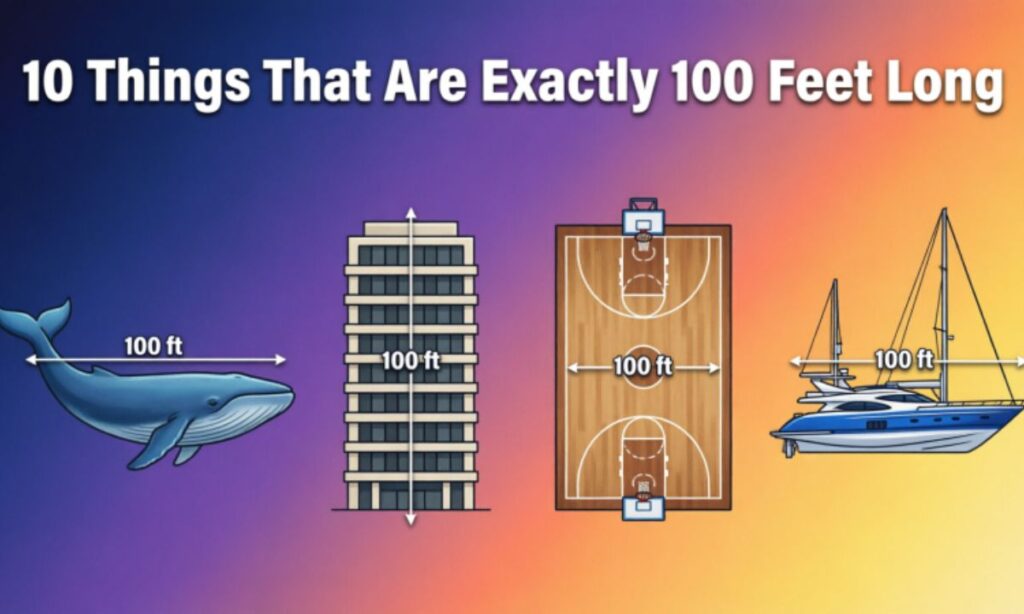
Numbers on a page do not stick. Real things do. Here are ten things that get you close to 100 feet, so the number finally means something.
also read:12 Common Things That Are 20 Feet Long
1. Blue Whale (Maximum Recorded Length)
The biggest blue whales ever measured come in close to 100 feet long. That is the largest animal that has ever lived on this planet, bigger than any dinosaur. Picture something the length of two and a half city buses, swimming.
Most people will never stand next to one. But documentaries and museum skeletons give you a taste. Even a life size mural of one at an aquarium tends to stop people in their tracks.
2. 10 Story Building (10 Feet Per Floor Standard)
Builders often plan office floors at around 10 feet each. Stack ten of those floors and you land right at 100 feet. Stand at the bottom of a building like that and your neck will crane back automatically.
This is probably the cleanest way to answer how tall is 100 feet. It is a number people already have in their head from walking past buildings every day.
3. Boeing 737 Wingspan
Here is a fun twist most articles get wrong. An older Boeing 737 Classic has a wingspan around 93 feet. A newer 737 MAX stretches closer to 118 feet, wingtip winglets included.
So depending on the model you are looking at, you are either just under or well over 100 feet. Next time you are at the airport, glance at the wings before boarding.
4. Statue of Liberty Pedestal Height
The pedestal alone, without the statue on top, measures 89 feet according to the National Park Service. That is close to 100 feet, just shy of it. Add a few feet of base structure underneath and you are basically there.
Stand at the bottom on Liberty Island and look up. The pedestal alone already towers over most buildings nearby, and the statue has not even started yet at that point.
5. Niagara Falls (Horseshoe Falls and American Falls)
Here is where a lot of guides get sloppy. Horseshoe Falls actually drops about 167 feet, not 100. But American Falls, the smaller side, drops closer to 100 feet at points along its edge, depending on rock buildup at the base.
So if you want an honest 100 foot water comparison, American Falls is your best bet. Standing near the mist, the height still feels wild even though it is the shorter of the two falls.
6. Two and a Half City Buses Lined Up
A standard city transit bus runs about 40 feet long. Line up two and a half of them bumper to bumper and you hit 100 feet. Picture a school pickup line or a bus depot and stretch it out a bit more than usual.
Walking that whole line takes real time, not a quick glance. It is one of those everyday comparisons that clicks instantly for city dwellers.
7. Parking Spaces in a Row (Standard Lot Layout)
A standard parking space runs about 9 feet wide, based on common US planning guidelines. Line up around 11 spaces and you get close to 100 feet. Next time you are hunting for a spot, count the paint lines as you walk.
Malls, offices, and grocery store lots all use this rough spacing. It is one of the most boring but honestly useful ways to picture 100 feet in daily life.
8. Football Field Section (NFL Regulation Context)
A full NFL field runs 360 feet including both end zones. 100 feet lands you a little past the quarter mark of the whole field. Picture a player sprinting from the goal line to just past the 30 yard marker.
On TV that distance looks small. Standing on the actual turf, it feels like a serious sprint, especially once you factor in pads and gear.
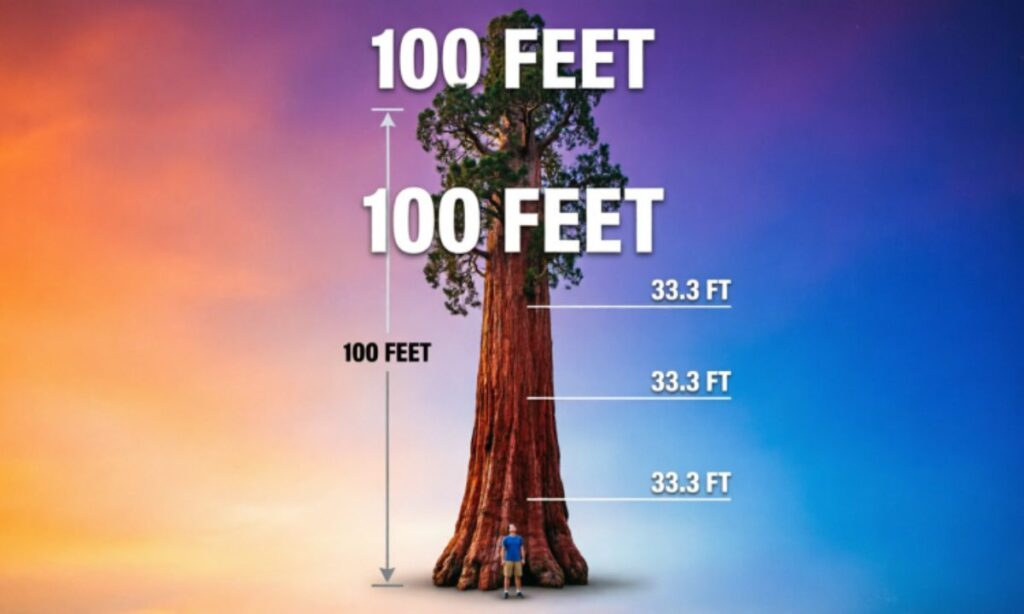
9. A Young Redwood Tree
Redwood trees are famous for reaching wild heights, sometimes past 300 feet once fully grown. But a younger redwood, somewhere around 50 to 60 years old, often sits close to 100 feet tall. That is basically a teenager in redwood years.
If you have ever walked through a redwood grove, you have probably stood under one this size without knowing it. Nature hits different when it comes to scale.
10. An NBA Basketball Court
A full NBA court measures 94 feet long, just 6 feet short of 100 feet. Close enough that most fans would not notice the difference by eye. Picture a player running full court, baseline to baseline, and you are basically there.
This one works well because almost everyone has seen a basketball court, in person or on a screen. Sports comparisons tend to stick because people already carry the image in their head.
How Big Is 100 Feet?
Indoors, 100 feet feels massive. It can stretch across several rooms in a large house or run the full length of a warehouse floor. Picture standing on one baseline of a basketball court and walking past the far end, that is close to the feeling.
Outdoors, the same number feels a bit more normal. In a parking lot, it is a long row of cars. In an open field, it is enough space to separate two structures comfortably.
How Tall Is 100 Feet?
Vertically, 100 feet feels dramatic in a way horizontal distance does not. It lines up with a 10 story building, where you have to tilt your head back just to see the top.
In nature, it feels even more powerful. A young redwood or a tall waterfall edge stretches into the sky in a way concrete rarely does.
How Far Is 100 Feet?
100 feet takes about 30 to 40 steps for the average adult to walk. At a normal walking pace, that is roughly 20 to 25 seconds. Short in time, but noticeable in space.
It is long enough to separate two conversations happening outside without anyone eavesdropping. It is short enough that you would never call it a real walk.
100 Feet Comparison
100 feet versus 80 feet is basically one extra city bus of length. 100 feet versus 120 feet adds roughly the length of a large delivery truck. 100 feet versus 200 feet is close to two NBA courts placed end to end.
These side by side comparisons help more than the raw number ever will. Once you attach a number to something you already picture in your head, it sticks.
How to Measure 100 Feet Without a Tape Measure
Method 1: Steps
Most adults have a stride somewhere around 2.5 feet per step. Walk in a straight line and count roughly 30 to 40 steps to land near 100 feet. For better accuracy, measure 10 steps once with an actual tape, then do the math for your personal stride.
Keep your steps natural, do not stretch them out to hit a number. Consistency matters more than speed here.
Method 2: Floor Tiles
Plenty of patios, garages, and warehouse floors use 1 foot tiles. Find a straight line of tiles and count until you hit 100. Double check your start and end points so you are not off by a tile or two.
Walk straight, not diagonally, or the count gets messy fast. This method works best on flat, even surfaces.
Method 3: Arm Span
Your arm span usually matches your height, more or less. If you are 6 feet tall, you will need around 17 arm spans laid end to end to reach 100 feet.
Move slowly and stay in one straight line. Rushing this one throws the whole count off.
Frequently Asked Questions
How long is 100 feet in meters?
100 feet equals 30.48 meters. This conversion gets used constantly in construction and engineering, especially when comparing building sizes across countries that run on the metric system.
How many steps is 100 feet?
Roughly 30 to 40 steps for the average adult, based on a typical stride of about 2.5 feet. It is a rough estimate, not a lab measurement, but it works fine for everyday guessing.
How tall is 100 feet compared to a house?
100 feet matches a 10 story building. Most homes only run 20 to 30 feet tall, so 100 feet is several times taller than a standard house.
Is 100 feet bigger than a school bus?
Yes, by a wide margin. A standard school bus runs 35 to 45 feet long, so 100 feet is more than double that length, with room to spare.
How long does it take to walk 100 feet?
About 20 to 25 seconds at a normal walking pace of roughly 3 miles per hour. Short on the clock, but long enough to notice in real space.
Conclusion
The easiest ways to picture 100 feet are a blue whale, a 10 story building, and an NBA basketball court. Each one hits a different angle: length, height, and something you have actually stood near before.
Once you connect 100 feet to something real, you stop needing a tape measure to guess distance. Bookmark this page, or better yet, just try the step count next time you are outside.