
30 cm equals 11.81 inches.
That’s the short answer.
It’s also 0.98 feet, 300 millimeters, and 0.3 meters.
Close to a foot, but not quite a foot.
Maybe you’re staring at a product page right now, wondering if that lamp will fit your shelf.
Or you’re cutting fabric and the tape measure only shows inches.
Either way, you landed here because a number on a screen didn’t mean anything to you yet.
By the end of this page, it will.
We’re going to cover the full conversion chart, walk through 12 things you’ve probably touched this month that are close to 30 cm, and clear up the mix ups people make between centimeters and inches. No jargon. No fluff. Just stuff that clicks.
30 cm: Every Conversion You Actually Need
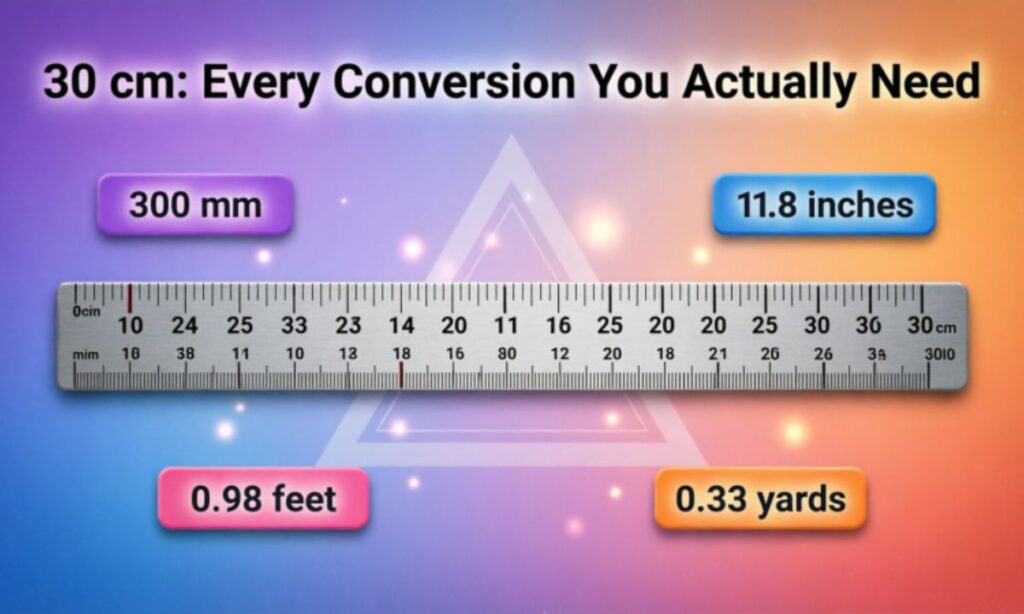
Here’s the number in every format you’ll ever need it in.
| Unit | Value |
| Centimeters | 30 cm |
| Inches | 11.81 in |
| Feet | 0.98 ft |
| Millimeters | 300 mm |
| Meters | 0.3 m |
| Yards | 0.328 yd |
| Pixels (72 DPI) | 850 px |
| Pixels (96 DPI) | 1134 px |
| Pixels (300 DPI) | 3543 px |
Bookmark this table.
You’ll come back to it more than you think.
If you’re working with a circle instead of a straight line, the math shifts a bit.
A 30 cm diameter gives you a circumference of about 94.25 cm.
That number matters more than you’d guess, especially for round tables, pots, and pans.
So why does 30 cm show up on so many labels in the first place?
It’s not random.
It sits in a sweet spot between “small enough to carry” and “big enough to actually use.”
Most of the world builds products around the metric system, and 30 lands as a clean, round number in that system.
That’s why it keeps popping up on tags, from garden pots to tile boxes.
Once you notice it, you can’t unsee it.
ALSO READ THIS:https://measureaxis.com/how-long-is-20-cm/
12 Everyday Things That Are Right Around 30 cm
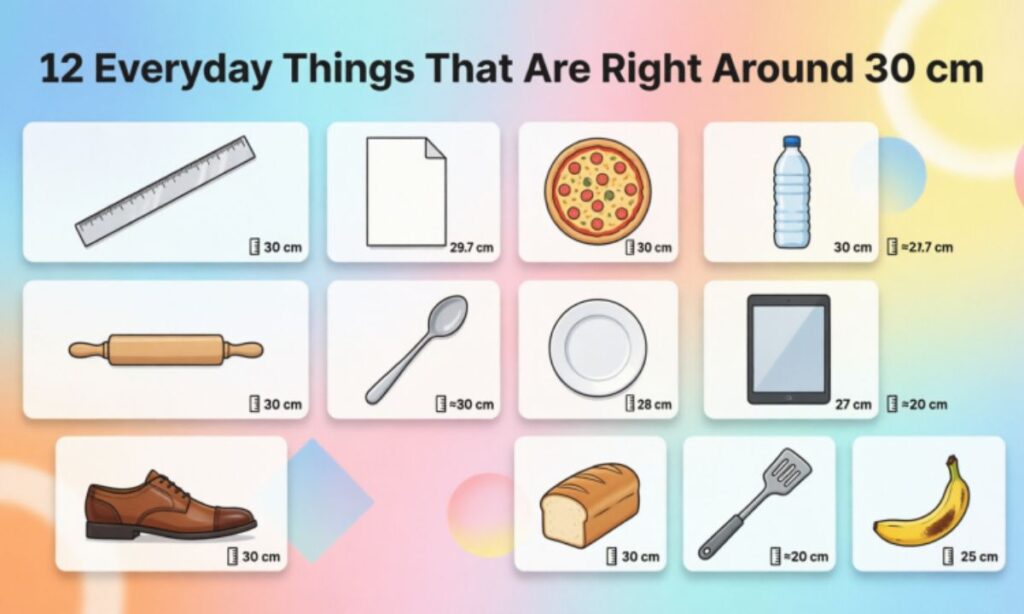
Numbers on a page don’t stick.
Objects in your hand do.
Here are 12 things you’ve probably seen this week that sit right around this measurement.
1. A medium pizza
Order a medium from most chains and you’re holding a 30 cm diameter pie, crust to crust.
That’s roughly 11.81 inches across, which is also why the box has to be a specific size.
Next time your pizza shows up, you’re basically eating a math lesson.
2. A standard plant pot
Garden centers sell a size that sits between a small starter pot and a big statement planter.
That middle size is almost always around 30 cm wide at the top.
If you’ve bought a pot for a citrus tree or a big leafy plant, there’s a good chance this was it.
3. A 12 inch vinyl record
A full size LP measures 30.48 cm across, which people round down to 30 cm in daily talk.
It’s been the standard since the 1950s, and it hasn’t budged since.
If you’ve ever held a record sleeve, your hands already know this size.
4. A round side table
Small circular side tables, the kind that sit next to a couch or a bed, are often built at this width.
Wide enough for a mug and a phone.
Narrow enough to not trip anyone walking past.
5. A standard floor tile
Walk into most bathrooms or kitchens and the tiles under your feet are often 30 cm on each side.
It’s one of the most common sizes stocked at hardware stores worldwide.
You’ve been standing on this measurement for years without knowing it.
6. A newborn baby, roughly from head to belly button
The average newborn measures close to 50 cm at birth.
30 cm gets you from the top of the head down past the chest, not quite to the waist.
It’s a strange comparison, but parents who’ve held a newborn tend to remember that stretch of length exactly.
7. A cut length of PVC pipe
Plumbers and DIY folks often cut smaller PVC pipe into 30 cm sections for household jobs.
It’s a length that fits cleanly with most standard fittings.
If you’ve watched anyone do basic home plumbing, you’ve seen this cut made.
8. A large candle plate or tray
Wide decorative trays made to catch wax drips are often built around this width.
Big enough to hold a few candles.
Still small enough to sit neatly in the middle of a dinner table.
9. A badminton racket, shaft to grip end
A full size badminton racket runs about 66 to 68 cm total, and the shaft section between the grip and where the head starts takes up a solid chunk of that.
Players across Asia and Europe handle this length constantly without ever thinking of it in centimeters.
Pick one up and you’ll feel exactly what 30 cm feels like in your grip and forearm combined.
10. A bathroom faucet, base to spout tip
Standard faucets vary a lot by style, but a common single handle model measures somewhere in this range from the base plate to the tip of the spout.
Hardware stores stock these in bulk because they fit most vanity widths without any custom work.
If you’ve replaced a faucet yourself, you’ve handled this exact stretch of metal.
11. A large chopping board
Many kitchen chopping boards, especially the wooden ones sold as a “large” size, run close to 30 cm on the long edge.
It’s wide enough for a whole chicken breast or a stack of vegetables.
Check the one in your kitchen. There’s a decent chance it matches.
12. A standard laptop screen, measured diagonally on a 13 inch model
A 13 inch laptop screen actually measures out to close to 33 cm diagonally, but the width of the screen itself, side to side, lands right around 30 cm on most models.
Next time you open your laptop, hold your hand across the screen.
That’s your new mental ruler.
None of these are perfect matches down to the millimeter.
But together, they give you something a number on a page never could. A gut feeling for the size.
30 cm in Inches and Feet: Quick Math Reference
People trip over this conversion more than you’d expect.
Here’s the plain version, no rounding tricks.
• 30 cm in inches = 11.81 inches, not 12
• 30 cm in feet = 0.98 feet, basically a foot but not fully there
• On a tape measure, that reads as 0 feet and 11.81 inches
• The gap between 30 cm and 12 inches is 0.48 cm, small but real
That 0.48 cm gap sounds tiny.
It isn’t always.
If you’re cutting shelving, framing a photo, or fitting something into a slot built for exactly 12 inches, that little sliver can be the difference between a clean fit and a piece that won’t sit flush.
For casual shopping or eyeballing size, calling it “about a foot” works fine.
For anything with fixed measurements, use the decimal.
Is 30 cm the same as 12 inches?
No.
12 inches converts to 30.48 cm, so 30 cm is the shorter of the two.
Keep that phrase in your back pocket. It’ll save you from a bad online order at some point.
30cm Diameter: What That Actually Means
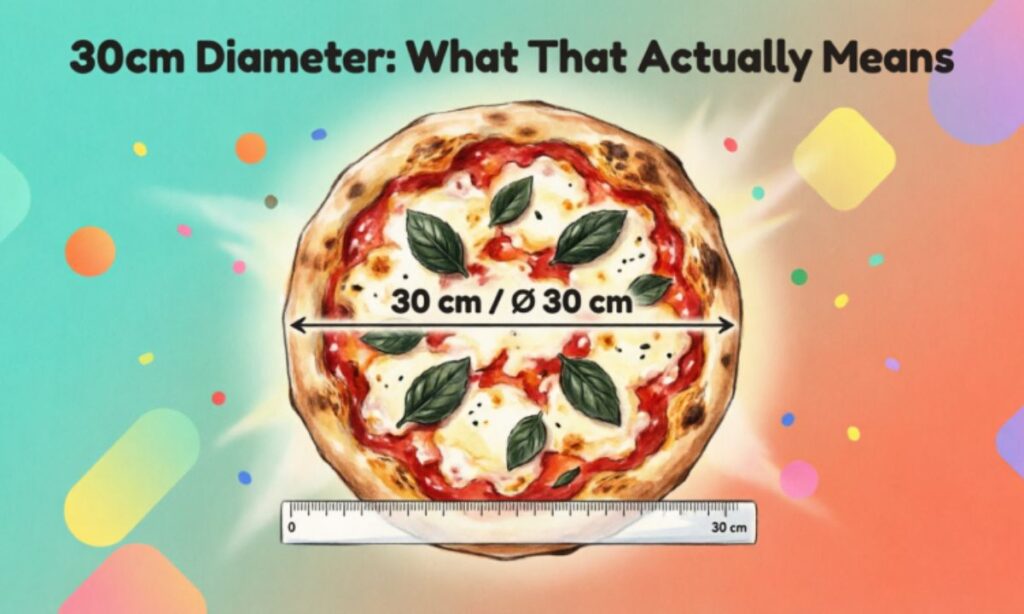
A lot of people searching this number are shopping for something round.
A pot. A pizza. A mirror. A rug.
So here’s what that circle actually looks like once you break it down.
• Diameter: 30 cm, straight across through the center
• Radius: 15 cm, half the diameter
• Circumference: about 94.25 cm around the outer edge
• Area: roughly 706.86 square centimeters
That circumference number matters more than people expect.
If you’re wrapping something round, fitting a lid, or checking whether a circular rug will clear a doorway, that’s the figure you actually need, not the diameter.
Picture it this way.
A 30 cm circle is noticeably bigger than a standard dinner plate but smaller than a car tire.
It sits comfortably on a kitchen counter without swallowing the whole space.
How to Estimate 30 cm Without a Tape Measure
Sometimes you just need a rough answer and there’s no ruler in sight.
Your own body can get you close.
• Forearm length, wrist crease to inner elbow, lands around 25 to 30 cm for most adults
• Two hand widths, measured across the knuckles, placed end to end gets you close to 30 cm
• A4 paper’s short side is 21 cm, so add about two thirds of that again to reach 30 cm
None of these will replace an actual tape measure.
But in a pinch, at a store, or mid project, they’ll get you close enough to make a decision.
Why This Measurement Matters More Than People Realize
Thirty centimeters isn’t just a number stuck on a chart.
It’s a decision point.
It’s the line between a pot that fits your windowsill and one that doesn’t.
The gap between a tile order that works and one you have to return.
The reason a pizza box is the exact size it is, not bigger, not smaller.
Once you know it in your hands and not just on paper, shopping gets faster.
Measuring gets easier.
And that nagging “will this actually fit” feeling mostly disappears.
FAQs
How much is 30 cm in inches?
30 cm equals 11.81 inches. That’s just under one full foot.
Is 30 cm the same as 12 inches?
No. 12 inches equals 30.48 cm, so 30 cm falls about half a centimeter short.
What is 30 cm diameter in inches?
A 30 cm diameter equals 11.81 inches across, with a circumference of roughly 37.1 inches.
How do I measure 30 cm without a ruler?
Use your forearm, wrist to elbow, which lands close to this length for most adults. Two hand widths placed end to end also gets you near enough.
What everyday object is closest to 30 cm?
A medium pizza and a 12 inch vinyl record are two of the most reliable everyday references for this size.
Wrapping It Up
30 cm isn’t some abstract number stuck on the back of a package.
It’s the pizza on your table, the tile under your feet, the pot on your windowsill, the record spinning on your shelf.
You now have the exact conversion, the quick math, and a dozen real objects to picture it by.
No tape measure needed the next time this number shows up on a label.
Got a comparison that helped this click for you? Drop it in the comments. We update these guides often, so your example might end up in the next version of this page.