
If it’s 8:19 AM right now, 10 hours from now is 6:19 PM.
That’s it. That’s the whole trick.
You take your current time, you add 10 hours, and boom, you have your answer.
But stick with me, because this little question hides a few sneaky traps.
Cross midnight and your date flips too.
Mix up AM and PM and your whole day gets ruined.
Ignore your time zone and you might show up to a call 10 hours off.
So let’s slow down and walk through it properly, the way a friend would explain it over coffee, not the way a robot would read it off a script.
Understanding 10 Hours as a Time Duration
Ten hours sounds small until you break it into pieces.
It’s 600 minutes.
It’s 36,000 seconds.
It’s 36,000,000 milliseconds if you want to get nerdy about it.
Your phone doesn’t actually think in hours. Behind the screen, it’s all counting tiny ticks called a timestamp, and your clock app just turns that number back into something you can read.
You don’t need to know any of that to plan your day. But it helps explain why apps never mess up your alarm even when your phone dies and restarts.
How to Calculate What Time Is 10 Hours From Now Manually
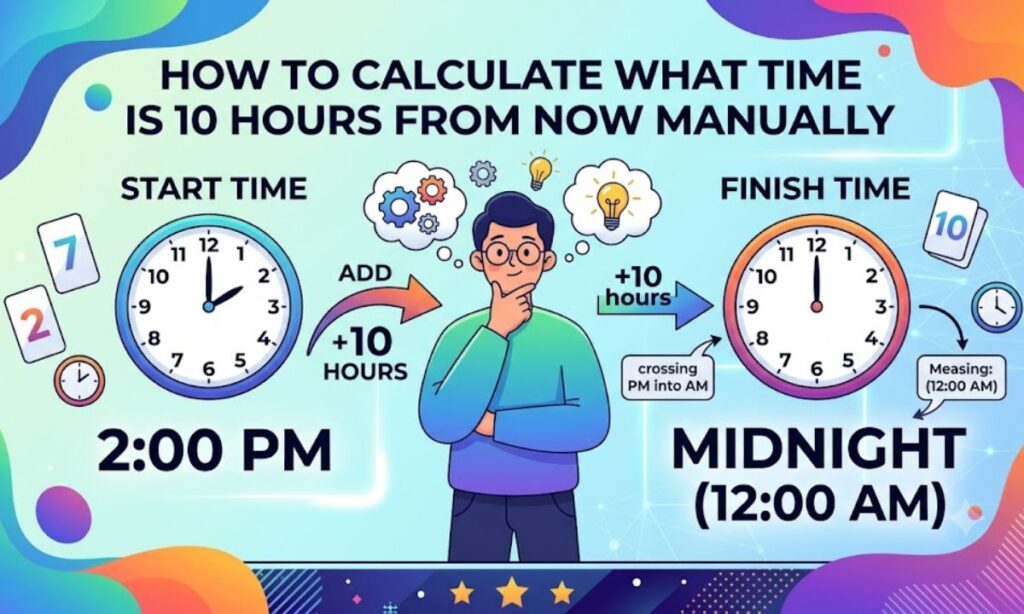
You really don’t need an app for this one. Grab your current time and just add 10.
Step one, look at the clock. Say it’s 6:15 AM.
Step two, add 10 hours. That gives you 4:15 PM. Simple math, no tricks yet.
Step three, check if you crossed midnight. If your start time was late evening, your answer probably landed the next morning.
Here’s a fast trick my aunt taught me years ago.
Add 12 hours first, since that just flips AM to PM (or the other way). Then subtract 2 hours to land on your real answer.
Sounds backwards, but it’s actually faster once your brain gets used to it.
Examples of 10 Hours From Now
Sometimes seeing a few real examples clears things up faster than any explanation.
● 8:19 AM becomes 6:19 PM, same day, easy one.
● 2:00 PM becomes 12:00 AM, so you’ve officially hit midnight.
● 7:30 PM becomes 5:30 AM the next morning, this one trips people up a lot.
● 10:00 AM becomes 8:00 PM, still nice and simple.
● 11:45 PM becomes 9:45 AM the following day.
Notice something? Anything after 2:00 PM tends to spill into tomorrow.
That’s the golden rule to remember, and it saves you from doing full math every single time.
ALSO READ THIS:https://measureaxis.com/12-hours-from-now-2/
What Time Was It 10 Hours Ago?
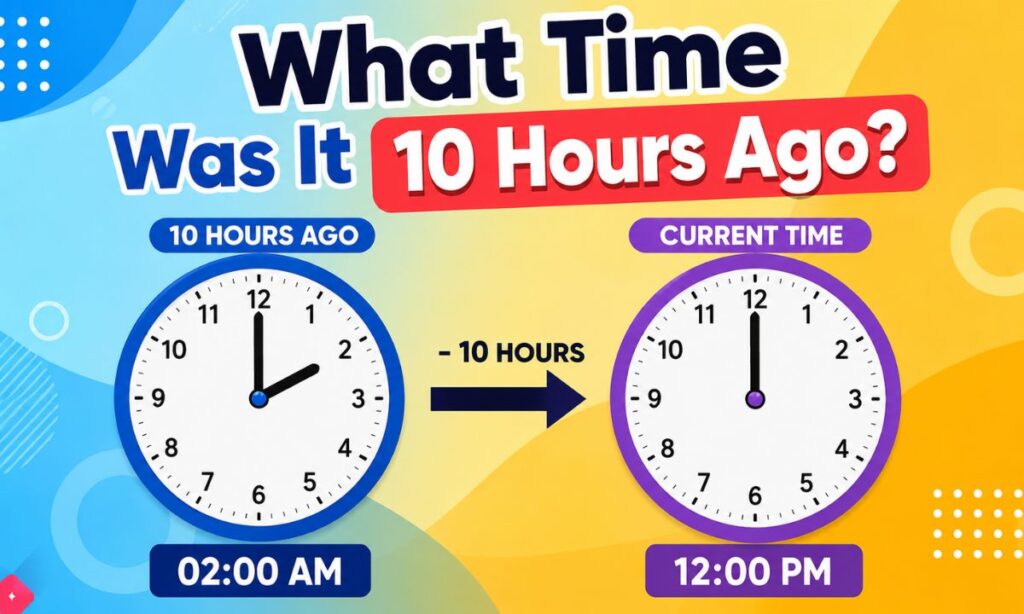
People search this one just as often, especially when they’re trying to figure out when something actually happened.
This time you subtract instead of add.
● 6:19 PM minus 10 hours takes you back to 8:19 AM.
● 5:30 AM minus 10 hours lands on 7:30 PM the day before.
● 12:00 AM minus 10 hours brings you to 2:00 PM yesterday.
This kind of elapsed time thinking shows up a lot in real life. Think of a missed call, a security camera log, or a text message that says sent 10 hours ago. Your brain is quietly doing this subtraction without even noticing.
What Time Is 10 Hours From Now Across Midnight?
This is where most people trip up, so let’s slow way down here.
Say it’s 8:00 PM right now. Add 4 hours and you land right at 12:00 AM, midnight exactly.
You still owe 6 more hours, so keep going. Add those 6 hours and you end up at 6:00 AM, and yes, that’s already the next calendar day.
This flip is called a date rollover, and airlines, hospitals, and booking systems build their whole scheduling logic around it.
Miss this detail once and you might show up a full day early to something important, which is not a fun surprise.
What Time Is 10 Hours From Now in GMT+5?
Here’s something a lot of articles get wrong, so let’s clear it up properly.
If you’re sitting in Pakistan on GMT+5, and your clock says 8:19 AM, then 10 hours from now is still just 6:19 PM, same day, same city.
Your time zone doesn’t actually change this particular math, because you’re staying inside your own local clock the entire time.
Where GMT+5 actually matters is when you’re comparing your time to someone else’s time somewhere else in the world.
That’s a totally different calculation, and it’s exactly what we’re covering next.
Time Zones Change Everything
This is where things actually get interesting, and a little chaotic if you’re not careful.
Say you’re scheduling a call between Pakistan, Europe, and North America.
You already know what 10 hours from now looks like on your own clock. But your teammate in New York is looking at a totally different number, because their local clock runs on its own offset from GMT.
This is exactly why professionals lean on a proper time zone calculator or a world clock app instead of doing mental gymnastics.
Global companies literally schedule thousands of meetings a day using these tools, because guessing leads to someone joining a call at 3:00 AM by accident. Nobody wants to be that person.
Using a Future Time Calculator
If manual math isn’t your thing, and honestly it isn’t for a lot of people, a calculator does the heavy lifting for you.
You punch in your current date, your current time, and how many hours you want to add.
The tool spits out your future timestamp instantly, handling the date calculation and any rollover without you lifting a finger.
Some popular tools worth knowing include an hours from now calculator, a duration calculator, a date difference calculator, and a countdown calculator.
These come in especially handy for longer stretches, like figuring out a date 3 weeks or 16 weeks from today, where mental math gets messy fast.
Real Life Uses of Calculating 10 Hours From Now
This isn’t just trivia, it actually shows up everywhere once you start noticing it.
● Work shifts. A nurse starting a 10 hour shift instantly knows when she clocks out, no guessing needed.
● Flights. Airlines recalculate arrival times constantly, and one delay can push every connecting flight by hours.
● Remote workers. Nobody wants to accidentally book a client call at 3 AM their teammate’s time, trust me, it happens more than you’d think.
● Freelancers. Promising delivery within 10 hours means way more when you actually know the exact clock time that promise lands on.
● Students. Countdown timers before an exam keep study sessions honest and focused.
● Travel plans. Estimating your arrival after a long drive saves you from showing up to a hotel at a weird hour.
● Medication schedules. Doctors often prescribe medicine every 10 or 12 hours, and getting this right actually matters for your health.
● Online gaming. Global tournaments pull players from different continents, and one wrong time zone guess means missing your match entirely.
12 Hour Clock vs 24 Hour Clock
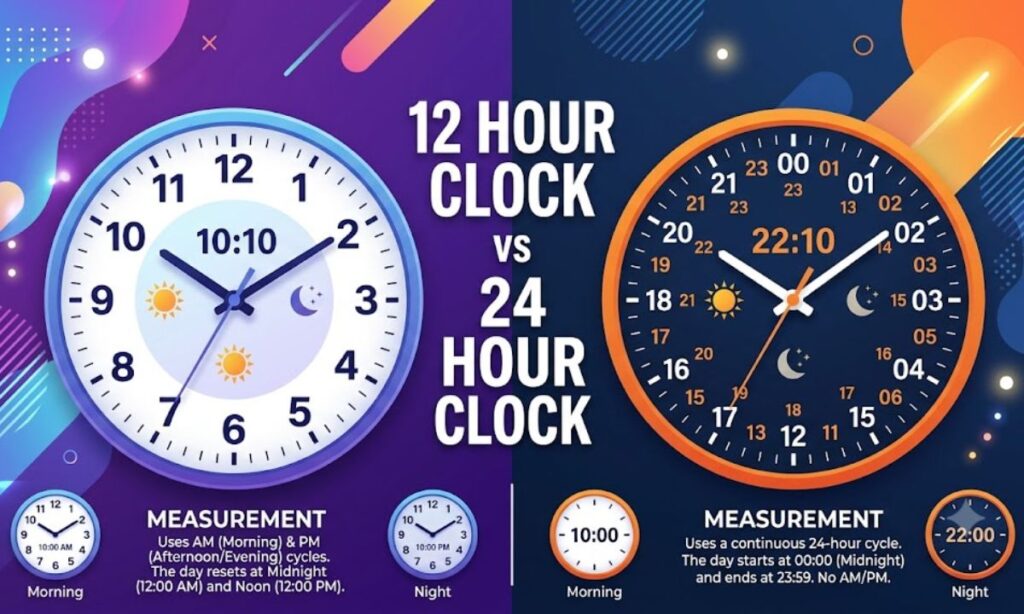
Different countries read time differently, and this trips up travelers all the time.
On a 12 hour clock, you’d see 6:19 PM, 5:30 AM, or 12:00 AM.
On a 24 hour clock, the same times read as 18:19, 05:30, and 00:00.
International teams often prefer the 24 hour format simply because it kills any AM or PM confusion before it starts.
If you’re booking international flights or hotels, get comfortable reading both formats, it saves headaches later.
Common Mistakes When Adding 10 Hours
A few slip ups show up again and again, so let’s name them clearly.
● Forgetting the date changes after midnight is probably the biggest one.
● Mixing up AM and PM comes in a close second, and it’s an easy trap.
● Ignoring your time zone when talking to someone overseas causes more missed meetings than anything else.
● Calculating from yesterday’s time instead of today’s happens more than you’d expect, especially first thing in the morning.
● Forgetting daylight saving adjustments in regions that use it can throw your whole calculation off by an hour.
Double check these small things and you’ll save yourself a lot of unnecessary confusion.
Handy Tools and Apps for Time Math
Beyond basic calculators, a few everyday tools make this whole process painless.
Your phone’s built in world clock app lets you pin multiple cities so you’re never guessing.
Calendar apps let you set an event directly instead of trusting your memory, which let’s be honest, isn’t always reliable.
Reminder apps can ping you the moment your 10 hour mark hits, so you never have to check the clock yourself.
For frequent international calls, browser extensions that show teammates’ local time right next to yours are genuinely a game changer.
Frequently Asked Questions
What time is exactly 10 hours from now?
Add 10 hours to your current local time, and that’s your answer, plain and simple.
How many minutes are in 10 hours?
600 minutes, every single time.
How many seconds are in 10 hours?
36,000 seconds.
How many milliseconds are in 10 hours?
36,000,000 milliseconds.
Does adding 10 hours always change the date?
No, only if your addition carries you past midnight.
How do I calculate future time manually?
Check your current clock, add 10 hours, then check if the date rolled over to the next day.
Why do time zones affect future calculations?
Because different countries sit at different offsets from GMT, so 10 hours later somewhere else might land on a completely different local clock than yours.
Conclusion
At the end of the day, figuring out what time it’ll be 10 hours from now really is as simple as adding 10 to your current clock.
The tricky part isn’t the math, it’s remembering the little details around it, midnight rollovers, AM versus PM, and time zones when other people are involved.
Whether you’re covering a hospital shift, catching a connecting flight, scheduling a call across continents, or just satisfying your own curiosity at 2 AM, this simple skill quietly makes life easier.
Practice it a few times and it becomes second nature, and you’ll find yourself reaching for a calculator less and less.
So next time someone asks you what time it’ll be in 10 hours, you won’t just answer with a number, you’ll actually get why that number matters.