
A gallon of water weighs about 8.34 pounds, or 3.78 kilograms, at normal room temperature.
That’s the quick answer if you’re in a rush.
But stick around, because the real number can shift a little depending on temperature, the type of water, and even where in the world you live.
By the end of this guide, you’ll know exactly how much water weighs in any amount, any container, and any unit you can think of.
Water Weight Calculation
Here’s the formula you’ll use for almost everything in this article.
Water weight = number of gallons x 8.34 pounds
So if you’ve got 10 gallons sitting in a bucket, you just multiply 10 by 8.34 and you get 83.4 pounds.
Simple, right?
This little formula works for pools, tanks, jugs, coolers, basically anything holding water.
Keep it in your back pocket because you’ll use it constantly, whether you’re a plumber, a fish tank owner, or just someone curious about their water bill.
How Much Does 1 Gallon of Water Weigh?
One US gallon of water weighs 8.33 to 8.34 pounds, which comes out to roughly 3.78 kilograms.
That tiny gap between 8.33 and 8.34 isn’t a mistake, it just comes down to water temperature and how precise you want to get.
The USGS actually measured water at 70 degrees Fahrenheit and got 8.329 pounds, which most people round up to 8.33 or 8.34 for everyday use.
For anything you’re doing at home, garage, or backyard, 8.34 pounds is the number to remember.
Save the extra decimal points for scientists and lab techs, they need that kind of precision, you probably don’t.
Why Does a Gallon of Water Weigh 8.34 Pounds?
This comes down to a relationship between volume and density.
A US gallon holds 3.785 liters of liquid, and water sits at close to 1 kilogram per liter under normal conditions.
Multiply those two numbers together and you land on about 3.78 kilograms, which converts to 8.34 pounds.
Here’s the math laid out simply.
3.785 liters times roughly 1 kg per liter gives you 3.785 kg.
Then 3.785 kg times 2.20462 gives you 8.34 pounds.
That’s the whole secret behind the number everyone quotes.
US Gallon VS Imperial Gallon
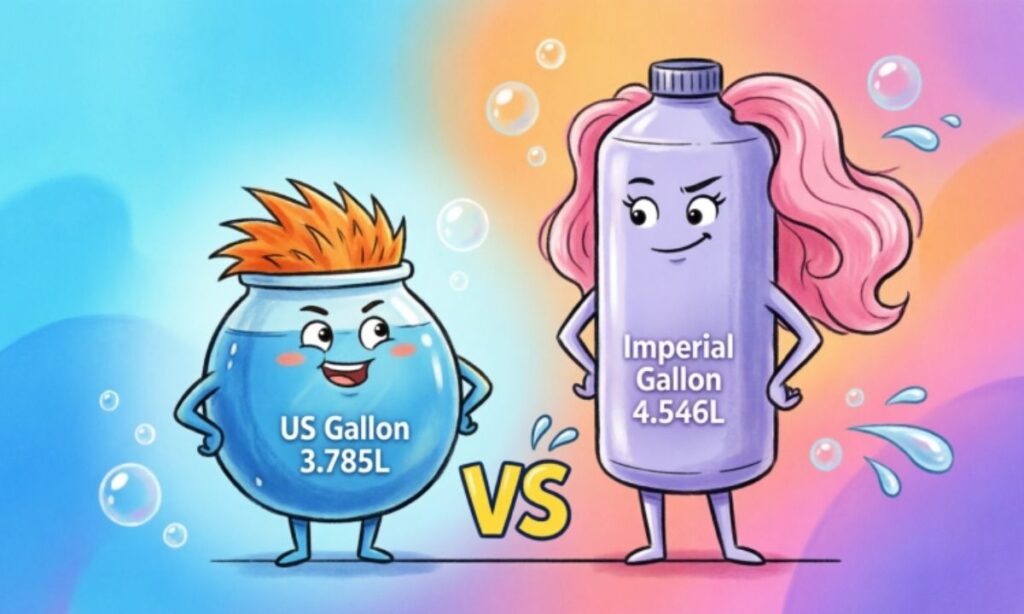
Not all gallons are created equal, and this trips up a lot of people.
A US gallon and an Imperial gallon are two completely different sizes, even though they share the same name.
A US gallon holds 3.785 liters and weighs about 8.34 pounds when filled with water.
An Imperial gallon holds 4.546 liters, which is noticeably bigger, and it weighs closer to 10.02 pounds.
If you’re following instructions from a UK source, or building something based on a British manual, this difference can throw your entire project off.
We’re talking almost 17 pounds of difference on a 10 gallon setup, which is not something you want to guess wrong on.
Always double check whether your source is using US or Imperial gallons before you calculate anything important.
How much does an imperial gallon of water weigh?
An Imperial gallon of water weighs about 10.02 pounds, or roughly 4.54 kilograms, at room temperature.
It’s heavier than a US gallon simply because it holds more liquid, 4.546 liters compared to 3.785 liters.
Since a liter of water weighs almost exactly 1 kilogram, more liters automatically means more weight.
That’s roughly a 20 percent jump compared to the US version.
Think about hauling 50 Imperial gallons versus 50 US gallons.
The Imperial load adds about 501 pounds, while the US load only adds 417 pounds, and that 84 pound gap can genuinely push a small truck past its safe limit.
ALSO READ THIS:How Heavy is 50 Pounds? 11 Common Things That Weigh 50 Pounds
How Much Do Common Amounts of Water Weigh?
People rarely need to know just one gallon, they usually want to know a bigger batch.
Maybe you’re filling a pool, setting up a fish tank, or figuring out if your floor can handle a water tank.
Below, we break down the most common amounts people search for, from a small 5 gallon jug all the way up to a massive 500 gallon tank.
How much does 5 gallons of water weigh?
Five gallons of water weighs about 41.7 pounds, or 18.9 kilograms, at room temperature.
Just multiply 5 by 8.34 and you land right on that number.
Picture the standard water cooler jug at your office or gym, that thing is over 40 pounds once it’s full.
That’s exactly why people throw their backs out trying to swap those jugs without bending their knees first.
Knowing this weight ahead of time helps you plan your grip, your lifting posture, and honestly, whether you need a buddy to help.
How heavy is 10 gallons of water?
Ten gallons of water weighs about 83.4 pounds, close to 37.8 kilograms.
That’s basically two full 5 gallon jugs stacked together.
10 gallons times 8.34 gives you 83.4 pounds, easy math once you know the formula.
A lot of campers and emergency prep folks store water in 10 gallon jugs, and honestly, lifting one of these solo can strain your back if you’re not careful.
Small carts or dollies make this a much safer move than trying to be a hero.
How heavy is 20 gallons of water?
Twenty gallons of water weighs about 166.8 pounds.
That’s 20 times 8.34, nothing fancy about the math here.
This size shows up a lot in medium fish tanks and small rain barrels around the yard.
Once you’re past the 150 pound mark, you really want to think about whether your shelf, stand, or floor can actually hold that much weight safely.
How heavy is 30 gallons of water?
Thirty gallons of water weighs about 250.2 pounds, or roughly 113.5 kilograms.
That’s the same as three full 10 gallon containers lined up together.
30 times 8.34 gets you to 250.2 pounds pretty quickly.
A lot of backyard rain barrels and mid sized aquariums land right around this weight, not counting the barrel or tank itself.
If you’ve got a weak deck or an old wooden stand, this is the point where you really want to double check its rating before filling anything up.
How much does 50 gallons of water weigh?
Fifty gallons of water weighs about 417 pounds, close to 189 kilograms.
That’s five full 10 gallon containers combined into one load.
This size matches up almost perfectly with a standard home water heater tank.
Once you add the metal tank itself, total weight can push past 500 pounds, which is exactly why plumbers always check floor support before installing one.
RV owners dealing with fresh water tanks run into this number constantly too, so it’s worth memorizing if you’re into road trips.
How much does 100 gallons of water weigh?
One hundred gallons of water weighs about 834 pounds, or 378 kilograms.
100 times 8.34 gives you that number instantly.
That’s roughly the weight of a small car engine, just to put it in perspective.
A 100 gallon aquarium holds over 830 pounds of water alone, not counting the glass, gravel, or filters.
At this weight, forget lifting anything by hand, you want a pump, a dolly, or at minimum, a couple of strong friends.
How much does 250 gallons of water weigh?
Two hundred fifty gallons of water weighs about 2085 pounds, close to 946 kilograms.
Multiply 250 by 8.34 and that’s your answer.
Irrigation tanks and rainwater collection systems commonly use this size, and once you toss in the tank itself, total weight can creep past 2200 pounds.
At this scale, you’re not putting this on a regular deck, you need solid ground or a properly reinforced platform underneath it.
How much does 500 gallons of water weigh?
Five hundred gallons of water weighs about 4170 pounds, or 1890 kilograms, which is more than two metric tons.
500 times 8.34 confirms the math.
Small pools and large storage tanks hit this number regularly, and it plays a big role in RV fresh water planning and emergency water storage setups.
At this weight level, even a small calculation mistake can push you past safe axle limits if you’re transporting it, so accuracy really matters here.
Do Water Weight Changes with Temperature?
Yes, water weight does shift a little depending on the temperature it’s sitting at.
Water hits its heaviest point, its maximum density, at around 39.2 degrees Fahrenheit, which is just above freezing.
As water warms up, it actually gets slightly lighter because the molecules spread out a bit.
The USGS found that water at 70 degrees Fahrenheit weighs about 8.329 pounds per gallon, just a hair under the rounded 8.34 figure everyone uses.
For everyday tasks like filling a cooler or a pool, this tiny difference genuinely does not matter.
But if you’re working in a lab, doing engineering calculations, or need lab grade precision, always use the temperature specific number instead of the rounded one.
Does the Type of Water Affect Its Weight?
Yes, the type of water you’re dealing with can change its weight too.
Plain fresh water and water loaded with dissolved minerals or salt are not the same density, salty water is heavier.
That’s exactly why seawater weighs more than the water coming out of your kitchen tap, all those dissolved salts add extra mass.
So 8.34 pounds is your everyday standard for regular fresh water, not some universal law that applies to every liquid calling itself water.
Here’s a fun one for the aquarium crowd.
Saltwater weighs about 8.55 pounds per gallon, so if you’re chasing a 300 pound reef tank setup, you’d need roughly 35 gallons of saltwater to hit that mark.
Do the math: 300 divided by 8.55 lands you at 35.09 gallons, perfect for coral lovers and boat owners tracking live loads.
How Much Does a Gallon of Water Weigh in a Container?

Here’s something people forget constantly, the water itself is only part of the total weight.
Once you add the jug, bottle, tank, or lid, the number climbs higher than the plain water weight alone.
One gallon of water is about 8.34 pounds, plus whatever the container weighs on top of that.
Five gallons comes to 41.7 pounds plus container weight, ten gallons hits 83.4 pounds plus container, and fifty gallons lands at 417 pounds plus the tank itself.
Whenever you’re checking if a shelf, floor, vehicle, or stand can hold your water setup, always calculate both pieces together, water plus container, never just one or the other.
How much does 1 liter of water weigh?
One liter of fresh water at room temperature, around 70 degrees Fahrenheit, weighs approximately 1 kilogram, or about 2.2 pounds.
That works out to roughly 35.2 ounces if you’re measuring by weight in the kitchen.
Water’s density sits right around 1 gram per milliliter, actually closer to 0.998 g/ml at room temp, which is why this conversion feels so clean and easy to remember.
How much does 500 ml of water weigh?
Five hundred milliliters of water weighs approximately 1.1 pounds, or about 17.6 ounces, at 70 degrees Fahrenheit.
Since water’s density at this temperature is nearly a perfect 0.998 g/ml, that 500 ml translates almost exactly to 500 grams of mass.
This clean 1 to 1 ratio is a lifesaver for home cooks and DIYers who want to estimate weight without dragging out a kitchen scale.
How much does a 16.9 oz bottle of water weigh?
A standard 16.9 fluid ounce water bottle weighs approximately 1.12 pounds, or about 17.95 ounces, at room temperature.
To get this number right, you actually need to look at two separate pieces, the liquid and the plastic around it.
The Breakdown: Water vs. Bottle
The water itself, all 16.9 fluid ounces of it, weighs about 1.1 pounds, or 17.6 ounces.
The plastic bottle adds roughly 0.35 ounces, which is about 0.022 pounds, on top of that.
Add them together and you’re carrying approximately 1.12 pounds total whenever you grab that bottle off the shelf.
A Note on Measurement Units
Quick heads up on units here.
These numbers are based on the US fluid ounce, which equals 29.57 ml.
If you’re working with UK Imperial fluid ounces instead, which equal 28.41 ml, your volume and weight will come out slightly lower.
This matters more than people think, especially if you’re calculating shipping weights or packing for international travel.
How Other Liquids Compare
Water isn’t the heaviest liquid in your kitchen, and it’s definitely not the lightest either.
Milk weighs about 8.6 pounds per gallon, a bit heavier than water because of all the fats and proteins floating around in it.
Gasoline comes in much lighter at around 6.1 pounds per gallon, which is exactly why gas floats on top of water during a spill instead of sinking.
Honey is one of the heaviest liquids you’ll find in a kitchen, tipping the scale at about 12 pounds per gallon.
Propane weighs roughly 4.24 pounds per gallon, about half of what water weighs.
Vegetable oil sits around 7.7 pounds per gallon, lighter than water, which is why oil always floats to the top in your salad dressing.
Rubbing alcohol weighs approximately 6.6 pounds per gallon, noticeably lighter than plain water.
Mercury, on the complete opposite end, weighs a jaw dropping 113 pounds per gallon, which is why old school thermometers used such a tiny amount of it.
Maple syrup comes in heavy too, at roughly 11.4 pounds per gallon, just under honey but still much heavier than water.
Knowing these numbers helps explain a lot of everyday kitchen and garage mysteries, like why oil sits on top of soup or why a gas spill floats instead of mixing in.
Why Water Weight Actually Matters in Real Life
This isn’t just trivia for a school project.
Plumbers need this number to check if floor joists can support a water heater tank without sagging or cracking.
Aquarium owners rely on it constantly to make sure their stand or floor can handle a fully stocked tank.
RV owners and campers use it to keep their fresh water tank from throwing off their vehicle’s weight balance.
Movers and shippers need it to calculate freight costs and avoid overloading trucks or trailers.
Even something as simple as filling a kiddie pool for your kids depends on knowing whether your patio deck can take the load.
Quick Reference Chart
Here’s a fast lookup table for the numbers people search for most.
| Amount | Weight in Pounds | Weight in Kilograms |
| 1 Gallon | 8.34 lbs | 3.78 kg |
| 5 Gallons | 41.7 lbs | 18.9 kg |
| 10 Gallons | 83.4 lbs | 37.8 kg |
| 20 Gallons | 166.8 lbs | 75.6 kg |
| 30 Gallons | 250.2 lbs | 113.5 kg |
| 50 Gallons | 417 lbs | 189 kg |
| 100 Gallons | 834 lbs | 378 kg |
| 250 Gallons | 2085 lbs | 946 kg |
| 500 Gallons | 4170 lbs | 1890 kg |
Bookmark this table, it saves you from doing the math every single time.
Frequently Asked Questions
How much does a gallon of water weigh in pounds?
A US gallon of water weighs about 8.34 pounds at room temperature.
Does hot water weigh less than cold water?
Yes, hot water is slightly less dense, so it weighs a tiny bit less per gallon compared to cold water.
Why is saltwater heavier than fresh water?
Dissolved salt adds extra mass to the water without adding much extra volume, which makes it denser and heavier.
Is an Imperial gallon bigger than a US gallon?
Yes, an Imperial gallon holds more liquid, 4.546 liters compared to 3.785 liters in a US gallon.
How much does a 5 gallon water jug weigh full?
A full 5 gallon jug weighs about 41.7 pounds of water, plus the weight of the plastic jug itself.
Conclusion
At the end of the day, a US gallon of water weighs about 8.34 pounds, or 3.78 kilograms, and that number is your go to for almost every everyday situation.
Just remember that temperature, salt content, and whether you’re dealing with a US or Imperial gallon can all nudge that number slightly in either direction.
Whether you’re lifting a jug at the gym, setting up an aquarium, filling an RV tank, or just settling a curious debate with a friend, you now have every number you need.
Bookmark this page, share it with someone who needs it, and drop a comment if you’ve got a water weight question we didn’t cover.