
Stand on the shore of Lake Michigan and you cannot see the other side.
That is not a trick of the eye.
It really is that big, that deep, and that important to millions of lives around it.
Here is the short answer before we go deep.
Lake Michigan covers 22,404 square miles.
It runs 307 miles long and 118 miles wide at its widest point.
Its deepest point drops to 923 feet.
It is the only one of the Great Lakes sitting entirely inside the United States.
And it supplies drinking water to more than 12 million people every single day.
Now let’s break down every piece of that story, one question at a time.
How Big Is Lake Michigan? The Core Dimensions
People usually ask this because they are planning a trip, writing a school paper, or just settling a bar bet.
So here is the deal in plain numbers.
Lake Michigan’s surface area is 22,404 square miles, which is bigger than the entire state of West Virginia.
Its volume sits around 1,180 cubic miles of water.
That is enough water to make your head spin if you try to picture it.
We will make that number feel real in a second.
The lake sits 577 feet above sea level.
That number matters more than it sounds, because it connects directly to Lake Huron, which we will get into later.
Lake Michigan Length, Width, and Shape
The lake stretches 307 miles from north to south.
At its widest, it spans 118 miles across.
Picture a long stretched oval tilted slightly, like someone nudged it while it was still wet clay.
That shape is not just trivia.
It actually causes the brutal lake effect snow that hammers towns like Grand Rapids and Traverse City every winter.
Cold air rolls across all that open water and picks up moisture the whole way down.
The narrow southern tip is where Chicago sits.
That is why the city feels tucked right into the lake’s edge instead of sitting somewhere in the middle of the shoreline.
Volume and What It Means

A number like 1,180 cubic miles does not mean much on its own.
So try this instead.
If you poured all of Lake Michigan across the lower 48 states, every inch of land would sit under more than a foot of water.
That much water is exactly why more than 12 million people in Chicago, Milwaukee, and dozens of smaller towns turn on their tap and get clean drinking water from this lake.
It is not a side benefit.
It is the whole reason those cities exist where they do.
Shoreline Length
The official shoreline length is 1,640 miles.
That number depends a bit on how closely you measure every little bay and inlet, which is a real thing called the coastline paradox.
Zoom in tighter on a map and the number creeps even higher.
Those 1,640 miles cross four states.
Each one looks completely different, and we will walk through that difference a little later in this guide.
How Deep Is Lake Michigan?
Depth is not one simple fact here.
It changes the whole personality of the lake depending on where you stand.
So let’s split it into what actually matters for swimmers, sailors, and scientists.
The maximum depth hits 923 feet near Cheboygan in the northern part of the lake.
Glaciers carved that basin thousands of years ago during the last Ice Age.
It is deep enough to hide entire shipwrecks that nobody has ever found.
But the number that actually runs the show day to day is the average depth, sitting at 279 feet.
Maximum vs. Average Depth
The average depth controls three things that shape the whole lake.
First, it drives thermal stratification, where warm water floats on top of cold water each summer like oil on vinegar.
Second, deeper water holds more heat, which fuels the powerful storms that roll through every fall.
Third, every autumn the surface water cools and sinks in a process called fall turnover.
That single event flips nutrients from the lake floor back up toward the surface.
Fishermen actually plan trips around this cycle because it changes where fish gather.
The Divide From North to South
An underwater ridge splits the lake roughly across the middle.
The northern half stays cold and deep, which is perfect for lake trout and other cold water fish.
The southern half near Chicago and Indiana runs warmer and shallower.
That warmer southern water sees more algae blooms and hosts a totally different mix of fish.
So depending which end of the lake you visit, you are basically looking at two different ecosystems wearing the same name.
Lake Michigan Size vs. Other Lakes
People love a good comparison, so here is the honest one.
Against its Great Lakes siblings and against the biggest lakes on Earth, here is exactly where Lake Michigan stands.
Here is a fact most articles skip entirely.
Lake Michigan and Lake Huron are technically one single body of water.
They connect at the Straits of Mackinac and share the exact same 577 foot surface elevation.
Combined, Michigan Huron becomes the largest freshwater lake on Earth by surface area, bigger even than Lake Superior.
Great Lakes Size Comparison
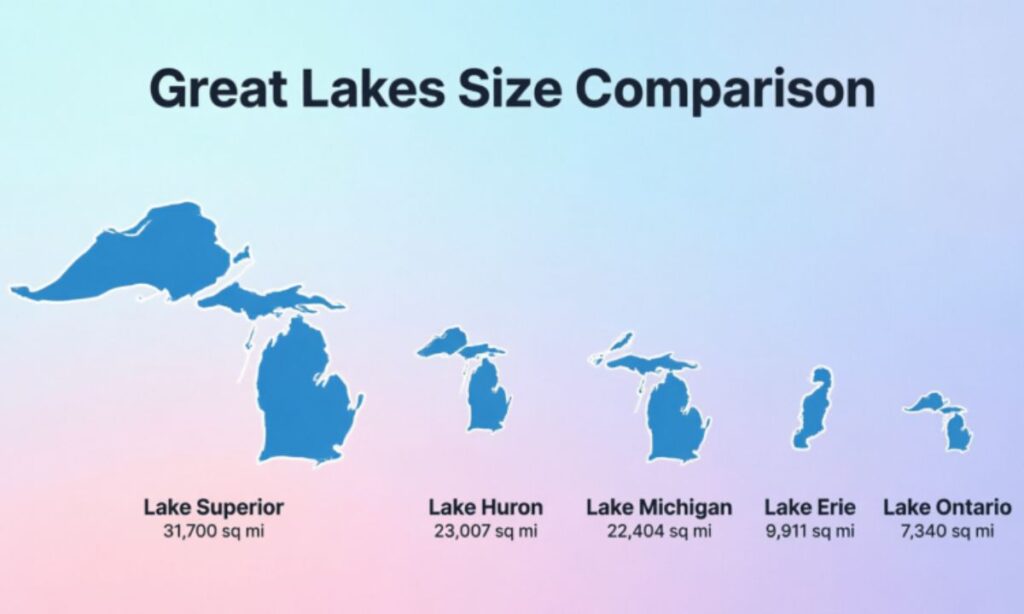
Treated as separate lakes, here is how they stack up.
• Lake Superior: 31,700 square miles, 1,332 feet max depth, 2,900 cubic miles of water
• Lake Huron: 23,000 square miles, 750 feet max depth, 850 cubic miles of water
• Lake Michigan: 22,404 square miles, 923 feet max depth, 1,180 cubic miles of water
• Lake Erie: 9,910 square miles, 210 feet max depth, 116 cubic miles of water
• Lake Ontario: 7,340 square miles, 802 feet max depth, 393 cubic miles of water
Superior wins on every measurement.
But Lake Michigan alone still holds more water than Erie and Ontario combined.
Global Lake Comparison
Zoom out to the whole planet and the picture shifts again.
• Lake Superior: 31,700 square miles, the largest freshwater lake by area on Earth
• Lake Victoria in Africa: 26,600 square miles, but shallow compared to the top lakes
• Lake Michigan: 22,404 square miles, the only Great Lake sitting entirely inside the United States
• Lake Tanganyika in Africa: 12,700 square miles, and the deepest lake on the continent
• Lake Baikal in Russia: 12,248 square miles, yet holding roughly a fifth of all unfrozen fresh water on the planet
Lake Baikal wins on sheer depth and volume even though it is smaller in area.
Lake Michigan wins on size.
Together, the Great Lakes hold about 21 percent of all the surface fresh water on Earth, and Michigan is a huge part of that total.
ALSO READ:2 Inches: 18 Everyday Items That Help You Visualize Measurement
The Shoreline: What 1,640 Miles Actually Looks Like
Every state touching this shoreline tells a completely different story.
It is not one long beach.
It is four separate personalities stitched together.
Wisconsin gives you bluffs, bays, and the Door Peninsula, often nicknamed the Cape Cod of the Midwest.
Illinois only gets 63 miles, almost entirely urban, but that includes Chicago’s Lakefront Trail, one of the best city waterfronts anywhere in the country.
Indiana gets just 45 miles, yet that stretch holds Indiana Dunes National Park, where freshwater dunes rise 200 feet into the sky.
Michigan claims the longest stretch of all, anchored by Sleeping Bear Dunes National Lakeshore, where dunes tower up to 400 feet above the water.
Lake Michigan Islands
The islands scattered across the lake each have their own character.
• Mackinac Island: 3.8 square miles, no cars allowed, and the most visited island on any Great Lake
• Beaver Island: 55 square miles, the largest island in Michigan waters, home to a small year round community
• North Manitou Island: 15 square miles of pure wilderness, reachable only by ferry
• South Manitou Island: 7.4 square miles, home to a historic lighthouse and an ancient cedar forest
• Washington Island: about 35 square miles, sitting off the tip of the Door Peninsula in Wisconsin
Water Quality and the Invasive Species Problem
Clean water here is not automatic.
It is a constant fight against real threats.
Water quality on Lake Michigan depends just as much on how the lake moves as on what people dump into it.
How the Lake Circulates
The lake moves in a giant counter clockwise loop.
Water pushes north along the Michigan shore and south along the Wisconsin shore.
That is exactly why one beach can close for E. coli while a beach just a few miles away stays perfectly clean.
The water retention time runs close to 99 years.
Water entering the lake today will not fully leave for about a century.
That single fact explains why pollution here takes generations to clean up, not just a few years of good policy.
The Mussel Paradox
Zebra mussels hitched a ride into the lake through ballast water in the late 1980s.
Quagga mussels followed soon after.
Both species filter tiny plankton out of the water so efficiently that visibility in parts of the southern lake jumped from about 15 feet to nearly 60 feet.
That sounds like great news.
It was actually a disaster.
That plankton was food for perch, alewives, and salmon, and once it disappeared, the whole nearshore food chain collapsed almost overnight.
Asian carp remain the next big threat, waiting at the Chicago waterway connection.
A 778 million dollar barrier system at Brandon Road Lock and Dam is currently the main defense keeping them out.
Economic Importance of Lake Michigan
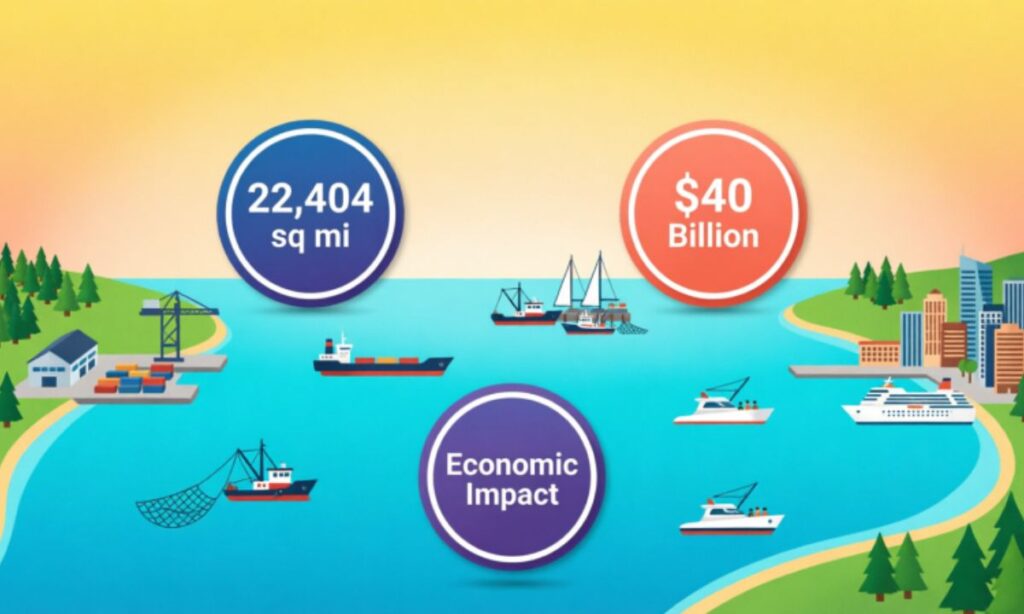
This lake is not just scenery.
It is a working economic engine that touches heavy industry, food, tourism, and daily drinking water all at once.
Ports and Shipping
Shipping on the lake connects straight into the Great Lakes St Lawrence Seaway, letting ocean ships reach deep into North America.
• Chicago Harbor in Illinois handles containers, steel, and grain
• Milwaukee Port in Wisconsin moves salt, coal, and steel
• Green Bay Port in Wisconsin ships paper, salt, and aggregate
• Burns Harbor in Indiana focuses almost entirely on steel
Fishing and Tourism
Commercial fishing here centers on lake whitefish and yellow perch, carefully managed under state and tribal agreements.
The Chippewa and Ojibwe nations hold treaty protected fishing rights across large parts of Michigan waters, a piece of history that rarely makes it into typical travel guides.
Tourism brings in serious money every single year.
• Indiana Dunes National Park pulls in more than 3 million visitors annually
• Sleeping Bear Dunes National Lakeshore draws over 1.5 million visitors each year
• Chicago’s lakefront alone sees tens of millions of visits annually
And the most important economic job of all is drinking water.
Chicago’s Jardine Water Purification Plant alone processes more than 700 million gallons every single day.
The Future: Water Levels, Climate, and Conservation
The past of this lake is impressive.
The future is genuinely uncertain, and that is worth taking seriously.
Record Breaking Water Level Swings
Between 2013 and 2020, the water level swung almost 6 feet, from a historic low to a near record high in just seven years.
Three forces drove that swing.
• Wetter winters pushed levels up starting around 2013
• Warmer temperatures increased evaporation off the surface
• Winter ice cover dropped sharply over the decades, which increases evaporation even more
Climate change does not seem to mean a slow steady rise here.
It means wilder swings between record lows and record highs, back and forth.
The Diversion Fight
The Great Lakes Compact, signed in 2008, bans most water diversions outside the basin.
As drought and water shortages grow worse across the American West and South, pressure to break that agreement grows a little bit stronger every single decade.
What’s Actually Working
Good news does exist here too.
The Great Lakes Restoration Initiative has invested more than 4 billion dollars since 2010, and it shows real results.
• Sea lamprey numbers dropped by about 90 percent through chemical treatment and barrier dams
• Phosphorus pollution has fallen sharply since the 1970s, which is why Lake Michigan has avoided the massive algae blooms that plague Lake Erie
• Wetland restoration along the southern and western shoreline is improving both filtration and fish habitat
• Over 100 polluted Areas of Concern have been targeted for cleanup, and several have already been officially delisted
Best Time to Visit Lake Michigan
If you are planning a trip, timing changes everything.
Late June through early September gives you the warmest water and the busiest beaches.
September and October bring cooler crowds, colorful dunes, and calmer water, which many locals actually prefer.
Winter turns the lake into something almost otherworldly, with ice caves forming along parts of the Michigan shoreline in especially cold years.
Just know that swimming season is short, so plan around July and August if warm water is the goal.
Fun Facts About Lake Michigan
Save these for your next road trip or trivia night.
• It has its own version of the Bermuda Triangle, nicknamed the Lake Michigan Triangle, centered near Benton Harbor, where a Northwest Airlines flight vanished in 1950 with 58 people aboard and was never found
• The sand dunes on the eastern shore actually migrate inland at up to 4 or 5 feet per year, slowly burying entire forests
• Chicago engineers reversed the flow of the Chicago River in 1900, making it drain away from the lake instead of into it
• On brutally cold mornings, the lake produces sea smoke, an eerie fog created when cold air meets warmer water
• Researchers have found a 10,000 year old forest still rooted in its original soil beneath shallow parts of the lake near Sleeping Bear Dunes
• Somewhere between 1,500 and 2,000 shipwrecks rest on the lake floor, more than are found in the actual Bermuda Triangle
• The lake almost never fully freezes, with most winters seeing only 40 to 70 percent ice coverage
• Despite feeling like an ocean, true tides here measure less than an inch, though wind driven waves called seiches can shift water levels by a foot or two between shores
Quick Quiz: How Well Do You Know Lake Michigan?
Test yourself before you scroll down.
1. Lake Michigan is the only Great Lake located entirely in which country?
A) Canada B) United States C) Both countries D) Neither one
2. About how long does water take to fully cycle through the lake?
A) 10 years B) 25 years C) 99 years D) 200 years
3. Which invasive species made the water clearer while wrecking the food chain?
A) Asian carp B) Sea lamprey C) Zebra and quagga mussels D) Alewife
4. What connects Lake Michigan and Lake Huron into one water body?
A) The Chicago River B) The Straits of Mackinac C) The Welland Canal D) The St Lawrence Seaway
Answers
1 is B. 2 is C. 3 is C. 4 is B.
Score yourself.
4 out of 4 means you basically live on this lake.
2 or 3 out of 4 is solid, better than most people ever manage.
0 or 1 out of 4 just means it is time to plan a visit and see it for yourself.
FAQs About Lake Michigan
Does Lake Michigan have tides like an ocean?
Technically yes, but you would never notice them.
Real gravity driven tides measure less than an inch.
What you actually see are seiches, wind driven sloshes that can shift water a foot or two between shores.
How many shipwrecks sit at the bottom of the lake?
Somewhere between 1,500 and 2,000, more than the actual Bermuda Triangle holds.
Cold fresh water preserves wrecks far better than salt water ever could.
Why doesn’t the lake freeze completely in winter?
The sheer volume of water holds too much heat for a full freeze in most years.
Most winters land somewhere between 40 and 70 percent ice coverage, and only a handful of winters in recorded history have come close to full freeze.
Conclusion
Lake Michigan’s numbers tell a real story, not just trivia.
22,404 square miles of surface, 923 feet of maximum depth, and 1,640 miles of shoreline all add up to a system that supplies drinking water to millions, powers a massive regional economy, and still faces real pressure from invasive species and a shifting climate.
The measurements are locked in.
What happens next inside them is still being written, and honestly, that is the part worth paying attention to.