
The short answer is simple. Take the current time and subtract it from 12:00 PM. If it is 9:00 AM right now, you have 3 hours left. If it is 11:40 AM, you only have 20 minutes.
That is the whole trick behind how long until 12:00 PM. But there is more to noon than a math problem. Keep reading and you will see why so many people check the clock for this exact moment, and how you can use that countdown in ways you never thought about.
Whether you are timing lunch, waiting on a meeting, or just curious, this guide walks through the full picture. You will get the quick math, the common mix ups, and a few tricks that make tracking noon actually useful.
Understanding How Long Until 12:00 PM
Here is the deal. Noon sits exactly in the middle of a 24 hour clock. So to find your wait time, you just subtract your current hour and minute from 12:00.
Say it is 8:15 AM. That means you have 3 hours and 45 minutes left until noon. Simple subtraction, nothing fancy.
If it is already past 12:00 PM, you are not counting down to today’s noon anymore. You are counting toward tomorrow’s noon, which resets the whole countdown timer.
Most people do this math in their head without even noticing. You glance at your phone, see 10:47 AM, and instantly know lunch is a little over an hour away. That instinct is exactly what a noon countdown formalizes into something you can plan around.
● 7:00 AM means 5 hours left
● 9:45 AM means 2 hours 15 minutes left
● 11:58 AM means 2 minutes left
● 12:01 PM means 23 hours 59 minutes left, until the next noon
If you want the answer down to the second, the math stays the same, just add seconds to the mix. At 8:34:01 AM, you are looking at 3 hours, 25 minutes, and 59 seconds left, which comes out to roughly 12,359 seconds total. That level of detail matters more for things like countdown apps and live event timers than everyday planning.
You do not need a calculator for most of this. A quick glance at the clock and a little practice is usually enough to estimate your remaining time within a minute or two, which is close enough for almost anything you are planning around noon.
Why People Search “How Long Until 12:00 PM”
People do not search this just for fun. Most of the time it is tied to something real, like lunch, a meeting, or a deadline that lands right at midday.
Think about a student staring at the classroom clock, waiting for the lunch bell. Or a worker with a call booked for 12:00 PM sharp, checking the time every few minutes out of habit.
This search also spikes on weekdays more than weekends, because that is when schedules matter most. A noon countdown becomes a small checkpoint that breaks the morning into something more manageable.
There is also a real psychological pull behind checking the clock this often. Time does not feel the same to everyone in every moment. A boring task can drag the last twenty minutes before noon into what feels like an hour, while an interesting one can make that same stretch disappear.
That is part of why “how long until noon” gets searched so often on weekday mornings specifically. People are not just curious about the number. They are looking for a small sense of control over a morning that might otherwise feel like it is dragging on forever.
Real life examples make this easy to picture. A nurse on a twelve hour shift might count down to noon as her unofficial halfway point. A parent working from home might count down to noon because that is when the school pickup planning starts. Neither of them needs a fancy tool, just a quick, honest answer.
How Countdown Timers Help With Daily Planning
A good countdown timer takes the guesswork out of your day. Instead of doing mental math every ten minutes, you glance at a timer and know exactly where you stand.
Picture someone cooking a big lunch for guests arriving at noon. They set a timer for each dish, working backward from 12:00 PM, so everything lands on the table hot and on time.
The same idea works for work calls, gym sessions, or school periods. A daily planning tool built around noon gives your whole morning a clear finish line to aim for.
● Cooking: time each dish to finish right before noon
● Work: set a reminder 15 minutes before a noon meeting
● Study: use noon as a natural break point between subjects
● Fitness: schedule a midday workout with a countdown alert
Phone apps make this even easier than it used to be. Most phones let you set a repeating alarm for a set number of minutes before noon, so you get a heads up without checking the clock every five minutes.
Some people prefer a visible countdown running in the background while they work, almost like a race against the clock. Others just want a single alert at the fifteen minute mark. Either approach works, the point is picking whatever keeps you from losing track of the morning.
For teams working together, a shared countdown can double as a soft deadline. Telling a group “wrap it up by noon” gives everyone the same clear target, instead of a vague sense that lunch is coming up soon.
ALSO READ THIS:https://measureaxis.com/12-hours-from-now/
Time Conversion: From AM and PM to 24-Hour Format
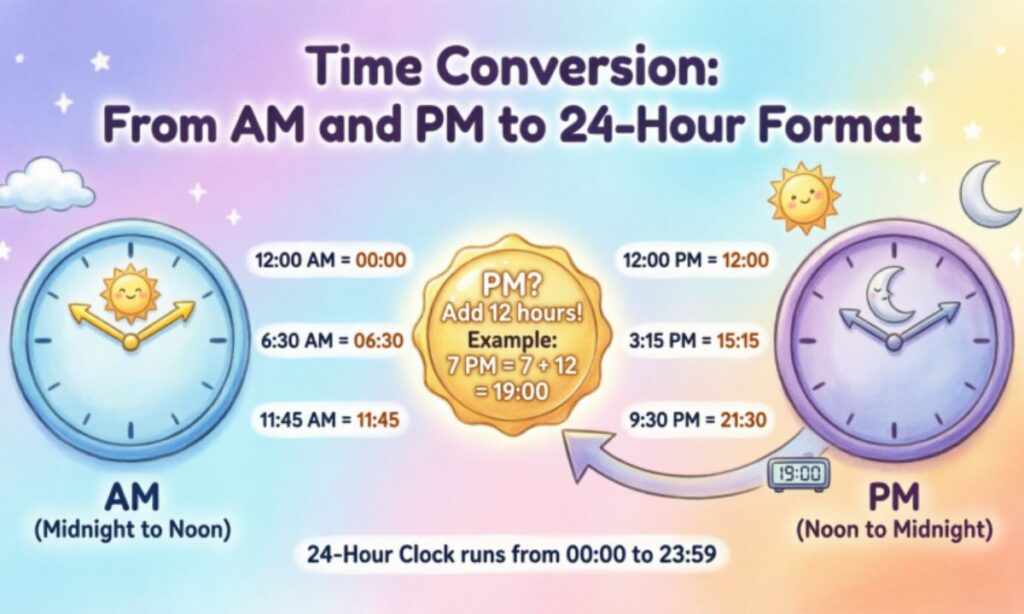
Noon causes more mix ups than almost any other time of day. In the 12 hour clock it is written as 12:00 PM. In the 24 hour clock, the same moment is written as 12:00 or 1200 hours.
Here is where people trip up. Midnight is 12:00 AM, not 12:00 PM, and mixing those two up can throw off flights, meetings, and even medicine schedules. Noon and midnight sit exactly 12 hours apart, but they often get typed the wrong way by mistake.
A quick AM PM conversion trick: anything from 12:00 to 12:59 in the afternoon stays the same in 24 hour format, just drop the PM. Anything from 1:00 PM onward, add 12 to the hour.
The opposite trick works for the morning hours too. From 1:00 AM to 11:59 AM, the 24 hour format matches the number you already see, just remove the AM. Midnight is the only real exception, since 12:00 AM becomes 00:00, not 12:00.
Airlines, hospitals, and the military rely on the 24 hour format specifically to avoid this confusion. When a flight is booked for “1200,” there is zero chance of mixing it up with midnight, which is exactly why the format sticks around in fields where mistakes are costly.
| 12 Hour Format | 24 Hour Format |
| 12:00 AM | 00:00 |
| 9:00 AM | 09:00 |
| 12:00 PM | 12:00 |
| 3:00 PM | 15:00 |
| 11:59 PM | 23:59 |
How Time Zones Affect the Noon Countdown
Your how long until 12:00 PM today answer depends completely on where you live. Someone in Lahore hits noon at a totally different real world moment than someone in New York or London.
This matters a lot for remote teams. A manager in one time zone might schedule a “noon call” without realizing their teammate on the other side of the planet is eating dinner, not lunch.
Daylight saving time adds another twist. Some countries shift their clocks forward or back twice a year, which quietly moves the local noon by an hour, even though the number 12:00 never changes on paper.
● Always confirm which time zone a “noon meeting” refers to
● Use a world clock app when working across countries
● Remember that daylight saving time can shift noon locally
● Double check dates near time zone changes, mistakes happen often
Here is a real example. A team lead in Lahore schedules a “noon call” for a colleague in London. Without checking, they might not realize Lahore sits five hours ahead, meaning their noon lands around 7:00 AM in London, well before most people are even at their desks.
This kind of mix up happens constantly with remote teams, and it is almost always avoidable. Writing the time zone directly into the invite, something like “12:00 PM PKT,” removes the guesswork entirely and saves everyone an awkward reschedule.
Creative Ways to Use a Noon Countdown
Noon does not have to be boring. Teachers use a countdown to build excitement before a lunch break or a class reward. Parents use it to keep younger kids patient before a midday snack.
Businesses lean on it too. A store might run a “noon flash sale,” where the discount only lasts until 12:00 PM, creating urgency without needing a long promotion.
Even a wedding planner might time a first look or toast to land right at noon, since midday light photographs beautifully outdoors. A simple number on a clock can shape real moments like these.
● Classroom reward countdown before lunch
● Flash sale that ends exactly at noon
● Outdoor photos timed for midday light
● Family lunch countdown to build anticipation
Content creators use noon deadlines too. A blogger might schedule a post to go live at exactly 12:00 PM, since that is often when engagement picks up during a normal workday. It is a small detail, but timing content around noon can genuinely change how many people see it.
Radio stations and podcasts sometimes build entire segments around the noon hour, calling it something like a “midday check in.” Listeners get used to that rhythm, tuning in right as their own personal countdown to lunch wraps up.
How to Make Time Messages More Personal
A plain reminder like “10 minutes left” gets the job done, but it does not connect with anyone. Add a little personality and the same message feels human.
Instead of “meeting at noon,” try something like “grab your coffee, we are on in 10.” It says the same thing but feels like it came from a person, not a robot.
Small touches like a person’s name, an inside joke, or a shared plan make time messages memorable. People remember how a reminder made them feel long after they forget the exact minute it mentioned.
This matters most with people you actually work or live with. A coworker who sends “hey, five minutes till we’re on, grab water” feels far more human than a calendar notification firing off automatically.
Try building this habit into reminders you send often. A short, honest line beats a long, generic one every single time, and it takes barely any extra effort to write.
Common Mistakes People Make With Noon Countdowns
Even something as simple as counting to noon trips people up more than you would expect. Mixing up AM and PM is the most common one, and it happens even to careful planners.
Another mistake is forgetting time zones entirely when scheduling with someone in another region. A “noon call” typed without a time zone label is basically a guess, not a plan.
People also forget that once the clock passes 12:00 PM, the countdown resets for the next day, not the same day. That mix up alone causes plenty of missed lunches and late meetings.
● Do not confuse 12:00 AM with 12:00 PM
● Always label the time zone in shared invites
● Remember the countdown resets after noon passes
● Do not trust a rounded number when seconds actually matter
One more mistake worth mentioning is relying on a device that has not synced its clock recently. Phones usually update automatically, but older devices, wall clocks, and some car dashboards can drift by a minute or two over time without anyone noticing.
That small drift does not matter much for a casual lunch plan. It matters a lot for things like timed exams, live broadcasts, or countdowns tied to a specific public event.
Expert Tips for Managing Your Noon Countdown
People who manage packed schedules for a living lean on a few simple habits around noon. First, they treat noon as a hard checkpoint, not a soft guess, and build buffer time around it.
Second, they set two reminders instead of one, an early heads up and a final alert closer to 12:00 PM. This gives enough time to wrap up whatever came before without rushing.
Third, they write times using both formats when sharing with a group, something like “12:00 PM (1200 hours).” That one habit alone cuts down on scheduling mix ups across teams and time zones.
A fourth habit worth borrowing comes from event planners. They build in a five minute cushion before any noon deadline, so a slightly late guest or a delayed dish does not throw the entire schedule off.
None of these tips require special software or training. They are just small, repeatable habits that turn a vague sense of “it’s almost noon” into an actual, reliable system.
10 Common Things You Can Do While Waiting for Noon
Waiting for the clock to hit 12:00 PM does not have to feel wasted. Plenty of small, useful tasks fit neatly into that morning stretch.
Most people spend the final stretch before noon on autopilot, scrolling or half working. A short list of intentional tasks turns that same window into something productive, without adding pressure.
Here are ten things worth doing while the clock ticks toward midday.
1. Prep lunch ingredients ahead of time
2. Answer quick emails before the busy afternoon starts
3. Take a short walk to reset your focus
4. Review your to do list for the rest of the day
5. Drink a full glass of water before your next meal
6. Tidy your desk or workspace for five minutes
7. Send a reminder to anyone joining a noon call
8. Stretch for a couple of minutes to shake off morning stiffness
9. Read one short article or newsletter
10. Plan your afternoon around what noon leaves behind
Frequently Asked Questions About Time Until Noon
How many minutes until 12 PM today?
Subtract your current time from 12:00 PM. If it is 10:30 AM, you have 90 minutes left.
How many seconds until noon?
Take the remaining minutes and multiply by 60. Ten minutes left equals 600 seconds.
What time is noon?
Noon is 12:00 PM, the exact midpoint of daytime hours on a standard clock.
Is 12:00 PM the same as 1200 military time?
Yes, they mean the exact same moment. Midnight, though, is 0000 or sometimes written as 2400.
Does noon change with daylight saving time?
The number 12:00 PM stays the same, but the real world moment can shift by an hour during clock changes.
Why do people say “noon” instead of “12:00 PM”?
Noon is just a shorter, older word for the same moment. Both terms mean the exact middle point of the daytime clock.
Is there a difference between noon and midday?
Not really, both words describe 12:00 PM. Midday is used a bit more in casual or British English, while noon is common everywhere.
Conclusion
Figuring out how long until 12:00 PM really comes down to one simple subtraction. But as you have seen, noon touches everything from lunch plans and work calls to time zones and daylight saving shifts.
Use a countdown timer when it helps, but also use noon as a natural checkpoint to reset, refocus, and plan your afternoon. Small habits around this one moment in your day can make your whole schedule run smoother.
Whether you use a phone timer, a simple mental subtraction, or a shared team reminder, the goal stays the same. Know your number, plan around it, and let noon do its job as the hinge between your morning and afternoon.
Got a favorite way you track the countdown to noon? Drop it in the comments below and share this with a friend who is always asking “how much longer until lunch?”