
If it’s 9:15 PM right now on a Wednesday, then 11 hours ago it was 10:15 AM on that same day.
The math is simple once you see it. You just move the clock back 11 hours and keep the minutes the same.
Most people search this because they are checking a log, a text message, or trying to remember when something actually happened. This guide gives you the fast answer first, then walks you through everything else so you never have to guess again.
Understanding Time Calculation in Everyday Life
Time calculation feels like a small thing until you actually need it for something real. You check a delivery time, a work shift, or a missed call, and suddenly you are doing math in your head.
Our brains are wired to move forward in time, not backward. That is why counting hours ahead feels natural, but subtracting hours ago always takes a second longer to click.
This isn’t just a random question people type into Google for fun. It shows up in real situations like checking elapsed time on a security camera, figuring out a medicine schedule, or settling an argument about when a call actually came in.
ALSO READ THIS:What Date Is 12 Weeks From Today?
How to Calculate What Time Was 11 Hours Ago Manually
You don’t need an app for this. A little time subtraction and a piece of paper will do the job just fine.
Here is the three step method that works every single time, no matter what the starting hour is.
Step 1: Note the Current Time
Start by writing down the exact current time you are working from.
Let’s use 9:15 PM on Wednesday, August 19, 2026 as our example for this whole guide.
Write the minutes down separately in your head. They usually don’t change during this kind of hour subtraction.
Step 2: Subtract Eleven Hours
Now count backward one hour at a time, or just subtract 11 from the hour number if you are using a 24 hour clock.
9:15 PM in 24 hour time is 21:15. Subtract 11 and you get 10:15, which is 10:15 AM.
The minutes stay exactly the same the whole way through. Only the hour moves.
Step 3: Check the Date
This is the step people skip, and it is the one that causes most mistakes.
In our example, 9:15 PM minus 11 hours lands at 10:15 AM on the same day, since we never crossed midnight.
But that is not always true, and the next section explains exactly when the date flips.
Why the Date Sometimes Changes
Here is the part that trips almost everyone up at least once. If your current time is early in the morning, subtracting 11 hours can push you into the day before.
Say it is 5:00 AM right now. Subtract 11 hours and you land on 6:00 PM the previous day, not the same day.
Below is a quick reference so you can check your own answer without doing the math twice.
| Current Time | 11 Hours Ago | Date Shift |
| 9:15 PM | 10:15 AM | Same day |
| 6:00 AM | 7:00 PM | Previous day |
| 3:30 AM | 4:30 PM | Previous day |
| 11:00 AM | Midnight | Previous day |
| 1:00 PM | 2:00 AM | Same day |
The general rule is simple. If the current hour on a 24 hour clock is 11 or higher, you stay on the same day. If it is below 11, you slide back to the day before.
What Time Was It 11 Hours Ago Across Different Time Zones
Time zones change everything about this calculation, and a lot of people forget that part.
If it is 9:15 PM in New York, that is not 9:15 PM everywhere else on the planet. Someone in London or Karachi is looking at a completely different clock at that exact same moment.
So when you subtract 11 hours, you have to subtract it from your own local time first, not someone else’s. Once you have your local answer, you can convert it to another zone if you need to compare notes with a friend or coworker somewhere else.
This is exactly why big companies use one shared reference point, usually UTC, instead of trusting everyone’s local clock to line up on its own.
Using a Time Calculator
Doing the math by hand is fine for one calculation. But if you are doing this ten times a day, a time calculator saves your brain some work.
Online tools handle hour subtraction, hour addition, date flips, and even AM/PM conversion in one click. You type in a time, hit subtract, and it spits out the answer instantly.
These calculators are genuinely useful for people juggling schedules, like:
● Shift workers checking clock in and clock out times
● Parents tracking a baby’s feeding or sleep schedule
● Freelancers logging billable hours across time zones
● Anyone reviewing a timestamp on a photo, message, or file
The manual method is great for learning it. The calculator is great for speed once you already understand the logic.
Converting Eleven Hours Into Different Units
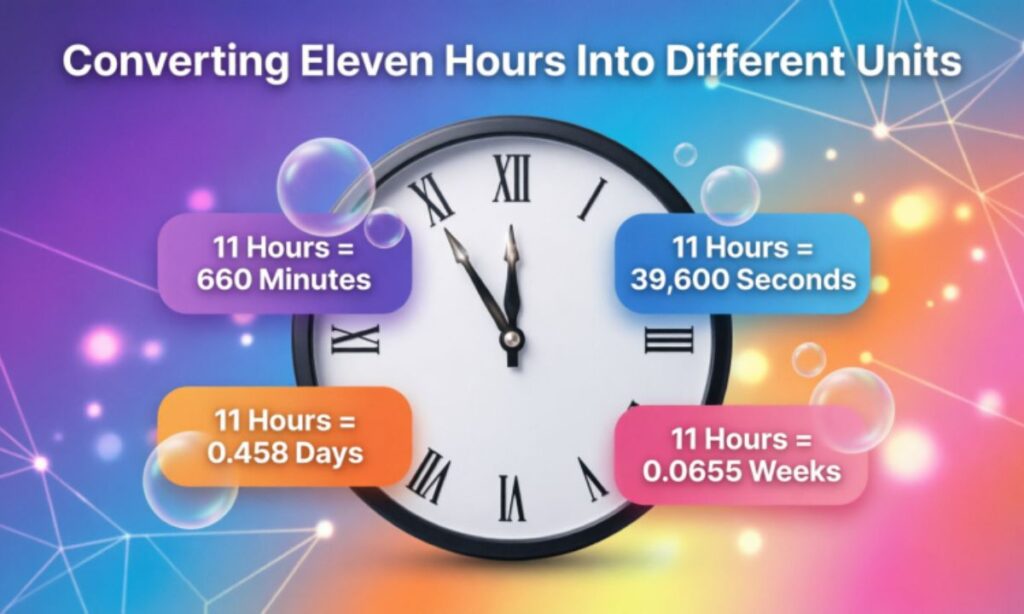
Sometimes you don’t need clock time. You need the raw number for a spreadsheet, a script, or a project timeline.
Here is 11 hours broken down into smaller units of measurement.
| Unit | Value |
| Minutes | 660 |
| Seconds | 39,600 |
| Milliseconds | 39,600,000 |
That is 11 multiplied by 60 to get minutes, then multiplied by 60 again for seconds, then by 1000 for milliseconds. This kind of duration conversion shows up a lot in coding, data logs, and anything dealing with a timestamp.
Why Computers Handle Time Better Than Humans
Computers never mix up AM and PM. They don’t forget that midnight exists either.
That is because a computer does not actually see a clock face at all. It just stores time as one long number, usually counted in milliseconds from a fixed starting point, and does basic subtraction on that number.
Humans read a clock visually, which is convenient but also where mistakes creep in. A computer just crunches numbers, so it never gets confused about whether 11 hours ago crossed into yesterday.
What Time Was It 11 Hours Ago Versus Hours From Now
People mix these two up constantly, so let’s clear it up in one place. One looks backward, the other looks forward, and they use opposite math.
Looking Back
Looking back means subtraction. You take your current time and pull it back by however many hours you need.
Using our 9:15 PM example, 11 hours ago is 10:15 AM the same day. That is the past.
Looking Forward
Looking forward means addition instead. You take the current time and push it ahead.
If it is 9:15 PM now, 11 hours from now would be 8:15 AM the next morning. Same 11 hours, completely opposite direction, and a completely different answer.
Common Mistakes When Calculating Eleven Hours Ago
Here are the 10 most common slip ups people make with this kind of time subtraction, including two that rarely get mentioned anywhere else.
● Mixing up AM and PM after crossing over the 12 hour mark
● Forgetting the date changes when subtraction crosses midnight
● Subtracting 12 hours by accident instead of 11
● Ignoring the time zone, especially when texting someone in another region
● Changing the minutes when they should stay exactly the same
● Misreading a 24 hour clock, like reading 21:15 as 2:15
● Rounding the time, like treating 9:47 as 9:45 to make the math easier
● Forgetting daylight saving time, which can shift the real difference by an extra hour twice a year
● Trusting a phone’s auto time zone when traveling, since it sometimes updates late
● Not double checking the final answer against the original starting time
Daylight saving and phone auto sync are the two that almost never show up on other guides, but they cause real confusion for travelers and remote teams more often than people admit.
Everyday Situations Where This Calculation Matters

Nobody Googles this just out of curiosity. It is almost always tied to something practical happening in real life.
Here are situations where knowing the exact past time actually matters.
● Checking when a security camera clip was actually recorded
● Confirming an employee’s clock in time for payroll
● Tracking medication timing between doses
● Reviewing sleep tracking data from a smartwatch
● Verifying a delivery timestamp on a package
● Cross checking a flight departure against a boarding pass
● Reading server logs during a tech outage
● Timing a workout session logged by a fitness app
Every one of these depends on getting the hour and the date right at the same time.
Similar Time Calculators You Might Need
Once you start using one calculator, you usually end up needing a few more. Here are the 10 related tools people search for most, filled out to the full list.
● Hours ago calculator
● Hours from now calculator
● Date calculator
● Time difference calculator
● Elapsed time calculator
● Future time calculator
● Online time calculator
● Past time finder
● Time zone converter
● Countdown timer calculator
The last two rarely get listed together with the others, but they are used just as often, especially by anyone scheduling calls across countries or counting down to an event.
Time Calculation Tips for Better Accuracy
A few small habits make this kind of math almost foolproof after a while.
Write the starting time down before you touch anything else. Trying to do it all in your head invites mistakes.
Always check whether you are using a 12 hour or 24 hour clock before you subtract anything. Mixing the two formats is where most errors start.
Keep an eye on daylight saving time during the spring and fall, since it can throw off your math by a full hour without warning.
Related Concepts Worth Knowing
A few connected ideas are worth knowing since they come up constantly around this topic.
These include clock time, calendar date, time interval, hour conversion, timestamp, elapsed time, and AM/PM converter. Knowing these terms makes every other time related calculation easier to understand.
Latest Videos, Feedback, and Suggestions
Some readers prefer watching a quick video over reading through steps, and that is completely fair.
If you have got a trick that helps you calculate time faster, drop it in the comments below. Someone else reading this might be stuck on the exact same thing you already figured out.
Feedback also helps improve this guide over time, so if something wasn’t clear, say so. Real questions from real readers are usually the best way to make a page like this actually useful.
Frequently Asked Questions
What time was it 11 hours ago?
Take your current time and subtract 11 hours, keeping the minutes the same. Check whether the hour drops below zero, since that means the date moves back one day.
Does 11 hours ago always land on the same day?
No. If your current time is before 11:00 AM, subtracting 11 hours pushes you into the previous day.
How many minutes are in 11 hours?
11 hours equals 660 minutes, or 39,600 seconds.
Why does my phone show a different time than my calculation?
Your phone might be set to a different time zone, or daylight saving time might not be accounted for correctly.
Conclusion
Figuring out what time was it 11 hours ago really comes down to one simple move: subtract 11 from the hour, keep the minutes untouched, and always double check whether you crossed midnight.
Once you have done it a couple of times by hand, it becomes second nature, and a calculator is always there for the days you just want a fast answer.
Got a moment when this kind of quick math actually saved you? Share it in the comments. It might help someone else who is stuck on the exact same question right now.