
You check your phone and see “active 23 hours ago” or you’re trying to line up a work shift, and suddenly you’re doing math in your head.
It sounds simple, but 23 hours is a weird number. It’s not quite a full day, so your brain wants to round it to “yesterday” and that’s where the mix ups start.
This guide walks you through exactly how to work out What Time Was It 23 Hours Ago, with real numbers, real examples, and zero guesswork.
Understanding What Time Was It 23 Hours Ago
Here’s the short answer first. Take your current time, subtract 23 hours, and you almost always land on the Previous Day, one hour later on the clock than where you started.
That’s the whole trick. Relative Time like this isn’t about a fixed date, it’s about counting backward from right now.
So if it’s 9:15 AM today, 23 hours ago was 10:15 AM yesterday. Not 9:15 AM. That one hour gap trips up more people than you’d think.
How to Calculate 23 Hours Ago Manually
You don’t need a fancy app for this one. Three steps and you’re done.
First, look at your current time. Second, subtract 23 hours from it. Third, check if the date rolled back to the Previous Day.
Let’s say it’s 8:15 AM on June 12. Subtract 23 hours and you get 9:15 AM on June 11. That’s it, that’s the whole calculation.
Once you do this a few times it becomes second nature, kind of like tying your shoes without looking.
Why 23 Hours Is Different From Yesterday
Most people think “23 hours ago” and “yesterday” are the same thing. They’re not, and this mix up causes real problems.
Yesterday at your exact current time is 24 hours ago, a full day back. Subtract only 23 hours and you stop one hour short of that mark.
So 6:30 PM today, 23 hours back, becomes 7:30 PM yesterday, not 6:30 PM yesterday. That single hour changes how you read messages, shifts, and timelines.
Real Life Examples of Time Difference Calculation
Numbers on a page are fine, but this stuff matters most when it shows up in daily life. Here’s where Time Difference Calculation actually earns its keep.
ALSO READ THIS:What Time Was It 11 Hours Ago?
Reviewing Chat History
Your friend’s app says “last seen 23 hours ago.” Instead of shrugging, you can pin down the exact moment they were online and compare it to your own timeline.
This matters more than people think when you’re trying to remember who said what and when.
Checking Email Activity
An important email lands and you need to know if it came in during work hours or overnight. Counting back 23 hours from now tells you exactly which window it fell into.
Handy for figuring out if someone actually read your message before they replied, too.
Work Shift Records
Nurses, guards, and factory workers compare shift logs constantly. A payroll mistake from a bad Hour Subtraction can cost someone real money.
Getting the math right here isn’t optional, it’s part of the job.
Travel Planning
Flights that cross time zones make your head spin. Working out what time it was 23 hours ago back home helps you keep your bearings during a long trip.
It also saves you from calling your family at 3 AM their time by accident.
Daily Journaling
Some people like looking back at where they were almost a full day ago, not to the minute, but close. It’s a small habit that shows how fast routines shift day to day.
Try it for a week and you’ll notice patterns you never saw before.
Converting 23 Hours Into Other Units
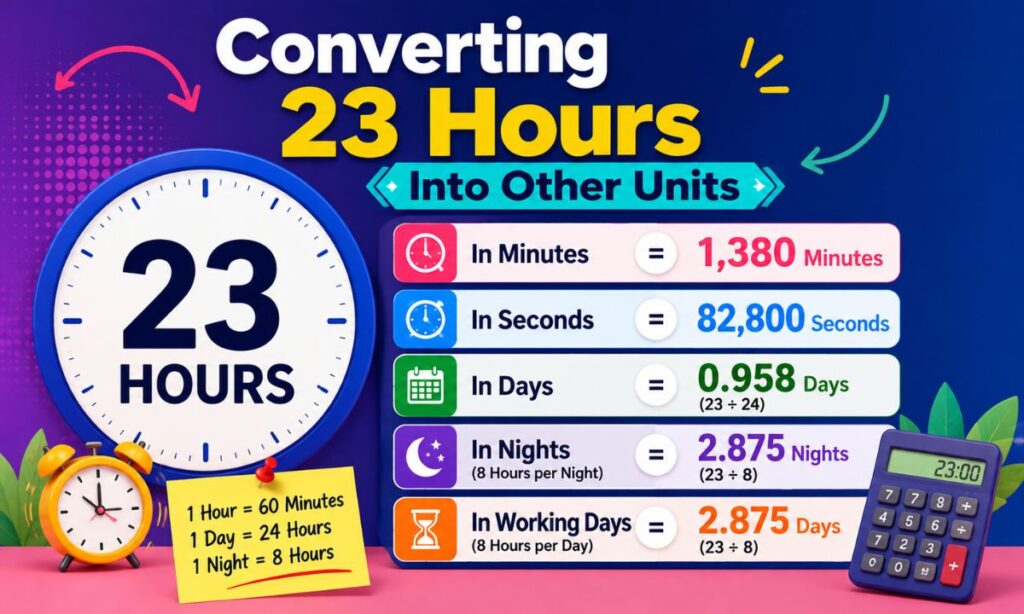
Sometimes you don’t need a clock time, you need a raw duration. Here’s the Date and Time Conversion breakdown.
● 23 hours equals 1,380 minutes
● 23 hours equals 82,800 seconds
● 23 hours equals 82,800,000 milliseconds
Developers and gadgets lean on these numbers constantly. A server logging that a file changed “82,800 seconds ago” is just speaking in a different unit of the same idea.
Using a Time Calculator
Doing the math by hand is a great party trick, but sometimes you just want the answer fast. That’s where a Time Calculator or Hours Ago Calculator comes in.
These tools handle the messy parts automatically, things like month changes, leap years, and different time zones, so you don’t have to think twice.
They’re not magic though. Feed them the wrong starting time or the wrong zone and you’ll get a wrong answer just as confidently as a right one, so it still helps to know the logic behind the scenes.
What Happens Around Midnight?
Midnight is where this calculation gets spicy. Cross it and both your date and your hour shift at the same time.
Take 12:00 AM on a Friday. Subtract 23 hours and you land at 1:00 AM Thursday, both the day and the hour moved.
Same goes for 3:45 AM. Go back 23 hours and you’re at 4:45 AM the day before. Slow down here, this is where most mistakes happen.
Understanding Previous Day Calculation
A Previous Day Calculation just means your math crossed midnight and dropped you onto an earlier date. Simple concept, but easy to lose track of mid calculation.
June 12 becomes June 11. Friday becomes Thursday. Monday becomes Sunday. Once that clicks, the whole idea of Relative Time gets a lot less confusing.
Most scheduling apps and payroll systems do this behind the scenes automatically, but knowing how it works lets you catch their mistakes too.
Does Daylight Saving Time Change the 23 Hour Rule
Here’s a wrinkle most guides skip completely. The neat “add one hour, go back a day” pattern only holds when there’s no clock change hiding inside your 23 hour window.
If a Daylight Saving switch falls between now and 23 hours ago, your local clock jumps or drops by an hour on top of the normal math. That means the gap can briefly look like 22 hours or 24 hours on the wall clock, even though the actual duration is still 23 hours.
This mostly matters for a couple weekends a year, but if you’re doing payroll or flight math near a Daylight Saving date, double check with a Time Difference Calculator instead of doing it in your head.
Why People Search What Time Was 23 Hours Ago
Thousands of people type this exact question into Google every day, and it’s rarely out of pure curiosity.
People are chasing down old messages, checking when a package moved, verifying a security camera clip, or trying to make sense of a notification that just says “23 hours ago” with no actual time attached.
In almost every case, they just want a clean Calculate Past Time answer without pulling out a calculator app.
Practical Examples of Calculating 23 Hours Ago
Reading rules is one thing, seeing them play out is another. Here are four quick runs through the math.
Example 1: Morning Calculation
Current time is 8:15 AM on June 12. Subtract 23 hours and you land on 9:15 AM, June 11. Classic Previous Day Calculation, the date drops back one, the clock moves forward one.
Example 2: Afternoon Calculation
It’s 12:00 PM on a Friday. Roll back 23 hours and you’re at 1:00 PM Thursday. Notice the weekday changed too, not just the date.
Example 3: Evening Calculation
Say it’s 7:30 PM right now. Go back 23 hours and you land at 8:30 PM yesterday. Same pattern, different hour on the clock.
Example 4: Late Night Calculation
Current time is 12:00 AM. Subtract 23 hours and you get 1:00 AM the day before. Midnight calculations like this one are exactly where people slip up, so double check your work.
What Time Was It 23 Hours Ago Across Different Time Zones
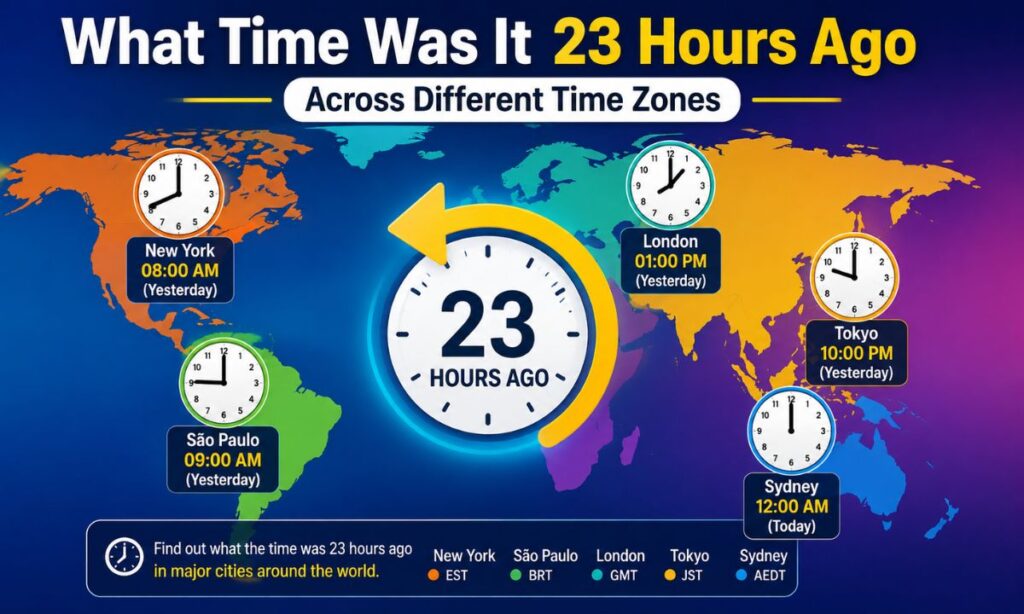
The actual duration of 23 hours never changes, but the number on your clock depends entirely on where you’re standing.
If it’s 9:15 AM in a GMT plus 5 zone, 23 hours back gives you 10:15 AM the day before, in that same zone. Someone watching the same event from a different country sees a different clock number even though the elapsed time is identical.
This is exactly why international teams lean on Date and Time Conversion tools when they’re booking calls or tracking a shipment across borders.
The Mathematics Behind Hour Subtraction
Strip away the examples and this is really just basic arithmetic. A full day holds 24 hours, and 23 is one shy of that.
That missing hour is the whole reason you land on the Previous Day but one hour later than expected. Think of it like almost lapping a track, you stop one step before your starting line.
Written out plainly: Current Time minus 23 Hours equals Previous Day plus 1 Hour. That formula holds steady no matter what time of day you’re starting from.
How Computers Perform Timestamp Calculation
People think in clocks and calendars. Computers think in raw numbers.
Most systems store a moment in time as a single number called a timestamp, and when you ask for something “23 hours ago,” the machine just subtracts 82,800 seconds from that number.
Once the subtraction is done, it converts the result back into something readable, a date and a clock time. This is Timestamp Calculation, and it’s quietly running behind your social media feed, your bank app, and every security camera system you’ve ever used.
Common Mistakes People Make With This Calculation
Even people who do this math often still trip up sometimes. Here’s what usually goes wrong.
● Mixing up 23 hours with a plain “yesterday,” which is actually 24 hours back
● Forgetting the date rolls backward once you cross midnight
● Ignoring a Daylight Saving shift sitting inside the window
● Swapping AM and PM by accident, which throws the whole answer off by 12 hours
● Assuming an online calculator is broken when really the starting time typed in was wrong
Quick Reference Table
| Current Time | 23 Hours Ago |
| 8:15 AM | 9:15 AM (Previous Day) |
| 9:15 AM | 10:15 AM (Previous Day) |
| 12:00 PM | 1:00 PM (Previous Day) |
| 1:00 PM | 2:00 PM (Previous Day) |
| 6:30 PM | 7:30 PM (Previous Day) |
| 7:30 PM | 8:30 PM (Previous Day) |
| 11:00 PM | 12:00 AM (Same Day) |
| 12:00 AM | 1:00 AM (Previous Day) |
| 3:45 AM | 4:45 AM (Previous Day) |
Frequently Asked Questions
Is 23 hours ago the same as yesterday?
Not quite. Yesterday at your exact current time is 24 hours back. 23 hours ago usually lands one hour later than that, still on the day before.
How many minutes are in 23 hours?
1,380 minutes.
How many seconds are in 23 hours?
82,800 seconds.
Does Daylight Saving Time mess up the math?
It can, if the clock change falls inside your 23 hour window. Outside of those couple weekends a year, the normal rule holds fine.
Which calculator should I use?
For everyday questions, a basic Hours Ago Calculator works fine. For work across time zones or near a Daylight Saving date, a dedicated Time Difference Calculator is safer.
Final Thoughts
What Time Was It 23 Hours Ago looks like a throwaway question, but it touches real skills, Relative Time, Hour Subtraction, and Previous Day Calculation among them.
Once you get that missing hour, the whole thing clicks. Whether you’re checking a message, running payroll, or planning a flight, you can now work this out in your head, no app required.
Got a timestamp mix up story of your own? Drop it in the comments, chances are someone else has made the exact same mistake.