
Ever picked up a coin and wondered just how light it really is?
Most of us hear the word gram on a food label and just skip past it.
But once you start looking, tiny everyday objects around your house match that exact 1 gram weight.
This guide breaks it down the simple way.
No science lecture, no boring textbook talk.
Just real things you already own, explained in plain language.
By the end, you will be able to guess 1 gram just by holding something in your hand.
That is a fun party trick and a handy skill for cooking, crafts, or school projects.
Let’s get into it.
How Heavy Is 1 Gram?
A gram is a small unit of mass used almost everywhere except the United States for daily measuring.
Think of it as one tiny building block of weight, way smaller than a pound or a kilogram.
To put it simply, 1 gram equals 1,000 milligrams.
It also equals about 0.035 ounces, which barely registers on a kitchen scale unless it is a good one.
Here is a fun fact that surprises most people.
One milliliter of water weighs almost exactly 1 gram, thanks to water’s steady density.
That one comparison alone makes the whole idea click for most readers.
ALSO READ:New York City: Dimensions, Population, Comparison and Facts
Common Things That Weigh 1 Gram
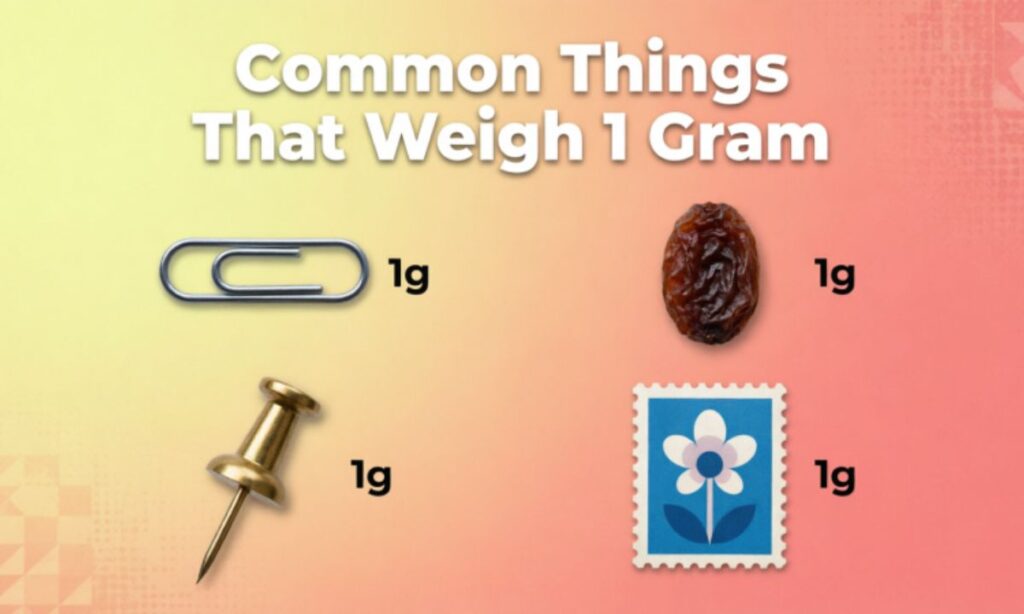
You do not need a lab or fancy tools to understand 1 gram.
Your kitchen drawer, office desk, and junk drawer are already full of examples.
Below are 18 items that hit that 1 gram mark, some exactly and some pretty close.
Each one comes with why it weighs what it weighs, not just a random guess.
1. A Standard Staple
A single tiny office staple does not quite reach 1 gram on its own.
But a small cluster of them together gets you right there.
Staples are made from thin steel wire, which keeps them light but strong.
Bigger staples used for boxes and shipping crates weigh noticeably more.
Next time you refill your stapler, grab a pinch of staples and feel that faint weight.
That is basically what 1 gram feels like in your palm.
2. Small Coffee Beans
Coffee lovers, this one is for you.
About seven to eight medium roasted coffee beans add up to roughly 1 gram.
Roast level actually changes this a bit.
Darker roasts lose more moisture, so they weigh slightly less per bean than lighter roasts.
This is exactly why baristas measure coffee in grams instead of guessing with a scoop.
A few beans off can throw the whole flavor balance out the window.
3. A Small Button
Plain plastic shirt buttons are shockingly close to 1 gram each.
Thickness and material decide how close they actually land.
Metal coat buttons are a different story completely.
They can weigh two or three times more because metal is simply denser than plastic.
So the next time a button falls off your shirt, do not toss it.
Save it as your personal 1 gram reference for random measuring emergencies.
4. One Jelly Bean
A single jelly bean usually weighs between 1 and 1.2 grams.
That sugary shell packs more weight than its tiny size suggests.
Flavor coatings and sugar crystals change the number slightly bean to bean.
That is why candy makers weigh giant batches instead of trusting eyeballing it.
Grab a handful from the candy jar and pick out just one.
That single piece is basically a sweet little science lesson.
5. A Paper Clip
If there is one item everyone already owns for this, it is the paper clip.
A standard steel paper clip weighs almost exactly 1 gram, no guessing needed.
Teachers love using these in classrooms for this exact reason.
They are cheap, everywhere, and perfectly consistent in weight.
Keep one taped inside a notebook.
It becomes your go to gram reference whenever you need a quick comparison.
6. A US Dollar Bill
Here is a cool one most people never think about.
A US dollar bill weighs about 1 gram, no matter the denomination printed on it.
That means a single dollar and a hundred dollar bill weigh the same.
The reason comes down to the paper itself, which is actually a blend of cotton and linen fibers, not regular paper.
This is also why bills survive washing machines better than regular paper would.
That tough fabric blend keeps them durable and consistently light.
7. A Pinch of Salt
Salt seems simple until you realize crystal size changes everything.
A pinch of fine table salt lands closest to 1 gram compared to chunkier salts.
Kosher salt and sea salt have bigger, uneven crystals.
That means the same pinch size can weigh less because there is more air between crystals.
Humidity plays a role too.
Salt naturally pulls in moisture from the air, which can nudge its weight up slightly on damp days.
8. A Raisin
One raisin typically lands right around 1 gram, give or take.
Since raisins are just dried grapes, size and moisture content decide the final number.
Plumper raisins that were dried less will weigh a touch more.
Drier, shriveled ones drop slightly below that gram mark.
Next snack break, weigh one on a kitchen scale if you have one handy.
It is a fun little test that never gets boring.
9. A 1 Gram Birthday Candle
Those thin, spiral birthday candles on top of cakes weigh close to 1 gram each.
They look weightless, but the wax packed inside adds a bit more heft than expected.
Wax density matters here more than size does.
A shorter, thicker candle can weigh the same as a taller skinny one depending on the wax type.
So next birthday, before you blow them out, give one a quick weigh.
It is a fun way to make candle math actually interesting.
10. A Bottle Cap
Plastic bottle caps from water or soda bottles usually sit around 1 gram.
Manufacturers keep these intentionally light to cut shipping costs and reduce plastic waste.
This small design choice adds up at a massive scale.
Millions of caps shipped worldwide means every gram saved actually matters for cost and the environment.
Save a few caps from your recycling bin.
They make a surprisingly solid gram comparison tool.
11. One Small Grape
A small grape can weigh close to 1 gram depending on the variety.
Green grapes usually run lighter than darker ones.
Black and red grapes tend to have thicker skins and more juice inside.
That extra juice content bumps their weight up just slightly compared to green varieties.
Next fruit bowl snack, grab one small grape and one large one.
Feeling the weight difference side by side really drives the point home.
12. A Thumbtack
Those little metal thumbtacks on your bulletin board weigh about 1 gram each.
Despite being tiny, they hold serious weight for their size, literally and figuratively.
The pin is usually steel, while the flat top can be plastic or metal.
That combination keeps them light enough to push in easily but strong enough to hold papers.
Pull one from your board right now.
That faint pressure in your fingers is exactly what 1 gram feels like.
13. A Pen Cap
A basic plastic pen cap, like the kind on a cheap ballpoint pen, weighs close to 1 gram.
Most have tiny ventilation holes built in for safety reasons, which barely affects the weight.
Fancier pens with metal caps weigh noticeably more.
That is a simple reminder that material always beats size when it comes to actual weight.
Grab any pen sitting on your desk right now.
Pop the cap off and give it a little toss in your hand.
14. A Silica Gel Packet
Those little packets that say do not eat, found in shoe boxes and electronics, weigh around 1 gram.
Inside them are tiny silicon dioxide beads that soak up moisture from the air.
Over time, a used packet can actually weigh slightly more than a fresh one.
That is because it has absorbed extra moisture, which is literally its entire job.
Next time you get new shoes, do not toss the packet.
Weigh it if you are curious, then toss it in a damp drawer to keep things dry.
15. Ten Wooden Toothpicks
One single toothpick barely weighs anything on its own.
But grab about ten standard wooden ones together, and you land close to 1 gram total.
This makes toothpicks a fun classroom tool for teaching small weight concepts.
Kids can count, stack, and weigh them without needing anything expensive.
Next time you use one after dinner, grab the box.
Counting out ten is a quick, easy gram experiment for anyone.
16. One Quarter Teaspoon of Sugar
About a quarter teaspoon of sugar equals roughly 1 gram.
That tiny amount barely covers the tip of a spoon, yet it hits the mark almost perfectly.
Not all sugar is equal here either.
Powdered sugar is fluffier and lighter, while raw sugar is denser due to bigger, coarser grains.
Next time you bake, measure a quarter teaspoon before adding it to your mix.
It is a small habit that actually improves your baking accuracy over time.
17. A Small Butterfly
Believe it or not, some of the tiniest butterfly species weigh close to half a gram each.
Two of them together land right around that full 1 gram mark.
Their featherlight bodies are built for one job, flying efficiently using very little energy.
That low weight helps them glide instead of forcing constant wing flapping.
It sounds unusual, but nature actually nails this measurement better than most man made objects.
Butterflies are proof that light does not mean weak.
18. A Japanese 1 Yen Coin
This one might be the most precise example on the entire list.
The Japanese 1 yen coin is minted to weigh exactly 1 gram, no rounding involved.
It is made completely from aluminum, chosen after World War 2 because it was cheap and widely available.
The Japan Mint keeps strict standards, which is why this coin remains a trusted, exact gram reference worldwide.
Here is the fun part most people never expect.
Because aluminum is so light, this coin can actually float on still water if placed down gently.
How To Estimate 1 Gram Without a Scale

Not everyone has a digital scale sitting around at home.
Good news, you really do not need one for a rough estimate.
Here are quick, reliable comparisons anyone can use:
• One paper clip is close to 1 gram
• One dollar bill matches 1 gram almost exactly
• One raisin lands near 1 gram
• One milliliter of water equals 1 gram
• One jelly bean sits right around 1 gram
Keep a couple of these items nearby, like in a kitchen drawer.
They work as a quick, no cost way to eyeball small weights whenever you need them.
Why Understanding 1 Gram Matters
This is not just trivia for fun facts night.
Small measurements like grams actually matter in real, everyday situations.
Here is where getting it right actually counts:
• Cooking and baking, where tiny sugar or salt differences change taste
• Medication dosing, where even small errors can be risky
• Jewelry weighing, since gemstones are priced by the gram or carat
• Science experiments, where precision changes results completely
• Nutrition tracking, especially for sugar, protein, and sodium counts
• Mailing lightweight items, where postage often depends on exact weight
Even a gram or two off can shift results more than people expect.
That is exactly why professionals in these fields never eyeball it, they measure it.
Quick Quiz: How Well Do You Know 1 Gram?
Test yourself before scrolling to the answers below.
1. How many standard paper clips weigh about 1 gram?
A) 5 paper clips B) 1 paper clip C) 10 paper clips D) 3 paper clips
2. Which coin is specifically minted to weigh exactly 1 gram?
A) US penny B) US dime C) Japanese 1 yen coin D) US quarter
3. About how many medium roasted coffee beans equal 1 gram?
A) 2 to 3 beans B) 15 to 20 beans C) 7 to 8 beans D) 20 to 25 beans
4. What material makes up a US dollar bill?
A) 100 percent cotton B) A cotton and linen blend C) 50 percent cotton and 50 percent paper D) 100 percent linen
5. How many milligrams are in 1 gram?
A) 10 mg B) 100 mg C) 10,000 mg D) 1,000 mg
6. Why does a used silica gel packet weigh more than a new one?
A) The plastic packaging expands B) It absorbs moisture from the air C) The beads grow larger over time D) It collects dust particles
7. Which salt type gives the most consistent 1 gram pinch?
A) Kosher salt B) Sea salt C) Table salt D) Himalayan pink salt
8. How many wooden toothpicks together weigh close to 1 gram?
A) 3 toothpicks B) 25 toothpicks C) 10 toothpicks D) 50 toothpicks
9. What makes the 1 yen coin famous beyond its exact weight?
A) It is made from gold B) It can float on still water C) It is the oldest coin in circulation D) It changes color in sunlight
10. About how much does a stack of 100 dollar bills weigh?
A) 10 grams B) 50 grams C) 100 grams D) 500 grams
Answers: 1-B, 2-C, 3-C, 4-B, 5-D, 6-B, 7-C, 8-C, 9-B, 10-C
Conclusion
Grams stop feeling abstract once you connect them to things you already touch every day.
A paper clip, a raisin, or a single dollar bill all tell the same story in different forms.
Next time someone asks how heavy 1 gram really is, you will not need a scale to explain it.
Just reach for a coin, a candle, or a coffee bean and let the object do the talking.
Small measurements teach a big lesson.
Once you notice the weight of tiny things, you start noticing details everywhere else too.