
Right now, if you are checking the time, you probably just want one thing. You want to know how many hours, minutes, and seconds are left until 2:45 PM today. A live countdown does that math for you the second you land on this page, so you never have to count on your fingers again.
That is the short answer. But there is more to this simple question than most people expect, and that is what this guide is here for.
Why People Search for This
Nobody wakes up curious about 2:45 PM for fun. There is always a reason behind it.
Maybe school gets out at that hour and you are the one doing pickup. Maybe your boss booked a meeting for 2:45 and you want to know exactly how much prep time you have left. Or maybe it is just the time you promised yourself a coffee break, and you are counting down like a kid waiting for recess.
A countdown timer turns that vague feeling of “is it almost time yet” into a real number. Once you see the exact time remaining, your brain can stop guessing and start planning.
Using a Calendar and Reminder System Together
Short answer first: pair your countdown with a reminder system and you will basically never be caught off guard again.
A countdown tells you how close you are to something. A calendar tells you what that something actually is. Put them together and you get a setup that both warns you and reminds you why it matters.
Here is a simple reminder plan that works for most people heading into a 2:45 PM meeting or task.
• One hour before, so you can wrap up whatever you are doing
• Thirty minutes before, so you can start getting your notes together
• Ten minutes before, so you can actually walk to the room or open the link
• Five minutes before, so you are not sprinting in at the last second
A lot of folks use mobile scheduling apps these days because the reminder pops up on the phone, the laptop, and even the smartwatch at the same time. I used to rely on sticky notes stuck to my monitor. They fell off constantly and I missed two calls because of it. A synced reminder never falls off a desk.
The real value of pairing a calendar with a countdown is that neither tool has to work alone. The calendar holds the context, meaning the who, the what, and the where. The countdown holds the urgency, meaning exactly how close you are to that moment. Miss one piece and the other stops being nearly as useful.
Think about a shared team calendar for a 2:45 PM client call. Everyone on the invite sees the same event, but not everyone checks their calendar every ten minutes. A synced reminder closes that gap by pushing the alert straight to the device someone is actually looking at, whether that is a phone in a pocket or a laptop open on a desk.
The Psychology Behind Waiting for 2:45 PM
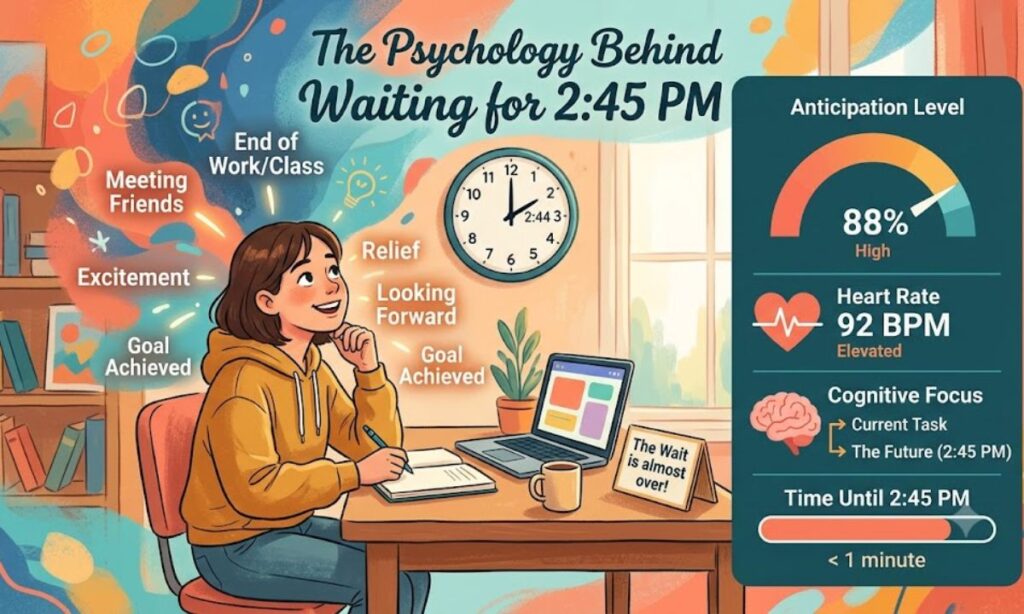
Short answer: waiting feels longer or shorter depending on what your brain is doing, not on the actual clock.
This is called time perception, and it is a well documented quirk of how our minds work. Five minutes staring at a countdown before an exam can feel like an hour. Meanwhile, an entire hour spent deep in a task can vanish without you noticing a single minute pass.
A visible countdown clock actually helps with this. It replaces the fuzzy feeling of “how much longer” with an exact number, and that alone tends to lower stress.
Researchers who study time perception often point out that uncertainty is what drags a wait out, not the actual length of it. Your brain spends energy guessing when it does not have a clear number to hold onto. Hand it a real countdown and that guessing work simply stops, which frees up mental space for something more useful.
This is part of why waiting rooms, airports, and even video game loading screens now show progress bars and countdowns instead of a blank screen. A blank wait feels endless. A wait with a visible number attached feels manageable, even if the actual number of seconds left is identical.
People waiting for a specific time like 2:45 PM often report a mix of feelings, and it is worth naming them because it makes the wait feel a lot less strange.
• Anticipation, especially before something exciting
• Mild stress, especially before something like a deadline
• Boredom, when the wait feels pointless
• Relief, once the countdown finally hits zero
• Motivation, when the countdown pushes you to finish something first
Productivity Tips While Counting Down
Short answer: do not just stare at the clock. Use the leftover time on purpose.
Even a stretch as short as twenty minutes can move your day forward if you treat it like a mini work sprint instead of dead time. The trick is picking a task that actually fits the time you have left, not something that needs an hour when you only have fifteen minutes.
Try one of these while your countdown to 2:45 PM ticks along.
• Clear out a few pending emails
• Tidy your desk or your browser tabs
• Skim your notes before the meeting starts
• Take a two minute stretch break
• Prep the documents you will need later
• Knock out one small task you keep putting off
I used to waste this exact kind of window scrolling social media, and I would show up to meetings feeling behind before they even started. Once I started using the gap for one tiny task, meetings started feeling like a natural break instead of an interruption.
ALSO READ THIS:http://measureaxis.com/15-hours/
Countdown Tools vs. Traditional Clocks
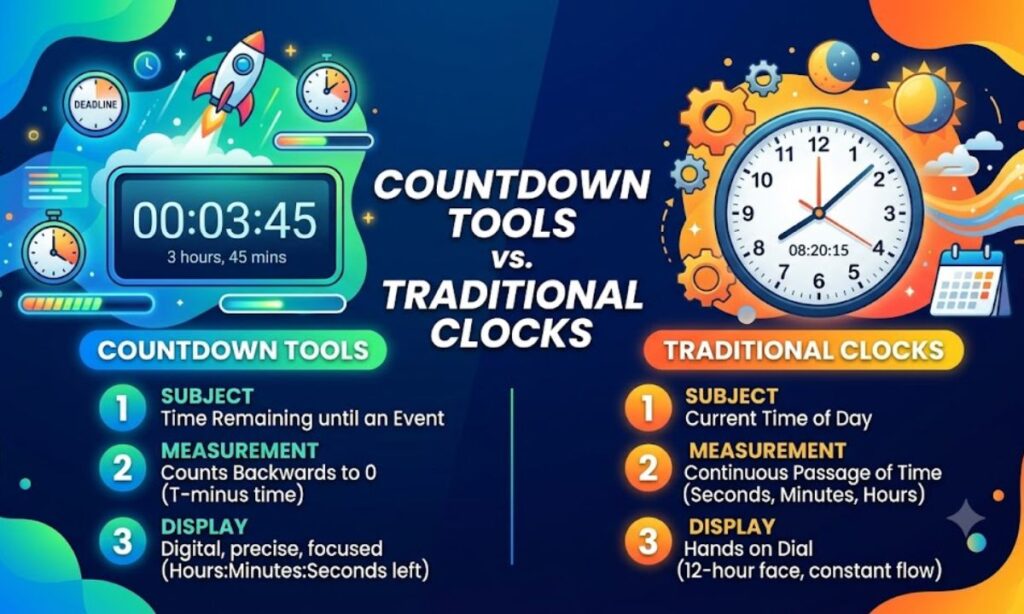
Short answer: a regular clock shows you now, while a countdown shows you what is coming.
A standard digital clock is great for precision. It tells you it is exactly 2:10 PM down to the second. But it does not tell you anything about what is left in your day, and that is where a lot of people get tripped up.
A countdown timer, on the other hand, flips the question around. Instead of “what time is it,” it answers “how much time do I have.” For a lot of people, that framing is just easier to act on.
Here is a quick side by side to make the difference obvious.
| Feature | Traditional Clock | Countdown Timer |
| Shows current time | Yes | Sometimes |
| Shows time remaining | No | Yes |
| Good for scheduling ahead | Limited | Strong |
| Useful during a live wait | Not really | Very useful |
| Common tools | Wall clock, watch | Countdown widget, app, browser tool |
Most modern online timer tools combine several features into one dashboard, including alarms, real time updates, multiple timers running at once, a stopwatch, and date calculations. That combo is why a lot of people have stopped using plain clocks for anything time sensitive.
How Countdown Applications Improve Daily Workflows
Short answer: everyone looking at the same countdown means nobody has to ask “how much time is left” out loud.
Schools, hospitals, sports teams, and offices all lean on shared timing tools because confusion about time wastes real time. When a project manager sets a milestone for 2:45 PM and the whole team can see the same live countdown, nobody has to interrupt the group chat to ask when the deadline actually hits.
Teachers project a countdown during classroom activities so kids can see exactly how much time is left on a quiz. Event organizers put a big countdown clock on screen before a talk starts so the room settles down naturally instead of someone shouting “two minutes.” It is a small thing, but watching the numbers drop together has a strange way of keeping everyone calm and focused at the same time.
Hospitals use timing tools for a very different reason, since some procedures and medication schedules genuinely depend on exact minutes rather than rough guesses. A nurse tracking a 2:45 PM medication round is not just being tidy, that timing can matter for patient safety. The same logic applies at a smaller scale in offices, where a shared countdown for a client call keeps the whole team from showing up staggered and unprepared.
Sports teams use similar tools during practice, timing drills down to the second so every player gets equal reps. None of these examples involve anything fancy. They all come down to the same basic idea, which is that a shared, visible number beats everyone quietly guessing on their own.
How Long Until 2:45 PM in Asia/Karachi?
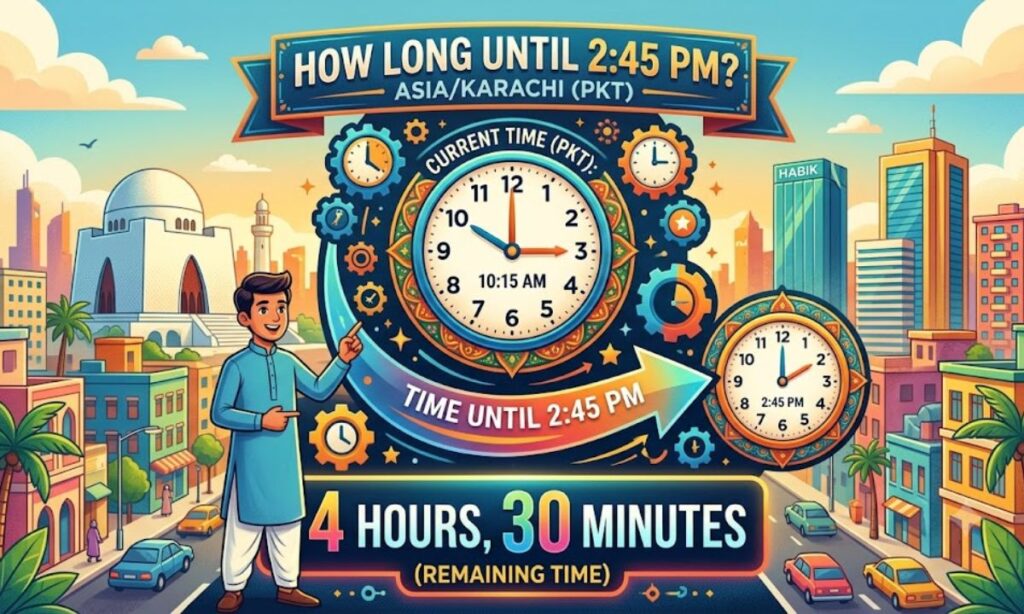
Short answer: if you are in Pakistan, your countdown runs on Pakistan Standard Time, and that does not shift with the seasons.
Pakistan does not currently observe daylight saving time, so Pakistan Standard Time (PKT) stays fixed at UTC plus five hours all year round. Whether you are checking from Karachi, Lahore, Islamabad, Peshawar, or Quetta, the countdown to 2:45 PM works off the exact same national standard.
This matters most when you are scheduling something across borders. A call set for 2:45 PM Karachi time will land at a completely different hour for someone in London or New York, so it is always worth double checking the time zone difference before you lock in a meeting.
Common Ways People Use a 2:45 PM Countdown
Short answer: the number 2:45 means something different to almost everyone who searches for it.
For a parent, it might mean school pickup. For an office worker, it could be a client call. For a student, it might be the exact moment a study session is supposed to end. The clock does not change, but what it means to each person absolutely does.
A friend of mine once told me the fifteen minutes before school pickup felt longer than her entire work day combined. That stuck with me, because it captures something real. Time does not move differently, but our attention to it sure does.
Freelancers and remote workers lean on a 2:45 PM countdown a little differently than office employees do. Without a manager walking past their desk, the countdown becomes their own internal accountability check, a quiet nudge that a deliverable is due or a client call is about to start. It replaces the social pressure of an office with a simple visual cue that does the same job.
Retail and hospitality workers use it too, though it rarely gets mentioned. A shift change scheduled for 2:45 PM means someone is counting down the last stretch of a long shift, and someone else is counting down the minutes until they need to clock in. Same number on the clock, two completely different feelings attached to it.
• School dismissal
• Afternoon coffee or tea break
• Client presentation
• Shift change at work
• Virtual conference login
• Medical appointment
• Team briefing
• End of a study block
Setting Up Your Own 2:45 PM Countdown
Short answer: you do not need anything fancy, just a tool that updates in real time and a clear target.
Most phones already have a built in timer or clock app that can count down to a specific time, not just a set duration. Search engines can also show a quick countdown widget right in the results when you type a query like “how long until 2:45 PM today.”
If you want something more visual for a shared screen, a browser based countdown page works well because it updates automatically and does not need refreshing. The key thing to check is whether the tool accounts for your actual time zone, since a countdown built for the wrong zone will quietly throw off your whole plan.
For repeated use, like a daily 2:45 PM shift change or a recurring class dismissal, it is worth setting up a saved reminder instead of typing the same search every day. Most calendar apps let you save a recurring event with a custom alert time attached, so the countdown effectively runs itself once it is set up correctly. That one time setup saves a surprising amount of daily hassle.
If you are building this for a team rather than yourself, a shared dashboard beats individual phone alarms every time. Everyone sees the same number, nobody has to text the group chat asking how much time is left, and the whole team moves toward the deadline together instead of on five different schedules.
Common Mistakes People Make With Countdowns
Short answer: most countdown mistakes come down to time zones and forgotten reminders, not the math itself.
It is easy to assume a countdown page defaults to your local time when it actually does not. Always double check the time zone setting before you trust the number on screen, especially for anything work related.
• Forgetting to adjust for daylight saving time in regions that observe it
• Setting a single reminder instead of a short sequence of them
• Relying on a phone alarm that gets muted by another app
• Ignoring the countdown once it starts and losing track of the actual task
• Assuming everyone on a call is checking the same time zone you are
Expert Advice on Managing Your Time Around a Deadline
Short answer: treat the countdown as a tool for action, not a source of stress.
Time management coaches often point out that a countdown works best when it is paired with a plan, not just watched passively. Knowing you have thirty minutes left is only useful if you already know what you are going to do with those thirty minutes.
A good habit is to glance at the countdown, pick one task that actually fits the time left, and ignore it again until the next natural check in point. Checking every thirty seconds does not make time move faster, it just adds stress on top of the wait.
Another tip that comes up often in productivity circles is batching small tasks against a countdown instead of tackling them randomly. If you know you have twenty five minutes before 2:45 PM, line up two or three quick tasks that fit inside that window rather than starting something that clearly needs an hour. Finishing something, even something small, feels far better than leaving a big task half done when the countdown hits zero.
Finally, build in a small buffer before the actual target time. If your meeting starts at 2:45 PM, aim to be ready by 2:40. That five minute cushion absorbs the small surprises, like a slow laptop or a last minute email, that would otherwise turn a calm countdown into a rushed scramble.
10 Common Things People Ask About the 2:45 PM Countdown
1. How many hours are left until 2:45 PM today
2. How many minutes are left right now
3. What does 2:45 PM look like in 24 hour time
4. Does the countdown change with daylight saving time
5. Can a countdown timer send a phone alert
6. What is the countdown in Pakistan Standard Time
7. How do I set a recurring reminder for 2:45 PM every day
8. Can I share a live countdown with my whole team
9. What is the difference between a countdown and a regular alarm
10. Why does waiting for 2:45 PM feel longer some days than others
Frequently Asked Questions
How many hours until 2:45 PM today? It depends completely on your current local time. A time calculator subtracts your present time from 2:45 PM to give you the exact hours, minutes, and seconds left.
How many minutes until 2:45 PM? This number changes every single minute, so a live countdown is the only way to get it right without doing the math yourself over and over.
What is 2:45 PM in military time? 2:45 PM is 14:45 on a 24 hour clock, written as 1445 in standard military notation.
How do countdown timers work? A countdown timer compares your device clock to your target time and updates the gap every second. Better tools also factor in your date and time zone so the number stays accurate.
Can I set a reminder for 2:45 PM? Yes. Nearly every phone, calendar app, and reminder system lets you set a one time or recurring alert for any specific time, 2:45 PM included.
Final Thoughts
“How long until 2:45 PM” looks like a small question on the surface. Underneath it, though, is something most of us actually care about, which is staying on top of the day instead of getting run over by it.
Whether you lean on a countdown timer, a countdown clock, or just your phone’s built in alarm, the goal is the same. These tools turn a fuzzy afternoon into something you can actually plan around.
So the next time you catch yourself wondering how long is left until 2:45 PM, use that time on purpose. Send the message. Finish the task. Take the short break you have been putting off. The minutes are going to pass either way, so you might as well make them count.
None of this requires expensive software or a complicated setup. A phone you already own, a calendar you already use, and a simple countdown page are enough to keep you ahead of the clock instead of chasing it. The people who feel calmest about their afternoons are rarely the ones with the fanciest tools, they are usually just the ones who checked the time once, made a quick plan, and trusted it.
Do you have a favorite way to track a countdown, or a trick that keeps you on schedule during a busy afternoon? Drop your approach in the comments. Someone else reading this might be looking for exactly that tip.